The Fate of the Old Testament Faithful

This topic does not directly impact any of us today, it is more of a curious bit of information. Still, the fate of the people of the Old Testament time does speak to the nature of God, the necessity of salvation through Jesus, and what God can and will do, besides being interesting.

It is clear that some people, not all people, from the ranks of Israel in the Old Testament received eternal life. God speaks of a “remnant” being saved. The word doesn’t inspire confidence that this is even a large minority of those in Israel. Did this remnant go to Heaven?

It may surprise people to know that there is no promise of humans residing in Heaven after death in the Old Testament. A few Old Testament prophets had out-of-body experiences of Heaven. The seventy elders of Israel at the time of Moses saw some shielded vision of God in Heaven. It says that Elijah was taken up into heaven.

 And as they still went on and talked, behold, chariots of fire and horses of fire separated the two of them. And Elijah went up by a whirlwind into heaven.

2 Kings 2:11 (ESV)

Being that this is an observation in the midst of a narrative, one can only conclude that Elijah went upward until he was out of sight. The passage doesn’t say anything about where he went. I would assume that even Elijah is not an exception. The Old Testament faithful all spoke of going to Sheol.

Serious theologians have been perplexed as to what to do with this word. Some translations rendered the word as “the pit” or “the grave”, and then would put a footnote saying : in Hebrew Sheol. Every word on the page was in Hebrew originally, so what was the footnote confessing? Sheol is not a hole in which we put a dead body. Sheol is a proper noun for a place. The place where the dead go pending some future event.

When the Old Testament was eventually translated into Greek, the word Sheol was translated as Hades. We could accuse the translators of coopting Greek religious ideas, since Hades is a place and a person in Greek mythology. It is Jesus who saves them from this fate. I would consider Jesus to be authoritative on this topic (actually any topic). In the story of The Rich Man and Lazarus, (Luke 16:19-31), Jesus gives us our most detailed look at Hades/Sheol. You might be fooled into thinking that this is a parable about Heaven and Hell, but the location of the rich man is identified as Hades.

In Hades the rich man is suffering. He states that he is in a fire. Hence the confusion with Hell. He has ability to speak with Abraham, one of the Old Testament faithful. Is this possible, or is this just a fiction? The use of names (Abraham and Lazarus) and the fact that this is not written as a parable with a symbolic lesson, suggests that this is an actual event. Add to it, that the Old Testament people spoke of going to Sheol and you learn that Sheol/Hades is a place divided by a “great chasm” where all the dead were to that point. Greek mythology states something similar. If this isn’t all myth, how would they know that? The forbidden practice of communicating with the dead could be a source.

The Old Testament faithful are not suffering in flames. Lazarus is being comforted. He is receiving good things. But he is not in Heaven.

Abraham and Lazarus may be among God’s chosen, but they are definitely still sinners. Why should they not be roasting with the rich man? A fairly well-known passage may have the answer:

25  [Jesus] whom God put forward as a propitiation by his blood, to be received by faith. This was to show God’s righteousness, because in his divine forbearance he had passed over former sins. 26 It was to show his righteousness at the present time, so that he might be just and the justifier of the one who has faith in Jesus.

Romans 3:25-26 (ESV)

This passage is a little hard to follow. It says the God offered Jesus as a sacrifice for sin to show that He didn’t compromise the Law with regard to the Old Testament faithful, even though He had left their sin unpunished up to the time of Jesus. He also offered Jesus to atone for those who have faith in Jesus presently and in the future.

The Old Testament faithful went to the comforting part of Sheol because Jesus would eventually pay for their sins. Are they still there?

They now dwell in Heaven because atonement is complete and Satan and his cronies have been booted. This movement is connected with “Jesus’ descent into hell”. More about that here:

https://afterdeathsite.com/2017/03/14/christs-descent-into-hell-part-1/

The Old Testament faithful are saved by being chosen by God, which manifested itself in trusting God for their salvation. They did not have details. Could such a path of salvation exist outside of Israel? I don’t see why not. There were faithful people before there was an Israel. Why not some outside of Israel and based on God’s mercy and foreknowledge?

So might you meet Abraham or Elijah or Lazarus in Heaven? I’m sure that is possible. They are alive and they are there. How about Adam and Eve so that you can thank them for messing up the world and your DNA for you? It would appear that they were repentant, so “yes”.

God reveals that He is unmoving with regard to keeping what is laid down as Law. Even though He spared the Old Testament faithful suffering, He did not just bounce them to Heaven until everything was actually completed. Foreknowledge was not enough. As people who live after Jesus, we can be thankful that God is faithful to His promises over millennia. We have the additional benefit of skipping Sheol all together in we are in Christ.

How Is Sheol Different than Hell?

Many, if not most people, have a simplistic view of what the Bible tells us about life after death. Simply put they believe in Heaven and Hell. One of the goals of this blog is to help people realize that two events change this model: the death and resurrection of Jesus and Judgment Day.

Prior to Jesus, the Old Testament people knew of two things regarding their existence after death. The knew that there would eventually be a bodily resurrection of dead followed by either everlasting life in a New Earth or everlasting contempt somewhere. (Dan. 12:2, Isaiah 65) This information can be traced as early as Job, which is likely the oldest book in the Bible.

For I know that my Redeemer lives,
    and at the last he will stand upon the earth.
26 And after my skin has been thus destroyed,
    yet in my flesh I shall see God,
27 whom I shall see for myself,
    and my eyes shall behold, and not another.
    My heart faints within me!

Job 19:25-27 (ESV)

The Old Testament people are aware that Heaven exists, but it is never promised as a destination for them after death. Instead, the Old Testament people had an expectation of going to Sheol (the place of the dead). This is not the same as the grave. Some translations of the Bible botch this and then note that the Hebrew word is “Sheol” in the footnotes. Sheol is a distinct place of conscious existence.

Sheol seems to be a two-part place. One section is comforting, but not necessarily better than life. The other section is a place of suffering. The New Testament and the Greek translation of the Old Testament (the Septuagint) switch from the word “Sheol” to the Greek “Hades”. These are synonyms. Jesus uses another word “Gehenna”, which is not a synonym. Gehenna refers to the final destination of the damned, the post-Judgment Day lake of fire. This would be my candidate for the English word, Hell.

Getting Hades/Sheol and Gehenna confused is pretty easy to do. They do share certain properties. Darkness, suffering, and fire seem to be a part of both. One description of Hades includes “where the worm does not die”. I don’t think this is talking about the decay of our corpse in the grave. This seems to be part of the suffering of Sheol.

Finding differences is harder. I can come up with only three within the scant information we are given.

  1. It appears that it is possible, but not acceptable, to communicate with the dead in Sheol. In the story of the Witch of Endor (1 Samual 28), Saul summons the prophet Samuel from the dead through the forbidden skills of the Witch of Endor. Samuel would have been in the comforting section of Sheol. He doesn’t seem too pleased about it either. This practice must have been a part of pagan Canaanite culture and possible also others. The Jews are strictly forbidden from doing this (Deut. 18:9-13). I would infer from this that those in the suffering section might also have been reachable. Once you are in Gehenna you are unreachable and no one will try. (More on that in a bit.)
  2. A second difference connects to what Jesus did right after his death.

For Christ also suffered once for sins, the righteous for the unrighteous, that he might bring us to God, being put to death in the flesh but made alive in the spirit, 19 in which he went and proclaimed to the spirits in prison, 20 because they formerly did not obey, when God’s patience waited in the days of Noah, while the ark was being prepared,

1 Peter 3:18-20a (ESV)

This is where we get Jesus’ “descent into Hell” from the Apostles’ Creed. Here “Hell” is a misleading term. It should be descent into “Sheol” or something to that effect. Originally it was.

What was Jesus trying to do? 1 Peter 4:6 explains it:

For this is why the gospel was preached even to those who are dead, that though judged in the flesh the way people are, they might live in the spirit the way God does.

1 Peter 4:6 (ESV)

It certainly sounds like these people, long dead, condemned, held in the prison of Sheol are getting a second chance through the preaching of Christ. Did this ever happen again? Don’t know. Is there another reference to this in Scripture? Nope. Outside of Scripture? Yes, a bunch. It was a favorite theme of the ancient Eastern church.

This leads to the final and most critical difference between Gehenna (Hell) and Sheol.

In Revelation 20:14, Hades/Sheol is thrown in “the lake of fire”/Gehenna/Hell. At that point, post-Judgment Day, they become one thing. It appears to me that the worst part of being damned doesn’t happen until then. At that point God forsakes you.

You are utterly separated from God and all of God’s redeemed forget you. Jesus experienced this for us on the cross. He was forsaken, and even though He knew it was coming, it crushes Him.

45 Now from the sixth hour there was darkness over all the land until the ninth hour. 46 And about the ninth hour Jesus cried out with a loud voice, saying, “Eli, Eli, lema sabachthani?” that is, “My God, my God, why have you forsaken me?”

Matthew 27:45-46 (ESV)

This whole topic can remain an academic discussion because Jesus took the suffering for us. If we are baptized in Christ’s name then we are baptized into His death–specifically, this part of His death.

I don’t need to get any closer to Sheol/Hades/Gehenna/the Lake of Fire/ Hell than this.

And This Is Eternal Life

When you think about eternal life, what do you imagine it is like? Many of us think of loved ones that went before us. We might think of having new abilities or being in beautiful surroundings. I don’t think that is wrong. But Jesus gives us something to ponder about eternal life.

In Jesus’ “high priestly prayer” He says:

And this is eternal life, that they know you, the only true God, and Jesus Christ whom you have sent.

John 17:3 (ESV)

What does this mean? Let’s start with something simple. Eternal life is not the same as eternal existence. We have been created to be eternal creatures. There is nothing that can stop that. Having our bodies fail does not mean we cease to exist. Part of us is temporarily gone, but we continue on. It is more of a move.

The Bible reserves the word “life” for something worth having. Existence in Sheol or the final lake of fire (Hell) is not worth having. Paul even casts a little dispersion on this “life”.

17 As for the rich in this present age, charge them not to be haughty, nor to set their hopes on the uncertainty of riches, but on God, who richly provides us with everything to enjoy. 18 They are to do good, to be rich in good works, to be generous and ready to share, 19 thus storing up treasure for themselves as a good foundation for the future, so that they may take hold of that which is truly life.

1 Timothy 6:17-19 (ESV)

Apparently, this life isn’t “truly” life. Paul not only was a conduit of revelation from God, he had an out-of-body experience that he refers to in 2 Corinthians. He speaks from experience. So the best this life has to offer doesn’t quite deserve the title “life”. It is damaged by sin, sinful nature, the curse, and the presence of Satan.

In Revelation 7, the inhabitants of Heaven have a term for this life. Referring to the people now in Heaven, an elder says:

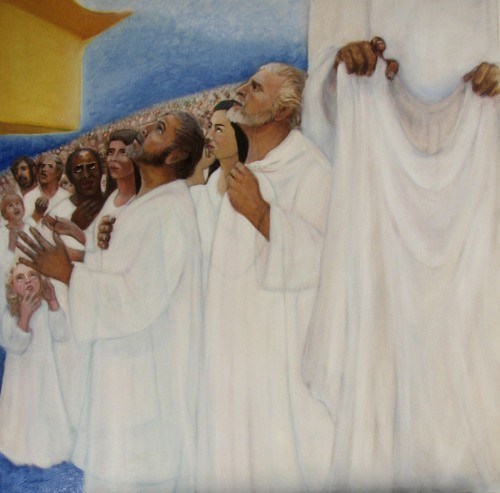
“These are the ones coming out of the great tribulation. They have washed their robes and made them white in the blood of the Lamb.”

Revelation 7:14 (ESV)

“Great tribulation” may refer to a specific period of world history or it may refer to it all. At very least, any other time is the usual “tribulation” and not life.

What does it mean to “know God” in this context. God is the source of every good thing. It is not that being with God is doing churchly stuff and being with Satan is having a raucous party with your friends. The ability to enjoy a party comes from God. Friends comes from God. Even alcohol comes from God. This doesn’t provide a reason to abuse it. Being known and not forsaken by God means that God will continue to fill your existence with good things. Many of which you have never conceived.

The second part about knowing “Jesus Christ whom You have sent” has a combination of meanings. Jesus will be a daily part of our existence. We will enjoy a wonderful, face-to-face relationship. But Jesus also is the only way to know the Father. Our connection with Jesus fulfills God’s Law for us and pays for our sinfulness. Without Jesus there will be no “life”.

Jesus said to him, “I am the way, and the truth, and the life. No one comes to the Father except through me.”

John 14:6 (ESV)

There are many smaller ways to make a person’s life better and we should pursue doing them if we can. Things like providing the basic necessities of living. But the deepest, most important way to give life is to give Jesus. My other blog http://givingchrist.com talks about various aspects of sharing the story and promise of Jesus, and what can stand in the way of real life. May nothing stand in your way, because truly having life is the most important asset we can have.

That Can Never Perish, Spoil or Fade

When we do funerals at our church, we often start the service with a verse from 1 Peter 1. It reads, in part:

In his great mercy he has given us new birth into a living hope through the resurrection of Jesus Christ from the dead, and into an inheritance that can never perish, spoil or fade. This inheritance is kept in heaven for you, who through faith are shielded by God’s power until the coming of the salvation that is ready to be revealed in the last time.

1 Peter 1:3b-5 (NIV)

Keep in mind, that our existence past the grave is not just a simple Heaven or Hell https://wordpress.com/post/afterdeathsite.com/131. The wording of this passage does raise some questions. First, and this may surprise you, this is one of the few passages that suggests that Heaven is a destination for human beings. There is no promise of Heaven in the Old Testament. There is more mention of the resurrection and the New Earth even in the New Testament. This passage suggests that our inheritance is in Heaven. Does it mean that we go there to get it? Does it say that we must wait until Judgment Day to have it?

I conclude that we do go to Heaven upon our death and receive at least part of our “inheritance”. I back that up with a passage in Revelation 7:9 that speaks about the location of the victorious dead:

After this I looked, and behold, a great multitude that no one could number, from every nation, from all tribes and peoples and languages, standing before the throne and before the Lamb, clothed in white robes, with palm branches in their hands,

Revelation 7:9 (ESV)

They are standing before God’s throne which was shown to be in Heaven to this point in Revelation.

What is the “salvation that is ready to revealed in the last time”? Isn’t this something that happens on the last Day–Judgment Day? I always read it that way. I see it differently now. God’s plan of salvation for human beings was only partially revealed prior to Jesus. They knew about the resurrection of the dead. They might have had an inkling that God would provide a way of forgiveness of sins that was permanent. They didn’t expect to go to God’s throne room. It wasn’t promised.

That didn’t mean that Heaven wasn’t in the plan. Heaven wasn’t officially on the table until Jesus had atoned for sin with His completion of God’s Law, paying the penalty of forsakeness https://wordpress.com/post/afterdeathsite.com/2234, and the casting of Satan out of Heaven (Rev. 12:7f). You could really say that it was contingent on Jesus’ success. But now that Jesus has prevailed, God’s full plan of salvation can be rolled out. It does say “last time”, not last day. Now is the last time, not Judgment Day.

The good news is not only will we have a resurrection of our bodies in perfected form and a New Earth after Judgment Day, but we a have immediate access to Heaven and glorious things within it, because God has “given us new birth”, connecting us to Jesus.

When you think about the best things in life now, they all will perish, spoil or fade. A new car will eventually be a boring old car and then rust. Exciting experiences lose their excitement. Everything declines either physically or in our reaction to it or both. Not the stuff of Heaven.

Relationships remain exciting. Seeing God never gets old. Our adventures remain fresh.

In the mean time, all these will keep. We have a job to do here and a certain amount of time to do it. While here, we remain in a danger zone. In Revelation 7 the inhabitants of Heaven refer to our current world as the Great Tribulation. This is hard to appreciate unless you are in a war zone, are chronically ill, or are trapped in dysfunctional relationships. But even if things are good, they are not Heaven good.

While here we are exposed to sin and the curse. God protects our connection to Christ, but we can still walk away from it.https://wordpress.com/post/givingchrist.com/843 We may suffer quite a bit while here. But God will support us and transform us. God will use us in powerful and unique ways. All of the trouble associated with the Great Tribulation will seem small once we move to our home. The one thing that I expect will fade, will be our memory of our struggle here.

Will Many Be Saved?

Have you gone to many, or any, funerals where you assumed a negative eternal destiny for a person? This is so hard to think about that we simply hope for the best, even in cases where there is little evidence that this could go well.

We are not to judge. We don’t have the ability to know what interactions a person has had with God. But even with the fact that Jesus died for the sins of everyone, and that God desires all people to be saved, one sobering verse stands out for me. I call it my least favorite passage of Scripture:

13 “Enter by the narrow gate. For the gate is wide and the way is easy that leads to destruction, and those who enter by it are many. 14 For the gate is narrow and the way is hard that leads to life, and those who find it are few.

Matthew 7:13-14 (ESV)

The word “few” devastates me. It is a relative term, so against the billions of people who have lived and currently live “few” could still be a vast number. Still, to imagine an even larger number going to eternal damnation is staggering.

How can this be? Isn’t God love? Isn’t God all-powerful? Yes, He is. But He is also a God of justice who abides by what is “written”. So, He will not do a compromising end run around the Law, even for this. If Scripture is to be believed at all, people are damned and they are damned in vast numbers.

I would love to wrong about this. Perhaps, “few” is 49.999%. Or it could be “few” relative to the 100% that could have been saved. Maybe 95%. Or maybe the key is the word “destruction”. If destruction refers only to Sheol and not necessarily Gehenna, then perhaps Jesus would have a mechanism to evangelize the dead and to do so in mass. I’m not saying that any of these could not be, but the most natural way to read this verse is to expect many losses.

Who would make up the many? Good works can’t make up for sins. There would be many “good people” by our standards who would miss out. Many consider Jesus to be irrelevant and hold on to a “let’s see what happens” approach to death. They reason that either they just cease to exist, or it will be O.K. because they are nice.

Many hold on to an alternative worldview with an alternative means of salvation, even if they have heard the Gospel. Muslims hold on to a somewhat vague hope of Allah’s mercy if they follow the Five Pillars of Islam well enough. Hindus cling to gradual ascension through reincarnation if they live well. Cultural Christians cling to being “good enough” if they don’t understand the Bible. Then there are the atheists who expect to disappear. That is a lot of people.

Maybe there are multiple paths to salvation?

Jesus said to him, “I am the way, and the truth, and the life. No one comes to the Father except through me.

John 14:6 (ESV)

It makes sense. If there were other ways, would God have made Jesus do what He did? If you don’t like it, speak to Jesus. I didn’t say it.

Many people have not even heard the Gospel of Jesus. What about them? I personally think that 1 Peter 4:6 alludes to how God deals with the Church’s failure to get the Word out.

For this is why the gospel was preached even to those who are dead, that though judged in the flesh the way people are, they might live in the spirit the way God does.

1 Peter 4:6 (ESV)

It is a somewhat vague, one passage testimony; but it makes more sense to understand this passage as Jesus or somebody preaching to the dead than all of the other weak explanations I have seen. If this were so, what sort of fool would reject the Gospel while toiling in Sheol? The mystery of faith is great. You would be surprised at how dense people can be.

When you add it all up it is sadly easy to imagine how the many end up in destruction. Can we move the needle in any way? Yes. Our witness to people matters. The few will still be a “great multitude that no could count.” (Revelation 7:9) I want to be in that multitude. I want those I love to be in that multitude. I want to have some role that many others will be in that multitude. And I still hope that the obvious way of understanding Matthew 7:13-14 is wrong.

What Did Jesus Mean By “Few Are Chosen”?

My picture of Heaven and the New Earth is one where there are many people and everybody who I ever knew in life. I don’t like funerals where there is any degree of doubt about a person’s destiny. Even if there is, we tend to put the best face on it.

Reality and desire rarely match. And even if the Gospel is literally the “good message”, there is some bad news mixed with the good news. The good news is that Jesus successfully fulfilled the Law for every person. A promise of forgiveness of sins and consequently eternal life with God is on the table. God has made good on long standing promises and His mission to save mankind, even potentially all mankind, has been enacted. The bad news is that in practice “few” get saved.

Where do I get this grim news. From my least favorite passages in the Scriptures:

14 For many are called, but few are chosen.”

Matthew 22:14 (ESV)

13 “Enter by the narrow gate. For the gate is wide and the way is easy that leads to destruction, and those who enter by it are many. 14 For the gate is narrow and the way is hard that leads to life, and those who find it are few.

Matthew 7:13-14 (ESV)

Both are out of the mouth of Jesus, who I have to consider an authority on the matter. There are other passages that corroborate this, so the fact that these are both from Matthew is of little consequence.

What does this mean? And why is it true? We have the universal desire of God to save all. We have the complete and sufficient life and death of Jesus to fulfill the legal requirements.

The Matthew 22 passage comes at the end of the Parable of the Wedding Feast. In the story a general invitation has been given to the populace to come to the wedding. One dude shows up without “wedding garments”, which would be provided. The King reacts strongly and the parable dissolves to bare truth, “Bind him hand and foot and cast him into the outer darkness. In that place there will be weeping and gnashing of teeth. For many are called, but few are chosen.”

The implied rejection of the wedding garment does in this man’s salvation.

The other quote is a part of the Sermon on the Mount. Jesus adds this information in the midst of a series of commands on how to live. Without the context of the whole Bible, one might conclude that the “narrow way” is a strict observation of the laws Jesus had just laid down.

The Sermon on the Mount is an example of how God uses the Law in different ways, even at the same time. The rigor of the Sermon on the Mount is meant to convict and to break any attempt to save yourself by your own actions. It is unachievable and already lost for a person with a sinful nature (that’s all of us). Martin Luther referred to this as using the Law as a mirror. We see ourselves, and the image isn’t good. Jesus’ statement of the narrow way is meant to create worry and to drive a person to another answer–God’s grace.

Jesus’ statement doesn’t appear to be an exaggeration for the sake of impact, however. The narrow way and the wedding garment are the same thing–the one thing that can save us.

Jesus said to him, “I am the way, and the truth, and the life. No one comes to the Father except through me.”

John 14:6 (ESV)

Being connected to Jesus is the one thing necessary. There are not other options that work, so it is “narrow”. It makes sense that this is true. If there were other options, Jesus wouldn’t have gone through what He did.

So how “few” is it? Many people lived and died and never heard the Gospel. I don’t believe that God would allow this to be a limiting factor. The function of Jesus’ “descent into Hell” seems to suggest, especially in 1 Peter 4:6, that Jesus can be evangelical even in Sheol. The limiting factors seem to be that many are hardened to the Gospel (Matthew 13:19) and Satan works to keep them that way. Others believe but find reasons to abandon the Gospel (persecution and difficulty, other worries of life). Some undermine the Gospel by changing the terms of God’s promise (the book of Galatians). Many become unrepentant sinners (John 3:19-20).

So what percentage can we expect? Is “few” relative to the whole population? Is “few” relative to the whole number that could have been saved? I hope it is the latter, but I wouldn’t be surprised that it turns out to be 10% or even less. Jesus seems to brace us for a low yield by some of His stories. But whatever the yield it will still be many people –a great multitude that no one could number (Rev. 7:9). We are blessed if we are counted among them.

The Divisiveness of Eternal Life

I love the Bible. It has taught me and changed me so much. I understand how it has been transmitted down through history. I have confidence in its divine origin. But there are a couple of passages in the Bible that I just hate. I hate that they are true. No doubt God isn’t crazy about them either. Here is the first:

13 “Enter by the narrow gate. For the gate is wide and the way is easy that leads to destruction, and those who enter by it are many. 14 For the gate is narrow and the way is hard that leads to life, and those who find it are few.

Matthew 7:13-14

Jesus’ fulfillment of God’s Law was on behalf of all mankind. His being forsaken on the cross could be for literally anyone. That the reality is that “few” will benefit is tragic. That means “many” will suffer eternally as forgotten by God. I would be thrilled to have this not be true, but I don’t doubt the source.

The other was our “Gospel” lesson just this past Sunday. Jesus speaking:

“I came to cast fire on the earth, and would that it were already kindled! 50 I have a baptism to be baptized with, and how great is my distress until it is accomplished! 51 Do you think that I have come to give peace on earth? No, I tell you, but rather division. 52 For from now on in one house there will be five divided, three against two and two against three. 53 They will be divided, father against son and son against father, mother against daughter and daughter against mother, mother-in-law against her daughter-in-law and daughter-in-law against mother-in-law.”

Luke 12:49-53 (ESV)

Jesus brings peace with God, which is the most important thing; but that doesn’t equate to peace between humans. A strong Satanic resistance campaign against the Gospel’s spread and acceptance accounts for most of the divisiveness. The rest is sinful human nature. Jesus knows this. Clearly, He isn’t thrilled with the fact; but it is the only way forward.

The result has been divided families all over the world. The consequences of which vary from heartbreak to violence. When somebody becomes a Christian in the midst of a Hindu, Muslim, Buddhist or Jewish home, it doesn’t always or often result in accepting curiosity. Parents, spouses, or extended families can resort to threats, beatings, even “honor” killings. They are worried about family reputation, preservation of culture, and even the response of the gods. Jesus is seen as a Western culture invasion. But Jesus increasingly is not a part of Western culture. Jesus didn’t grow up in the United States or Europe. Jesus was a Jew. His culture is primarily the culture of God, not of some people group.

What Jesus did He did for the whole of Creation. It is a pity that the whole of Creation, especially every human being won’t benefit from it. Division on Earth will result in division in eternity. Some will have been made sinless by the death of Jesus and inherit Heaven and then at Judgment Day a New Earth in addition. Others will find themselves horrible surprised that they are consciously “alive” but excluded from the presence of God. It won’t be because they were not wanted.

When I think about my own “loved ones”, do I think they will all be with me? I hope so. There is a reasonable chance. Amongst the dead, I am not sure about the status of a couple of grandparents. God’s grace is very broad, but I didn’t see convincing evidence that God had reached them. Will my heavenly experience be diminished by their absence?

I answer this with a metaphor. In my yard there were a couple of bare spots where the grass had died. Its loss diminished my yard. Since then, grass has grown in and eliminated the bare spot. My yard looks whole again. And so will we be. We don’t want to lose anybody. Their presence would always improve our joy. We should be willing to take great risks to bring them the Gospel. The rest is on God. But maybe there will be losses. The bare spots will grow in through the beautiful relationships we will have with those who were strangers in life and with the face-to-face presence of God.

Family In Eternity

I have heard it many times. A person is dying but they are ready. Why? Because they want to see their spouse, child, mother or father. They are eager to see lost family. This is understandable. Our family are usually the people we are closest to and love the most during life. What do we know about the transition to eternal life and family?

One bit of information comes in Matthew 22. The Sadducees are trying to prove logically that the resurrection does not literally exist. They present a scenario where a woman loses her husband without having children. In Jewish law, the brother is to marry the woman and have children. The law served as a social, safety net as there was no government support for widows. In this scenario, the woman survives the death of seven brothers. Surely, the Sadducees argue, the resurrection would create massive family issues as people marry and re-marry during life.

Jesus answers their argument this way:

At the resurrection people will neither marry nor be given in marriage; they will be like the angels in Heaven.

Matthew 22:30 (ESV)

Some people seize on the wording to say that Jesus is only saying that there won’t be weddings in Heaven. But that loses the context. He is saying that marriages created in this life are only for this life. Other passages support that marriage is a contract that ends with death. That may make you sad or give you relief. No matter how you feel about it, it is a stated fact. That doesn’t mean you won’t know and love the people you know and love now.

We are left to imagine what Jesus means by “they will be like the angels in Heaven”. The implication is that the angels have a very different arrangement than what we have now. Jesus is also talking about “at the resurrection”, so this is post-Judgment Day information and may or may not apply to the period between your death and Judgment Day when you will be exclusively in Heaven.

Some worry that we won’t even recognize each other or remember our former relationships. Here I present you a mixed bag of evidence. The first is Jesus’ resurrected bodily appearances. Sometimes He is not recognizable. Other times He is readily recognizable. Again, this is a resurrected body (so post-JD for us). He is also the Son of God, so this may not even apply to us. Another weird piece of information comes from the story of the Witch of Endor (1 Samuel 28). In this story, Saul utilizes a woman, who knows occultic arts, to raise the Prophet Samuel from Sheol. It works, and Samuel is readily recognizable (and angry).

Near Death Experiences (NDE), for what they are worth, do include at times family who recognize each other and recognize their relationship.

I expect that not only will we recognize our families, but that we will know everyone else as well. Peter, James and John recognized Moses and Elijah without introduction, to our knowledge. I also expect that there will be closeness and relationship that rivals the best family relationships with everyone else. Because of this, the significance of family will fade without the blessing of those who are our family being lessened.

What about family who rejects Jesus? Jesus is not optional when it comes to receiving eternal life. I expect that we can have our losses. 1 Corinthians 7:14 says:

For the unbelieving husband is made holy because of his wife, and the unbelieving wife is made holy because of her husband. Otherwise your children would be unclean, but as it is, they are holy.

1 Corinthians 7:14 (ESV)

While I would like to believe that this passage says that we are saved in groups, I don’t believe it says that. It only indicates that our unbelieving family have a special priority and source of the Gospel because of us. Jesus indicates that in many cases a person’s enemies because of the Gospel will come from within their family. This is often seen in conversions from other world religions.

So, would not Heaven be diminished if not ruined by a family member who has rejected salvation? We certainly grieve them while on Earth. It would not surprise me if we would briefly grieve them in Heaven. But I expect that loss and even the memory of it to fade in the midst of the glory and love that will envelope us in Heaven.

Will our grief not be re-opened on Judgment Day? Perhaps, but we have this brief description of being in the New Earth:

The former things will not be remembered, nor will they come to mind.

Isaiah 65:17b (ESV)

I cannot guarantee that everyone in my family will be saved. In fact, I would bet against some who have passed. I would love to be surprised on this matter. All I can do is to be sure to share the Gospel while I can. I don’t want to feel like I left critical matters of salvation unspoken. The rest is in God’s hands.

The Mystery of Faith

It is an encouraging and exciting thing to know something about what God promises can be our life beyond the grave. It is also an easy thing to assume that everybody will get to enjoy it. Thinking that someone could be banished from God and spend endless years in hopelessness and agony is too much for many to even consider. We don’t want to believe this, so we just won’t. Still, Jesus said this:

13 Enter by the narrow gate. For the gate is wide and the way is easy that leads to destruction, and those who enter by it are many. 14 For the gate is narrow and the way is hard that leads to life, and those who find it are few.

Matthew 7:13-14

It is the worst news in the Bible. I would love to ignore it, but I can’t.

If you only knew this one passage you would think that getting into Heaven was by some difficult form of self-effort. It isn’t. Oddly, the way that people are forgiven of their sins and given a place with God is a gift. To top it off, it is God’s desire to give this gift to all. The whole process of making this gift ours is a mixture of easy to impossible.

Life with God is so valuable that to earn it one must be completely sinless (impossible). Since no human is, God created a plan where the Son of God would become a human and be sinless for us. (Easy for us) He would also fulfill a legal requirement that sins be punished by “eternal death”–being forsaken by God (Easy for us, miserable for Jesus). Jesus’ voluntary, sacrificial death is sufficient to cover any sin by anybody. But it doesn’t.

The last step in the necessary process is that God connects a person to Jesus in some mysterious way. The Bible states (1 Corinthians 2:14) people in their natural state (messed up by our sinful nature) cannot create or accept this connection. The Holy Spirit has to be able to create this connection for us. On the surface, creating this connection looks like an intellectual process. You tell a person about their sinful condition, share what Jesus did and why, proclaim to them God’s promise of forgiveness, and baptize them in the name of Jesus. They in turn believe it and are saved. While our intellect is engaged in the process, in the end believing isn’t a choice we make. It is the Holy Spirit doing something.

This is the mysterious part. What exactly does the Holy Spirit do? Why doesn’t this work for everyone? Why can’t the Holy Spirit create this connection all the time? Is it that people hold intellectual objections to this narrative? Might it be something else like genetics or brain structure? It is not for a lack of love on God’s part.

Whatever the barrier is, it can break at a time that you would never expect. Super-intellectuals, who were committed atheists, have come to faith and even they can’t really explain it. Hardened criminals have been moved to repentance and saved. People committed to other world religions have had dreams of Jesus, or miraculous healings, or just heard the Gospel and become believers. And yet others, who seem to be on the brink, just can’t believe.

For instance, Thomas Nagel, a renown professor of philosophy from New York University, in his book Mind and Cosmos, argues convincingly against the materialist, Neo-Darwinian worldview. He even states that he wished he could believe the Christian worldview of friends, but in the end, he can’t do it. It is a mystery why not. The fact that people do come to faith unexpectedly is both hopeful and aggravating. As somebody who wants others to have eternal life, you don’t always know what to do or expect.

If you are an unbeliever and somehow are reading this article, I would tell you that there is a lot at stake for you. You can’t change who you are. I can’t force you to believe in Jesus. But I would challenge you to read Jesus’ story in one of the four Gospels in the Bible (Matthew, Mark, Luke or John). It doesn’t take that long. It’s a worthwhile exercise even for cultural awareness. I would further challenge you to think about why you don’t believe this story and why you do believe whatever you do believe about this universe, life and death. It is my hope that God himself would work in this process and surprise us both in the best way possible.

You’re Invited to a Wedding Feast

As a pastor I would estimate that I have done around 200 weddings in my career. Here is a bit of a confession. I don’t usually enjoy weddings that much. I’m not much of a dancer, I shouldn’t drink to excess, the food is usually OK no better, and the room is often loud, so conversation is hard. That said, maybe a wedding feast isn’t the best metaphor for conveying the joy that awaits me in Heaven and the New Earth. Probably a Packer football game would be a better metaphor for me, except this week.

For many people in many cultures, however, weddings are a blast. Probably the most anticipated social event of the year. For this reason, Jesus uses a wedding feast to convey not only the joy to be expected but several other aspects. Let’s take a look at them.

We will start with Jesus’ first miracle at Cana (John 2). While this is not obviously a statement about eternal life, the significance of Jesus making this His first public miracle suggests that it is more than a miraculous favor for the wedding hosts. Jesus creates the “best of wines” and in an overflowing abundance (120-180 gallons). The message? God is preparing the best for last for His people. It will not only be quality, it will be quantity.

In Matthew 22, Jesus tells a parable about a wedding banquet. Again, the banquet is unmistakably speaking about eternal life with God and a wedding is used as a metaphor to convey the party nature of eternal life. The point of the parable is different, however. In this case, it is about the snubbing that the initial set of guests give to the invitation. This is about the Jewish rejection of Jesus as the Messiah. The invitation then goes to everybody else:

Then he said to his servants, ‘The wedding feast is ready, but those invited were not worthy. Go therefore to the main roads and invite to the wedding feast as many as you find.’ 10 And those servants went out into the roads and gathered all whom they found, both bad and good. So the wedding hall was filled with guests.

Matthew 22:8-10

Notice that the invitation is to both “good” and “bad”. It speaks of the time of evangelization in which we are currently living. Behavior or character is not a pre-condition. Obviously, many non-Jews reject the Gospel as well, but the end result is still a “wedding hall filled with guests.” Jesus’ death and God’s promise could save so many more than will be saved. People foolishly reject it as fiction or choose other priorities.

A problem exists with one guest:

11 “But when the king came in to look at the guests, he saw there a man who had no wedding garment. 12 And he said to him, ‘Friend, how did you get in here without a wedding garment?’ And he was speechless. 13 Then the king said to the attendants, ‘Bind him hand and foot and cast him into the outer darkness. In that place there will be weeping and gnashing of teeth.’

Matthew 22:11-13

The wedding garment is representative of the righteousness that Jesus provides for us. We don’t do anything ourselves. It is a gift, but absolutely necessary. Though invited, this guest also rejects the Gospel and consequently finds himself in Hell which is described as “outer darkness..(where) there will be weeping and gnashing of teeth.”

This is wedding that you don’t want to miss, and don’t have to. The invitation is extended to you. The necessary righteousness is given to you. Why would people reject it and face the only alternative? You tell me.

The other wedding metaphor used to describe eternal life is in Matthew 25:1-13. Here a common wedding week game is used to teach. In Jesus’ culture the bridegroom would go away and build a room for he and his wife at his parents’ home. Then he would sneak back to the bride’s town where the wedding was held. The game was that the bridesmaids had to catch him returning. In this parable the bridegroom comes at night, and lamps that represent a person’s faith in Jesus as their Savior have to remain lit. The problem is that the bridegroom and Jesus’ return is a long time in coming. Some of the lamps run out of oil just as some people’s faith, when unfed, dies out.

When the festivities kick off the following happens:

10 And while they were going to buy, the bridegroom came, and those who were ready went in with him to the marriage feast, and the door was shut. 11 Afterward the other virgins came also, saying, ‘Lord, lord, open to us.’ 12 But he answered, ‘Truly, I say to you, I do not know you.’

Matthew 25:10-12

The promise of eternal life through Jesus is out there now. It has to create faith in a person now. It is too late after you die or when Jesus is visibly returning. It is a disaster to be shut out.

These comparisons of eternal life with God to a wedding feast are definitely double-edged. First, it will be great to be a part of it–a party, a joy. The invitation is extended. The requirements for entrance covered by God. But the other edge is a warning of disaster. To reject it or to be shut out due to neglect is the worst thing that can happen to a person. May it not happen to you.