Time and Eternity

I recently stumbled across an article with this title, “Scientists Create a State of Matter that Has Time in Two Dimensions.” In the common experience of our universe everything can be described by three spatial dimensions and the fourth is time. What would be described in that article would certainly bend the mind as most quantum mechanics does. I read only a short distance into the article before giving up. Their observation was that a second dimension of time was “borrowed” from another spatial set of dimensions “that did not exist”. I’m not sure how you arrive at that conclusion.

I share this brief synopsis to introduce the idea that time is not as straight forward as we might think. It seems to be something definitely tied to creation. It does not transcend creation. One fallacy that I have seen in some theological thinking is that we will transcend creation and time at our death. For instance, one common view is that when we die, we move forward directly to Judgment Day because we transcend time. Revelation 6:9-11 puts a hole in that theory:

When he opened the fifth seal, I saw under the altar the souls of those who had been slain for the word of God and for the witness they had borne. 10 They cried out with a loud voice, “O Sovereign Lord, holy and true, how long before you will judge and avenge our blood on those who dwell on the earth?” 11 Then they were each given a white robe and told to rest a little longer, until the number of their fellow servants and their brothers should be complete, who were to be killed as they themselves had been.

Revelation 6:9-11 (ESV)

Here people who have been martyred, so they are definitely dead, are asking how long it will take to get to Judgment Day. They are asking a time question. They are told to wait (a time answer). Nobody is transcending anything.

I do believe in the possibility of transcending all time, space, and physical laws. That is what God does. He is the Creator of all of these things and is “outside” of the constrains of time-space. People do not become like God in this regard. This may explain why to God a “day is like a thousand years and a thousand years is like a day.”

In the study of our universe, it was theorized and later proved that time changes as you approach the speed of light. From our experience it would seem like time is a constant. Would time remain the same if you moved into a different time-space continuum? This is what I theorize happens when we die. Heaven isn’t a distant part of our universe. It is a parallel universe that does exist. The passage of time there and the passage of time here may not be in lockstep. What would this mean for our experience? I’m not sure. I believe that post-Judgment Day we will have a resurrected body that will be movable from this renewed universe to a renewed Heaven. The Bible hints that we have an eternal inheritance in both. If time doesn’t move the same in both, that might lead to an interesting experience.

The final “time” topic I have is that of the word “eternal” itself. Is eternal a straight-line unending stream of experience? In the description of the new Earth in Isaiah 65 the length of our existence is compared to the lifespan of a tree. It doesn’t seem unending there. This dissonance with later revelations which use the word “eternal”, could be attributed to the limited revelation given to Isaiah who lives before Jesus’ victory.

God certainly had at least the ability to know that Jesus would succeed in His mission to atone for the sins of the world. He might just be not letting on to Isaiah that a place in Heaven was in the future for redeemed humans and that life in the New Earth was more than long but rather eternal. It also might be true that we just don’t know what it is like to transcend time as God does.

While I expect the meaning of “eternal” might be more complex than our minds can comprehend, I think the message is that our existence will be pleasingly unending. We will not return to beginning as some views in Eastern religions suggest.

While eternal joy sounds great, eternal suffering and damnation is another story. The Bible definitely portrays a majority being damned. It does not leave room for a damnation that consumes a being and leaves them non-existent. I suppose a possibility is that the experience of time might be vastly different in the time-space of Hell. This might mitigate the horror in some way.

With our limited experience and our limited revelation, there are more questions than answers. It is a topic that challenges the mind and leaves room for our imagination. We can be certain that whatever we experience, because of Christ, it will be good.

And This Is Eternal Life

When you think about eternal life, what do you imagine it is like? Many of us think of loved ones that went before us. We might think of having new abilities or being in beautiful surroundings. I don’t think that is wrong. But Jesus gives us something to ponder about eternal life.

In Jesus’ “high priestly prayer” He says:

And this is eternal life, that they know you, the only true God, and Jesus Christ whom you have sent.

John 17:3 (ESV)

What does this mean? Let’s start with something simple. Eternal life is not the same as eternal existence. We have been created to be eternal creatures. There is nothing that can stop that. Having our bodies fail does not mean we cease to exist. Part of us is temporarily gone, but we continue on. It is more of a move.

The Bible reserves the word “life” for something worth having. Existence in Sheol or the final lake of fire (Hell) is not worth having. Paul even casts a little dispersion on this “life”.

17 As for the rich in this present age, charge them not to be haughty, nor to set their hopes on the uncertainty of riches, but on God, who richly provides us with everything to enjoy. 18 They are to do good, to be rich in good works, to be generous and ready to share, 19 thus storing up treasure for themselves as a good foundation for the future, so that they may take hold of that which is truly life.

1 Timothy 6:17-19 (ESV)

Apparently, this life isn’t “truly” life. Paul not only was a conduit of revelation from God, he had an out-of-body experience that he refers to in 2 Corinthians. He speaks from experience. So the best this life has to offer doesn’t quite deserve the title “life”. It is damaged by sin, sinful nature, the curse, and the presence of Satan.

In Revelation 7, the inhabitants of Heaven have a term for this life. Referring to the people now in Heaven, an elder says:

“These are the ones coming out of the great tribulation. They have washed their robes and made them white in the blood of the Lamb.”

Revelation 7:14 (ESV)

“Great tribulation” may refer to a specific period of world history or it may refer to it all. At very least, any other time is the usual “tribulation” and not life.

What does it mean to “know God” in this context. God is the source of every good thing. It is not that being with God is doing churchly stuff and being with Satan is having a raucous party with your friends. The ability to enjoy a party comes from God. Friends comes from God. Even alcohol comes from God. This doesn’t provide a reason to abuse it. Being known and not forsaken by God means that God will continue to fill your existence with good things. Many of which you have never conceived.

The second part about knowing “Jesus Christ whom You have sent” has a combination of meanings. Jesus will be a daily part of our existence. We will enjoy a wonderful, face-to-face relationship. But Jesus also is the only way to know the Father. Our connection with Jesus fulfills God’s Law for us and pays for our sinfulness. Without Jesus there will be no “life”.

Jesus said to him, “I am the way, and the truth, and the life. No one comes to the Father except through me.”

John 14:6 (ESV)

There are many smaller ways to make a person’s life better and we should pursue doing them if we can. Things like providing the basic necessities of living. But the deepest, most important way to give life is to give Jesus. My other blog http://givingchrist.com talks about various aspects of sharing the story and promise of Jesus, and what can stand in the way of real life. May nothing stand in your way, because truly having life is the most important asset we can have.

The Seventh Trumpet

The Book of Revelation gives us many of the pictures we have about life after death. In this article, I want to look at short passage with plenty of content. This is part of a series of revelations that starts with seven seals being broken on a critical scroll, is then followed by seven trumpets sounding, and finally seven incense burners being poured on Earth. These visions are not to be understood as being in chronological order, but rather each set of seven run parallel between the time of Jesus re-entering Heaven and His return to Earth.

The section I will write about today is Revelation 11:15-19:

15 Then the seventh angel blew his trumpet, and there were loud voices in heaven, saying, “The kingdom of the world has become the kingdom of our Lord and of his Christ, and he shall reign forever and ever.” 16 And the twenty-four elders who sit on their thrones before God fell on their faces and worshiped God, 17 saying,

“We give thanks to you, Lord God Almighty,
    who is and who was,
for you have taken your great power
    and begun to reign.
18 The nations raged,
    but your wrath came,
    and the time for the dead to be judged,
and for rewarding your servants, the prophets and saints,
    and those who fear your name,
    both small and great,
and for destroying the destroyers of the earth.”

19 Then God’s temple in heaven was opened, and the ark of his covenant was seen within his temple. There were flashes of lightning, rumblings, peals of thunder, an earthquake, and heavy hail.

Revelation 11:15-19

The seventh trumpet is sounded in the midst of Judgment Day. Perhaps it is the trumpet spoken of in Matthew 24:31 and 1 Thessalonians 4:16. It marks the transition from the Earth being Satan’s kingdom to it being God’s Kingdom once again. Once this happens there will be no more falling away again, for it says that He will reign forever and ever. “Forever and ever” is a bit redundant, but it emphasizes the point and makes for great music lyrics.

In what sense did God not reign? He is the Almighty. But operating under God’s own laws, Satan had seized control through Adam and Eve and the Tree of the Knowledge of Good and Evil. That event changed the genetics of creation at a minimum. Now God’s Word will be coded in the flesh of all living things.

The inhabitants of God’s throne room give Him praise, for now Judgment Day will begin. What does it involve?

The list of those being rewarded is curious. First, anyone being rewarded on Judgment Day has to be someone forgiven through the death of Jesus (John 14:6) They are made clean by Jesus’ blood (Revelation 7:14b). Then building on that forgiveness people can have a reward. The list breaks out prophets, saints (literally holy ones, not the Roman Catholic definition of saint) and those who fear God’s name. This would seem to be overlapping categories. The point I would make is that it is a comprehensive description of God’s people, as opposed to Revelation 6 and 20 which only enumerate the martyrs. The reward is some aspect of living in the New Heaven and Earth.

The final bullet is the destroying of the destroyers. Who is this? People have defiled the planet through pagan worship and sin, but they would be included in the judgment of the dead. Judgment Day also brings the final destruction of Satan and the demons that follow him. They have been fundamental in ruining God’s creation for Him. Now they will get theirs.

In the final verse, God’s temple in Heaven is opened. This is to distinguish between the former earthly temple (gone since 70 AD) and the arrangement of the New Jerusalem which will have no temple. Within it is the ark of the Covenant. So it is not in a church in Ethiopia https://nypost.com/2021/02/20/at-least-800-ethiopians-killed-after-defending-ark-of-the-covenant/ , nor is it in a US government warehouse like in Indiana Jones. God’s most holy relic is His. Its unveiling is merely to show that God’s people will have direct access to God.

The Glory I Had with You

In Jesus’ High Priestly Prayer in John 17, Jesus speaks of returning to a “glory I had with you before the world existed”. What would Jesus consider to be glorious? Is it a glory that we will be able to see? Is it something that will be experienced in other ways?

The first thing to note is that “glory” is probably not the same in God’s eyes as in ours. We think in terms of power, praise, pleasure, and authority. I expect that such categories would also be a part of God’s definition. But God would add love to that list.

In His prayer, Jesus asks the Father to glorify Him. This request is focused on what would happen before Jesus ascended back to Heaven. Crucifixion is not glorious. Being forsaken by God is even more inglorious. Being crucified with the purpose of fulfilling God’s Law for others because you love them and honor the Father, that is very glorious. Paying the ultimate price when you didn’t owe it out of love, that is the pinnacle of glorious.

Prior to the crucifixion James and John and their mom went on a glory-seeking mission. Having been enculturated to see glory in terms of praise and power they approached Jesus about sitting on His right and left when He entered into His glory.

20 Then the mother of the sons of Zebedee came up to him with her sons, and kneeling before him she asked him for something. 21 And he said to her, “What do you want?” She said to him, “Say that these two sons of mine are to sit, one at your right hand and one at your left, in your kingdom.” 22 Jesus answered, “You do not know what you are asking. Are you able to drink the cup that I am to drink?” They said to him, “We are able.” 23 He said to them, “You will drink my cup, but to sit at my right hand and at my left is not mine to grant, but it is for those for whom it has been prepared by my Father.”

Matthew 20:20-23 (ESV)

James, John and mom definitely were thinking in terms of some sort of throne arrangement. Jesus indicates that this isn’t what you are thinking. His ultimate glory would be on the cross. The thieves to the right and to the left are the ones “chosen” for roles. These are not necessarily coveted positions. None-the-less, James and John would be chosen for the glory of suffering for the Gospel and, in James’s case, martyrdom.

This brings me back to the idea of heavenly glory. Is it all just bright lights, beautiful music and praise? I expect the glory of love will remain a big part of it. Will there be a necessity for sacrificial love in Heaven or the New Earth? Maybe. It will be nothing like the cross and nothing near forsakeness. The need to care for each other, to give to each other is not just limited to a world with sin and the curse in it. We will experience God’s love for us and a love for each other in many ways.

For me, this emphasizes the importance of our current life. Because sin, the curse, and the work of Satan are such influential forces, the need for genuine, sacrificial love is so important. The need and the opportunities abound. This won’t be so in Heaven or the New Earth. Living in a world that incorporates evil is terrible and I want no more of it than I have to take; but I am willing to stay as long as I can be useful and exercise my “glory” which is the love of God working in me.

This point-of-view can also illustrate why Sheol and Gehenna are so bad. Yes, the description of fire and maggots is mortifying. But the absence of the glory of God is worse. There is a growing absence of love.

In the one story about Sheol that we have, that of the beggar Lazarus, at least the rich man has compassion on his living siblings. He cares whether they arrive in Sheol. This indicates to me that being forsaken by God has not yet set in. In Gehenna, post-Judgment Day, I don’t expect any hope or unselfishness to be found. It is completely inglorious.

The glory of God, in Jesus’ crucifixion, enables the experience of the broader glory of God in eternal life. We will observe His glory in astounding beauty and power. We will live in the midst of the light of His glory in the New Jerusalem. We will experience and express His glory in a great love for each other. We can get a head start on it now.

That Can Never Perish, Spoil or Fade

When we do funerals at our church, we often start the service with a verse from 1 Peter 1. It reads, in part:

In his great mercy he has given us new birth into a living hope through the resurrection of Jesus Christ from the dead, and into an inheritance that can never perish, spoil or fade. This inheritance is kept in heaven for you, who through faith are shielded by God’s power until the coming of the salvation that is ready to be revealed in the last time.

1 Peter 1:3b-5 (NIV)

Keep in mind, that our existence past the grave is not just a simple Heaven or Hell https://wordpress.com/post/afterdeathsite.com/131. The wording of this passage does raise some questions. First, and this may surprise you, this is one of the few passages that suggests that Heaven is a destination for human beings. There is no promise of Heaven in the Old Testament. There is more mention of the resurrection and the New Earth even in the New Testament. This passage suggests that our inheritance is in Heaven. Does it mean that we go there to get it? Does it say that we must wait until Judgment Day to have it?

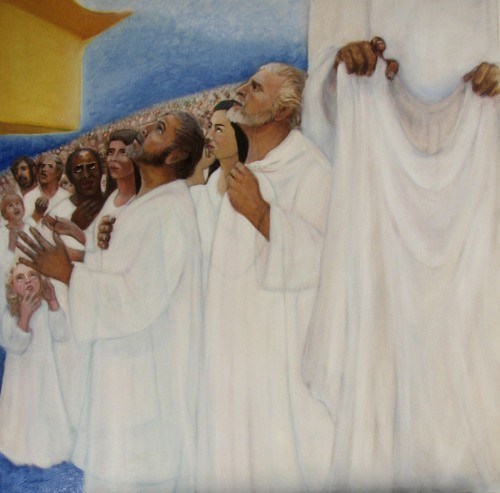
I conclude that we do go to Heaven upon our death and receive at least part of our “inheritance”. I back that up with a passage in Revelation 7:9 that speaks about the location of the victorious dead:

After this I looked, and behold, a great multitude that no one could number, from every nation, from all tribes and peoples and languages, standing before the throne and before the Lamb, clothed in white robes, with palm branches in their hands,

Revelation 7:9 (ESV)

They are standing before God’s throne which was shown to be in Heaven to this point in Revelation.

What is the “salvation that is ready to revealed in the last time”? Isn’t this something that happens on the last Day–Judgment Day? I always read it that way. I see it differently now. God’s plan of salvation for human beings was only partially revealed prior to Jesus. They knew about the resurrection of the dead. They might have had an inkling that God would provide a way of forgiveness of sins that was permanent. They didn’t expect to go to God’s throne room. It wasn’t promised.

That didn’t mean that Heaven wasn’t in the plan. Heaven wasn’t officially on the table until Jesus had atoned for sin with His completion of God’s Law, paying the penalty of forsakeness https://wordpress.com/post/afterdeathsite.com/2234, and the casting of Satan out of Heaven (Rev. 12:7f). You could really say that it was contingent on Jesus’ success. But now that Jesus has prevailed, God’s full plan of salvation can be rolled out. It does say “last time”, not last day. Now is the last time, not Judgment Day.

The good news is not only will we have a resurrection of our bodies in perfected form and a New Earth after Judgment Day, but we a have immediate access to Heaven and glorious things within it, because God has “given us new birth”, connecting us to Jesus.

When you think about the best things in life now, they all will perish, spoil or fade. A new car will eventually be a boring old car and then rust. Exciting experiences lose their excitement. Everything declines either physically or in our reaction to it or both. Not the stuff of Heaven.

Relationships remain exciting. Seeing God never gets old. Our adventures remain fresh.

In the mean time, all these will keep. We have a job to do here and a certain amount of time to do it. While here, we remain in a danger zone. In Revelation 7 the inhabitants of Heaven refer to our current world as the Great Tribulation. This is hard to appreciate unless you are in a war zone, are chronically ill, or are trapped in dysfunctional relationships. But even if things are good, they are not Heaven good.

While here we are exposed to sin and the curse. God protects our connection to Christ, but we can still walk away from it.https://wordpress.com/post/givingchrist.com/843 We may suffer quite a bit while here. But God will support us and transform us. God will use us in powerful and unique ways. All of the trouble associated with the Great Tribulation will seem small once we move to our home. The one thing that I expect will fade, will be our memory of our struggle here.

Will Many Be Saved?

Have you gone to many, or any, funerals where you assumed a negative eternal destiny for a person? This is so hard to think about that we simply hope for the best, even in cases where there is little evidence that this could go well.

We are not to judge. We don’t have the ability to know what interactions a person has had with God. But even with the fact that Jesus died for the sins of everyone, and that God desires all people to be saved, one sobering verse stands out for me. I call it my least favorite passage of Scripture:

13 “Enter by the narrow gate. For the gate is wide and the way is easy that leads to destruction, and those who enter by it are many. 14 For the gate is narrow and the way is hard that leads to life, and those who find it are few.

Matthew 7:13-14 (ESV)

The word “few” devastates me. It is a relative term, so against the billions of people who have lived and currently live “few” could still be a vast number. Still, to imagine an even larger number going to eternal damnation is staggering.

How can this be? Isn’t God love? Isn’t God all-powerful? Yes, He is. But He is also a God of justice who abides by what is “written”. So, He will not do a compromising end run around the Law, even for this. If Scripture is to be believed at all, people are damned and they are damned in vast numbers.

I would love to wrong about this. Perhaps, “few” is 49.999%. Or it could be “few” relative to the 100% that could have been saved. Maybe 95%. Or maybe the key is the word “destruction”. If destruction refers only to Sheol and not necessarily Gehenna, then perhaps Jesus would have a mechanism to evangelize the dead and to do so in mass. I’m not saying that any of these could not be, but the most natural way to read this verse is to expect many losses.

Who would make up the many? Good works can’t make up for sins. There would be many “good people” by our standards who would miss out. Many consider Jesus to be irrelevant and hold on to a “let’s see what happens” approach to death. They reason that either they just cease to exist, or it will be O.K. because they are nice.

Many hold on to an alternative worldview with an alternative means of salvation, even if they have heard the Gospel. Muslims hold on to a somewhat vague hope of Allah’s mercy if they follow the Five Pillars of Islam well enough. Hindus cling to gradual ascension through reincarnation if they live well. Cultural Christians cling to being “good enough” if they don’t understand the Bible. Then there are the atheists who expect to disappear. That is a lot of people.

Maybe there are multiple paths to salvation?

Jesus said to him, “I am the way, and the truth, and the life. No one comes to the Father except through me.

John 14:6 (ESV)

It makes sense. If there were other ways, would God have made Jesus do what He did? If you don’t like it, speak to Jesus. I didn’t say it.

Many people have not even heard the Gospel of Jesus. What about them? I personally think that 1 Peter 4:6 alludes to how God deals with the Church’s failure to get the Word out.

For this is why the gospel was preached even to those who are dead, that though judged in the flesh the way people are, they might live in the spirit the way God does.

1 Peter 4:6 (ESV)

It is a somewhat vague, one passage testimony; but it makes more sense to understand this passage as Jesus or somebody preaching to the dead than all of the other weak explanations I have seen. If this were so, what sort of fool would reject the Gospel while toiling in Sheol? The mystery of faith is great. You would be surprised at how dense people can be.

When you add it all up it is sadly easy to imagine how the many end up in destruction. Can we move the needle in any way? Yes. Our witness to people matters. The few will still be a “great multitude that no could count.” (Revelation 7:9) I want to be in that multitude. I want those I love to be in that multitude. I want to have some role that many others will be in that multitude. And I still hope that the obvious way of understanding Matthew 7:13-14 is wrong.

Who Are the Elders?

They only show up in a few spots in the Bible, but their veiled identity is intriguing. In case you don’t know to whom I am referring, here is one spot:

 the twenty-four elders fall down before him who is seated on the throne and worship him who lives forever and ever. They cast their crowns before the throne, saying,

11 “Worthy are you, our Lord and God,
    to receive glory and honor and power,
for you created all things,
    and by your will they existed and were created.”

Revelation 4:10-11 (ESV)

All of the references to this group come from Revelation. They talk but they are never explained as to who they are. Since they are not identified in Isaiah’s vision of God’s throne room, it is possible that they have been added since then. Perhaps they are 24 chosen representatives of the Old Testament righteous. The number 24 seems significant since that is twice the number of the tribes of Israel. This could be 12 from Israel and 12 from the nations.

One significant reference to Elders among the tribes of Israel is at Mt. Sinai. Here the number is not 12 or 24, but 70. These men are allowed to go up the mountain and to “see God”. Their experience ends up with an explanation of what was under God’s feet. It would seem that these men didn’t get the best view and are shielded from God by some type of floor. It is unlikely that there is connection between these two groups.

Another possibility for the 24 is a representative for each of the twelve tribes plus the 12 Apostles. This would include either Paul or Matthias in replacement of Judas, but it should also include John who is observing the group. To this I can’t say “no”, but I am not inclined to say, “yes”.

The elders do not permanently remain in a circle formation around God. In Revelation 7, one comes to speak to John:

 And all the angels were standing around the throne and around the elders and the four living creatures, and they fell on their faces before the throne and worshiped God,… Then one of the elders addressed me, saying, “Who are these, clothed in white robes, and from where have they come?” 14 I said to him, “Sir, you know.” And he said to me, “These are the ones coming out of the great tribulation. They have washed their robes and made them white in the blood of the Lamb

Revelation 7:11,13-14 (ESV)

First, this Elder doesn’t include himself as someone who has come out of the Great Tribulation. The Great Tribulation may be a specific time period or event during which persecution is or was intense. I would also entertain the possibility that the Great Tribulation is how the inhabitants of Heaven refer to Earth. In that case, the Elder would not have been an inhabitant of Earth. He is also not identified as something other than a human, though that does not absolutely rule out some type of angel.

Why would we be told about these beings without an explanation of who they are? Even the Cherubim are given a brief explanation. What is their function? Do they only praise God from the front row? All we see are the Elders in action within the throne room of God. Their function within the room is connected to worship.

Since Revelation is an apocalyptic vision, it is possible that the elders are symbolic. Their likely symbolism is that they are the Church. So if that is the case, we circle the throne of God, we throw down our crowns of glory and give praise to God. We are enthroned and given some measure of authority. That would be my first choice if not for the conversation in Revelation 7.

I would still say that these are 24 actual individuals chosen to represent the church as a whole. The message they silently give is that we, as members of the church, are given close access to God in Heaven. We will no longer be separated by a floor, vision, cloud, curtain or anything else that necessarily isolated us from direct contact with God.

Just One Life

About twenty years ago, I traveled to India. It was both a cultural experience and a place of many surprises. We landed in Hyderbad in the middle of the night. As our bus drove to the hotel, the streets were dark. I could vaguely make out the shadows of something on the sidewalk. I didn’t figure out until the next morning that it was all people who were homeless.

India is a nation that is primarily Hindu. A core belief of Hinduism is that this life’s situation is the just product of a previous life. Consequently, if you are homeless you deserved that fate.

You could even return as another living thing. The consequence was that roads would go around a tree. Still, this isn’t exactly a respect for nature. There was litter everywhere.

Another likely result of believing that you are on a journey through multiple lives was the extremely dangerous traffic situation. Overcrowding and poverty no doubt contributed to the situation, but it is easier to face death if you expect to be born again.

The Bible doesn’t take on the topic of reincarnation directly. It does speak of eternal existence for all, but it denies that this existence will be here–at least not immediately.

27 And just as it is appointed for man to die once, and after that comes judgment, 28 so Christ, having been offered once to bear the sins of many, will appear a second time, not to deal with sin but to save those who are eagerly waiting for him.

Hebrews 9:27-28(ESV)

We die once, not over and over. Death is the separation of body and soul. Something that would never happen except for sin. We don’t lapse into non-existence nor even unconscious existence, we consciously continue in either Heaven or Sheol.

In this article, I am interested in the implications of this fact for this brief life. Is this life a throw-away, because something better is beyond it? Is it a time to pursue hedonistic pleasures because something worse is next? Is it as the famous polka says, “In Heaven there is no beer, that’s why we drink it here.”? Certain pleasure are earthly pleasures, so pursue them now. Some embrace this philosophy because they feel that the truth about our fate after death is unknowable. I obviously disagree. To the skeptic, I would point out not only Scripture, but Near-Death Experiences. What happens at our death is only unknowable if you don’t try to know. For something as important as this, denial is a fool’s strategy.

Far from an approach that neglects this life, the set of promises that come with connection to Jesus Christ makes this life brief but valuable and life-after death the true prize. Jesus takes the pressure of saving ourselves off of our shoulders and places it on His. Forgiveness of our sins, our inability of fulfilling God’s Laws are all settled by His life. Heaven and beyond that a New Earth are ours for the taking. They are God’s gift.

This life becomes valuable because of what we can accomplish here with the presence of God within us. We can make an eternal difference in another person’s life. We can be a visible representative of God Himself. These things are worthy enduring the finite amount of grief that this life will throw at you.

So what are some of the consequences of knowing what God has given to us? First, I protect my life and try to be a good steward of my health and time, because I won’t get the same kind of opportunity to serve once I die. It isn’t beer that I have to get here, it is sharing God’s promises and His love in an environment that lacks knowledge of God. Besides that, they probably do have beer in Heaven.

Next, I value other people, even my enemies. They are potentially savable. They would be transformed by a connection to Jesus. They can be a reward to me. Life is cheap in many places, but it is not cheap to me.

The circumstances in which people live can be the product of many things: misfortune, bad parenting, limited natural abilities, poor education, poor government, injustice, bad decisions. The list goes on and on, but I can be a source of positive change. Their circumstances are not set by a previous life.

I will get older and closer to death every day. I am neither concerned about death nor a loss of purpose on the way. I know where I am going next and why. I am going to Heaven because of Jesus. My purpose may change as I lose abilities, but I will have a God-given purpose to the end.

Interacting with God in Eternity

Today, especially if you are living as a disciple of Jesus, you interact with God. At the most basic level, God keeps you and the universe you live in functioning. God is aware of your actions and thoughts. He hears your prayer, considers your situation, and moves in this world for your well-being. You can experience God teaching you when you study the Bible. You can experience God working through you when you step out to serve. It’s good but it is not what we would like.

We want to see Jesus and touch Him. We would like to see and feel the Father and the Holy Spirit. Will we?

The best and certainly the most underrated blessing of eternal life with God is the interaction we will have with God in Heaven and in the New Earth. What will that be like?

My understanding is that we will always be a creature that is in one place at a time. There will be no omnipresence for us even in Heaven. That said, I understand the Bible to say that we will ultimately have a very vast domain to explore: a recreated universe (not just a planet) and the whole domain of Heaven. With that I would infer that our means of movement will be greatly enhanced; but no matter where we go, Jesus will be near us. That will be a great blessing.

Right now, Jesus is with us as well, but we don’t perceive that. After we leave this life, Jesus in His already resurrected body will speak with us, comfort us, guide us first just in Heaven and then after Judgment Day everywhere.

For the Lamb in the midst of the throne will be their shepherd,
    and he will guide them to springs of living water,
and God will wipe away every tear from their eyes.

Revelation 7:17 (ESV)

What about the other persons of the Trinity? It is true that when you encounter Jesus, you encounter them all, but will we specifically experience the Father or the Holy Spirit?

Jesus is still the incarnate Son of God. While omnipresent, He has a specific, human form. The Father and the Holy Spirit are spirit(s). I believe that means that they can take on forms but are not specific in their appearance.

One way we will experience the Holy Spirit is as the waters of the River of Life.

 Then the angel showed me the river of the water of life, bright as crystal, flowing from the throne of God and of the Lamb.

Revelation 22:1

I don’t think this river is just something to look at. I expect that it is something to experience. We will wade into the river of Life and experience an interaction with the Spirit unlike anything we have in this life.

It would not be surprising if we encounter the Spirit in many forms, including human form. It will make for a uniquely beautiful relationship.

How will we experience the Father?

 No longer will there be anything accursed, but the throne of God and of the Lamb will be in it, and his servants will worship him. They will see his face, and his name will be on their foreheads.

Revelation 22:3-4

The curse is attributed as being the cause of many woes in this life: illness, natural disasters, defects in genetics, really anything that is not directly caused by sin. But what is it? I think it is just God stepping back a bit from the controls (Not stepping away). The world operates out of sync. It is a part of our rejection of Him as God. The curse also phases in (in Genesis) as people lose the face-to-face interaction with God. In Heaven and the New Earth, that will no longer be an issue.

There we will see the Father’s “face”. Does He have a face being a spirit? I’m not sure. What we will behold will be glorious. How we will behold it is still a mystery. Seeing God’s face implies a broader and more personal interaction. It is not just reserved for when we enter His throne room.

The experience of God, Father, Son and Holy Spirit, will be the pinnacle experience of eternal life. The limited revelation we have and our best speculations I’m sure don’t come near to describing it. There is value, however, in trying to imagine what will come. It keeps us looking forward. There is also value in making the most of the interaction that we can have now. That sense of personal relationship with God keeps us strong in the faith.

What Did Jesus Mean By “Few Are Chosen”?

My picture of Heaven and the New Earth is one where there are many people and everybody who I ever knew in life. I don’t like funerals where there is any degree of doubt about a person’s destiny. Even if there is, we tend to put the best face on it.

Reality and desire rarely match. And even if the Gospel is literally the “good message”, there is some bad news mixed with the good news. The good news is that Jesus successfully fulfilled the Law for every person. A promise of forgiveness of sins and consequently eternal life with God is on the table. God has made good on long standing promises and His mission to save mankind, even potentially all mankind, has been enacted. The bad news is that in practice “few” get saved.

Where do I get this grim news. From my least favorite passages in the Scriptures:

14 For many are called, but few are chosen.”

Matthew 22:14 (ESV)

13 “Enter by the narrow gate. For the gate is wide and the way is easy that leads to destruction, and those who enter by it are many. 14 For the gate is narrow and the way is hard that leads to life, and those who find it are few.

Matthew 7:13-14 (ESV)

Both are out of the mouth of Jesus, who I have to consider an authority on the matter. There are other passages that corroborate this, so the fact that these are both from Matthew is of little consequence.

What does this mean? And why is it true? We have the universal desire of God to save all. We have the complete and sufficient life and death of Jesus to fulfill the legal requirements.

The Matthew 22 passage comes at the end of the Parable of the Wedding Feast. In the story a general invitation has been given to the populace to come to the wedding. One dude shows up without “wedding garments”, which would be provided. The King reacts strongly and the parable dissolves to bare truth, “Bind him hand and foot and cast him into the outer darkness. In that place there will be weeping and gnashing of teeth. For many are called, but few are chosen.”

The implied rejection of the wedding garment does in this man’s salvation.

The other quote is a part of the Sermon on the Mount. Jesus adds this information in the midst of a series of commands on how to live. Without the context of the whole Bible, one might conclude that the “narrow way” is a strict observation of the laws Jesus had just laid down.

The Sermon on the Mount is an example of how God uses the Law in different ways, even at the same time. The rigor of the Sermon on the Mount is meant to convict and to break any attempt to save yourself by your own actions. It is unachievable and already lost for a person with a sinful nature (that’s all of us). Martin Luther referred to this as using the Law as a mirror. We see ourselves, and the image isn’t good. Jesus’ statement of the narrow way is meant to create worry and to drive a person to another answer–God’s grace.

Jesus’ statement doesn’t appear to be an exaggeration for the sake of impact, however. The narrow way and the wedding garment are the same thing–the one thing that can save us.

Jesus said to him, “I am the way, and the truth, and the life. No one comes to the Father except through me.”

John 14:6 (ESV)

Being connected to Jesus is the one thing necessary. There are not other options that work, so it is “narrow”. It makes sense that this is true. If there were other options, Jesus wouldn’t have gone through what He did.

So how “few” is it? Many people lived and died and never heard the Gospel. I don’t believe that God would allow this to be a limiting factor. The function of Jesus’ “descent into Hell” seems to suggest, especially in 1 Peter 4:6, that Jesus can be evangelical even in Sheol. The limiting factors seem to be that many are hardened to the Gospel (Matthew 13:19) and Satan works to keep them that way. Others believe but find reasons to abandon the Gospel (persecution and difficulty, other worries of life). Some undermine the Gospel by changing the terms of God’s promise (the book of Galatians). Many become unrepentant sinners (John 3:19-20).

So what percentage can we expect? Is “few” relative to the whole population? Is “few” relative to the whole number that could have been saved? I hope it is the latter, but I wouldn’t be surprised that it turns out to be 10% or even less. Jesus seems to brace us for a low yield by some of His stories. But whatever the yield it will still be many people –a great multitude that no one could number (Rev. 7:9). We are blessed if we are counted among them.