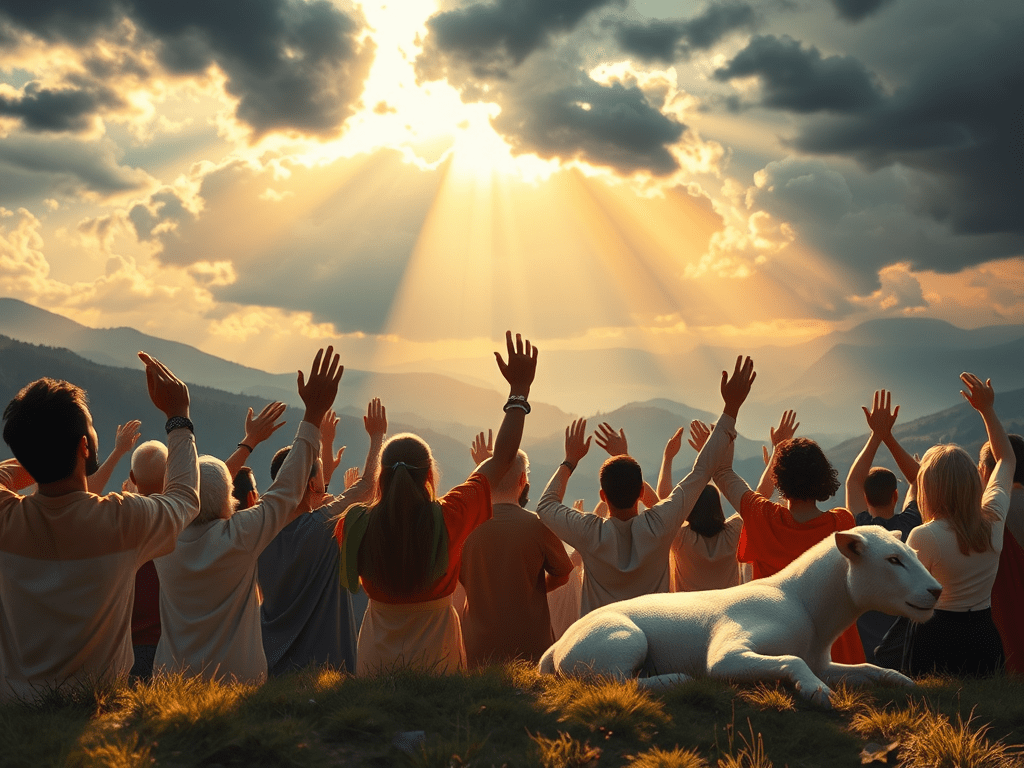
How Will We Be Like Him?

The author contemplates the transformative experience of Heaven and the New Earth, focusing on how believers will resemble Christ in character and have new, indestructible bodies free from sin. They explore the uniqueness of individual personalities, potential cognitive abilities, recognition, and the non-divisive nature of gender and race in the afterlife.

I think that it is exciting to think about what I will be like in Heaven and the New Earth. It is not just our environment that will change, but we will be changed. The classic teaser passage about this is 1 John 3:2,

Beloved, we are God’s children now, and what we will be has not yet appeared; but we know that when he appears we shall be like him, because we shall see him as he is.

1 John 3:2 (ESV)

My question for this article is, “How will we be like Him”? Jesus is the incarnate Son of God. He became human and all indications is that He remains human to this day. I am human and when I pass I will remain human. I will not become an Angel. Angels are a separate yet similar species. I will be a human with a heavenly body (2 Corinthians 5:1). That will be a body very different than I one I now have. It will not have the genes or the structures formed by sinful nature. That is a big plus. It will be a body formed to exist in the dimensional space of Heaven and not this universe. That may not be noticeable to me. What else?

When Jesus rose from the dead, He had a resurrected, human body and also was the incarnation of the Son of God. I am not sure that I will have the same properties when I have a resurrected body that is built for this universe. What can we say about our heavenly body and our resurrected earthly body or just “our self” after death in Christ?

Our character will be like Christ, not just “sort of” like Christ as we are now? I will have all of the fruit of the Spirit to the full:

22 But the fruit of the Spirit is love, joy, peace, patience, kindness, goodness, faithfulness, 23 gentleness, self-control; against such things there is no law.

Galatians 5:22-23 (ESV)

Beyond this there are many other personality qualities listed in the New Testament. These won’t make us into personality clones of each other. We will just be great people. I expect that we will retain certain personality traits that make us unique now–positive ones.

My body(ies) will be indestructible and eternal. No more sickness, aging, or death. I’m looking forward to that. Anything else? The rest is strictly hypothetical.

1 Corinthians 15:42-44 speaks about the resurrected body, not necessarily the heavenly body:

42 So is it with the resurrection of the dead. What is sown is perishable; what is raised is imperishable. 43 It is sown in dishonor; it is raised in glory. It is sown in weakness; it is raised in power. 44 It is sown a natural body; it is raised a spiritual body. If there is a natural body, there is also a spiritual body.

1 Corinthians 15:42-44(ESV)

I’m going to say “glory” in verse 43 means in part “beautiful”. Most of us will not leave pretty corpses. Some of have been unattractive even as babies. It will be equal, yet diverse, forms of beautiful. How will we know each other then? If you die looking awful. Will you be unrecognizable? I hypothesize that we will have a gift of recognition not based on seeing faces. This would be great for those who are currently “face blind”. Peter, James and John knew Moses and Elijah at the Transfiguration. We are not told of introductions or name tags.

The quote above uses “powerful”. I expect both bodies to be “powerful”. But with what powers? No fatigue? Able to move fast? Able to lift heavy stuff? I am not really sure what “powerful” all entails. But we will in no way be feeble.

Will we retain gender or race? God desires people from every nation and Revelation 7 says:

After this I looked, and behold, a great multitude that no one could number, from every nation, from all tribes and peoples and languages, standing before the throne and before the Lamb, clothed in white robes, with palm branches in their hands,

Revelation 7:9 (ESV)

I expect that the answer is yes, but it will in no way be divisive or diminishing.

What about cognitive abilities? Not sure. Muscle memory and athleticism? Exciting to think about, but I don’t know. Abilities that have no analog with our abilities now? I sure hope so. The resurrected Jesus seems to either blind people’s recognition abilities or to be a shape-shifter. That may be a God quality. Might we able to present as a child, adult, or good-looking senior? It’s an intriguing idea.

There is much to look forward to when you are connected to Christ and have God’s grace covering you.

Purpose In the Kingdom of God

The content explores the concept of purpose in life and after death, emphasizing the importance of serving God and others. While earthly pleasures may seem fulfilling, true satisfaction comes from meaningful engagement. It highlights biblical passages about eternal life, suggesting that purpose exists beyond rest, with joyful, fulfilling activities in Heaven and the New Earth.

What would you do if money and health were not issues? If you had no other purpose than to enjoy yourself, would you be happy? I think I would be for awhile. I would travel, golf, hangout with my kids and grandkids, hike, explore, ski, and much more. Many people think of retirement like that, only to be disappointed by restrictions and a nagging need for purpose.

As a person who is already a part of the Kingdom of God. There is an enormous amount of purpose to be had. We glorify God through doing a great job at our job. We are to show kindness and forgiveness to others. We are to be good stewards of time, money, skills, our body, our planet, our knowledge of Scripture, our relationships and more. We are to make disciples. We are to counteract evil. If you can’t find something to do as a disciple of Jesus, you are not looking hard enough.

But what about after death? Eternity is a long time. Will we be able to experience new things and enjoy fun things we already enjoy? I expect so. Will there be purpose? While there is never enough information about our existence in Heaven and the New Earth for my taste, there actually is more about purpose than there is about entertainment.

But let’s start with this passage:

13 And I heard a voice from heaven saying, “Write this: Blessed are the dead who die in the Lord from now on.” “Blessed indeed,” says the Spirit, “that they may rest from their labors, for their deeds follow them!”

Revelation 14:13 (ESV)

This passage has unintentionally put into people’s minds that eternal life is a bunch of naps. “Resting from labors” is not sitting around. It is no longer experiencing the physical drag of work. When I have something to do, even something I will enjoy, there is a part of me that doesn’t want to do it. My body doesn’t want to give up the energy. That experience will be done. Nothing will be laborious. There will be purposeful, comforting, exhilarating, entertaining, loving, bonding, but not laborious.

I am not sure about the experience of being damned. The Bible speaks of fire and decay(worms). Jesus’ experience speaks of being abandoned by God and hopelessness. I would expect purposelessness and maybe laborious activity.

Can we know anything more specific about the purpose of the redeemed?

“Therefore they are before the throne of God,
    and serve him day and night in his temple;
    and he who sits on the throne will shelter them with his presence.

Revelation 7:15 (ESV)

This is still rather vague. What type of “service” does God need? Honestly nothing. But just as we are allowed to be a part of God’s work here, we are also allowed to be in the direct presence of God and with purpose. Don’t read into this that direct worship is all that we do. Also, don’t pull into it visions of working a night shift here. This service is fundamentally different.

Another purpose section comes from Isaiah 65. Isaiah 65 is a hard passage to interpret in light of other Scriptures. See a bigger discussion here: https://afterdeathsite.com/2022/05/24/wrestling-with-isaiah-65/ But Isaiah, speaking of the New Earth, includes a number of familiar functions.

They shall build houses and inhabit them;
    they shall plant vineyards and eat their fruit.
22 They shall not build and another inhabit;
    they shall not plant and another eat;
for like the days of a tree shall the days of my people be,
    and my chosen shall long enjoy the work of their hands.
23 They shall not labor in vain
    or bear children for calamity,
for they shall be the offspring of the blessed of the Lord,
    and their descendants with them.

Isaiah 65:21-23 (ESV)

This section is about the New Earth. It says so. Will we build and plant and have kids? Looking at other Scriptures, I can say that our days won’t be limited like a tree. We have eternal life. Will we go through cycles or does Isaiah 65 just compare the sorrows of current life to the absence of sorrows in the New Earth? It is hard to say, but I would not count out any of the purposes listed here.

Obviously, there is much we have left to discover about life in Heaven and the New Earth. It will be an experience that is “truly life”, and that includes purpose. Probably it includes familiar things and things that we have never imagined. None of it will be laborious. It will be joy.

Biblical Out of Body Experiences

Modern medicine has increased the frequency of Near Death Experiences (NDEs). Individuals often seek to replicate these experiences through psychedelics and meditation. The article explores Biblical accounts, specifically Isaiah and Paul’s encounters with Heaven, emphasizing the spiritual nature of these experiences and the caution advised regarding contemporary interpretations of NDEs.

Because of modern medicine, more and more people are having Near Death Experiences. Some, eager to repeat the experience, experiment dangerously with psychedelics, Transcendental Meditation, and occultic methodology.

Out-of-body and Near-Death Experiences are not something new. They are just more frequent. The Bible records a couple of these experiences that I would like to explore in this article.

The first is Isaiah’s experience of Heaven in Isaiah 6:

In the year that King Uzziah died I saw the Lord sitting upon a throne, high and lifted up; and the train of his robe filled the temple. Above him stood the seraphim. Each had six wings: with two he covered his face, and with two he covered his feet, and with two he flew. And one called to another and said:

“Holy, holy, holy is the Lord of hosts;
the whole earth is full of his glory!”

And the foundations of the thresholds shook at the voice of him who called, and the house was filled with smoke. And I said: “Woe is me! For I am lost; for I am a man of unclean lips, and I dwell in the midst of a people of unclean lips; for my eyes have seen the King, the Lord of hosts!”

Then one of the seraphim flew to me, having in his hand a burning coal that he had taken with tongs from the altar. And he touched my mouth and said: “Behold, this has touched your lips; your guilt is taken away, and your sin atoned for.”

Isaiah 6:1-7 (ESV)

There is nothing in the story that indicates that Isaiah was near death. His body remained in some state in the temple in Jerusalem on Earth. How do I know this wasn’t a physical field trip? The main thing is Jesus’ comment in John 3:

13 No one has ascended into heaven except he who descended from heaven, the Son of Man.

John 3:13 (ESV)

To this point, Heaven was strictly off limits to humanity. Our sinful condition made bodily access intolerable for us. I also think that the other dimensionality of Heaven would exclude our body prior to being resurrected.

Even without being bodily in Heaven, Isaiah feels the weight of being a sinner. The experience should have been pure joy, but he proclaims, “Woe is me!” The experience is given to Isaiah for the purpose of recruitment for a thankless job. If you go further in Isaiah, he volunteers to take the job of proclaiming to Israel words that will close their ears and harden their hearts. That is not a job I would want.

Still, he has this vision/OBE to remember. What he sees is a portion of Heaven–God’s throne room. He experiences atonement for his sins through the touch of coals from the altar. This would be the real altar that is represented by the bronze altar for sacrifice in the Tabernacle and later in the Temple. Why does this work? It is prophetic of Jesus’ sacrifice and that His body touches our lips in the Lord’s Supper. Whether there is more to it is hard to say. It is important to remember that Isaiah is not physically there. This is not imaginary either. He experiences it in spirit only.

Isaiah says that he saw the Lord. Direct viewing of God is fatal for sinful flesh. Not being in the flesh protects him. Touching the coals of the altar protects him and allows him to stay and to speak. Once he receives his commission he is returned to his body in the temple on Earth.

Paul had a similar experience. He doesn’t say as much about it, but what he says is found in 2 Corinthians 12:

I know a man in Christ who fourteen years ago was caught up to the third heaven—whether in the body or out of the body I do not know, God knows. And I know that this man was caught up into paradise—whether in the body or out of the body I do not know, God knows— and he heard things that cannot be told, which man may not utter.

2 Corinthians 12:2-4 (ESV)

He describes his destination as the “third heaven”. For people of that time the first heaven is our atmosphere, the second is the universe, the third is where God dwells or what we call “Heaven”.

Fourteen years ago would be about 40AD. Paul’s conversion would be around 36AD. Jesus’ crucifixion is likely 33AD. Perhaps this corresponds with an incident where Paul was stoned (the old sense of that word, with rocks) and left for dead. In that case this is an NDE. He doesn’t describe the throne room. He calls what he sees “paradise”. He is not sure of his bodily state. I’m pretty sure it is out-of-body.

Then the teaser. He hears things that He is not permitted to tell. God has a few more mysteries to reveal. What could these be? It could be about the full glory that God has prepared for us. Near Death Experiences are generally glorious if the person experiences Heaven, but I do not trust them fully. They can have a universalistic bent that clashes with what Jesus has said. I’m not sure if it is a misinterpretation of the person, or Satan can inject falsehood into the experience at times, or something else. I trust the Bible for details. The things Paul hears could also be about coming judgments on the Earth. The 70AD destruction of Jerusalem is still in front of Him, for example.

The Biblical out-of-body experiences are interesting and informative. It shows that God can use such an experience. These two are approved to be carried forward as God’s Word. Others need to be approached with caution. They may be accurate and real experiences, or not.

Does Anything from This World Carry Over into Eternity?

The current world, seen as “The Great Tribulation,” is marred by sin and the curse, affecting everyone and everything. However, aspects like people, nature, deeds, and certain glories will carry into the New Earth post-judgment. Relationships and the beauty of God’s creation will transform, offering a vastly improved existence.

The conditions of this world, relative to Heaven or the New Earth, are pretty grim. Everything is tainted by either sin or the curse. That includes more than humanity. It includes the whole of this universe. The citizens of Heaven refer to this life as “The Great Tribulation” (Revelation 7:14). That is hardly a complement.

It is also true that God will tear it all down and start over.

But by the same word the heavens and earth that now exist are stored up for fire, being kept until the day of judgment and destruction of the ungodly.

2 Peter 3:7 (ESV)

So, does anything from this life and this universe carry over into the next? There are beautiful things here. There are really valuable aspects of now. As you search through the Bible about this you can come up with these important carry-overs: people, nature, certain deeds, and the “glory of the kings of the Earth.”

Let’s start with people. People are clearly one of the more contaminated things in this universe. We have proven ourselves to be capable of some horrible stuff. But people are also the main thing that Jesus came to save. I say this because Jesus was born a human and not something else. Once we put aside our current bodies which house our sinful nature, we will purely reflect the image of God again. People are something very valuable, although it currently may be well hidden.

We certainly value the idea of bringing our loved ones to eternal life with us. This should also be true of family or acquaintances that have not been very good to us. If they can be connected to Jesus through faith and baptism and remain in that connection, they will be a glorious asset in eternal life for they will be changed.

This is true of total strangers as well and even enemies. We can expect to have many new and valuable relationships among people. Will we be grouped as we are now? I am not sure. Our relationships will be different. I suspect that we will have contact with those we ministered to here on Earth. So, the more you reach here, the bigger your circle will be there. This is not to exclude other new relationships formed in Heaven or the New Earth.

Then there is nature:

The wolf shall dwell with the lamb,
    and the leopard shall lie down with the young goat,
and the calf and the lion and the fattened calf together;
    and a little child shall lead them.
The cow and the bear shall graze;
    their young shall lie down together;
    and the lion shall eat straw like the ox.
The nursing child shall play over the hole of the cobra,
    and the weaned child shall put his hand on the adder’s den.
They shall not hurt or destroy
    in all my holy mountain;
for the earth shall be full of the knowledge of the Lord
    as the waters cover the sea.

Isaiah 11:6-9 (ESV)

Nature has also been corrupted by sin. The current form must go away, but it will be reintroduced in a renewed form. This seems to include familiar species. Will it include familiar animals, like your pets? I don’t know, but maybe. This is in reference to the New Earth. It is a post-Judgment Day occurrence.

Then deeds. Our actions, words, thoughts condemn us. We are saved by the actions of Jesus. But as redeemed people we have the opportunity to build on the foundation of grace good deeds that are done by the power of God in humility and love. These deeds and their impact can follow us past the grave in the form of some type of reward.

13 And I heard a voice from heaven saying, “Write this: Blessed are the dead who die in the Lord from now on.” “Blessed indeed,” says the Spirit, “that they may rest from their labors, for their deeds follow them!”

Revelation 14:13 (ESV)

Finally, the least clear thing, the glory of the kings of the Earth. Speaking about the New Jerusalem, the Bible says:

24 By its light will the nations walk, and the kings of the earth will bring their glory into it, 25 and its gates will never be shut by day—and there will be no night there. 26 They will bring into it the glory and the honor of the nations.

Revelation 21:24-26 (ESV)

What is this? Is it great art or architecture? God finds beauty in some man-made things, and it seems to be preserved. What constitutes “glory” or “honor” is not clear. It certainly won’t include art that reflects either our false notions of God or the perversion of our sinful nature. There are other things that are worth remembering and keeping and God will keep them.

There will be many new, beautiful, breath-taking creations of the God, the ultimate Creator. the experience of Heaven and the New Earth will be different and massively better. But some of the familiar and what God values of the current universe will be a part of our new life in eternity. One would hope to be a contributor to this list.

Whoever Believes Has Eternal Life

The author reflects on a visit to the Church of the Holy Sepulcher, where they encountered a priest who mistakenly defined eternal life. The piece clarifies the distinction between “eternal existence” and “eternal life,” emphasizing that the latter is connected to belief in Jesus and a mystical union with Him, experienced both now and in Heaven.

I went to Israel about 10 years ago. In the Church of the Holy Sepulcher (shown above), which houses the traditional place of Jesus’ crucifixion and His burial tomb, I overheard a priest say to his tour group, “I don’t know what eternal life is, but I would like to think that it has something to do with being remembered.” This admission and glaring error shocked me. I want you to know very clearly what is meant by “eternal life”.

First, we must make a distinction between “eternal existence” and “eternal life”. God made a few creatures to have eternal existence. To my knowledge from the Bible these include: Seraphim/Cherubim (same thing different names), Angels/Demons (same thing but the latter is in rebellion against God), and human beings. You won’t cease to exist. Your body will die but you will find yourself in another body in another place (not Earth). This has been true of you since conception, and there is no way to opt out.

Because of our rebellion against God and the sin that is enshrined in our DNA, our eternal existence would naturally be first in Sheol (use the search box above to look for articles on Sheol), and then after Judgment Day in Gehenna, which we commonly refer to as Hell. Nobody should call such an existence “life”, and the Bible doesn’t.

Jesus’ life, forsakeness, death and resurrection are for the purpose of taking us from such a fate and giving to us instead “eternal life”. If the first temptation is thinking that life equals existence, the second is to think that eternal life begins at our physical death. Look at the following Bible passages:

47 Truly, truly, I say to you, whoever believes has eternal life.

John 6:47 (ESV)

36 Whoever believes in the Son has eternal life; whoever does not obey the Son shall not see life, but the wrath of God remains on him.

John 3:36 (ESV)

And to the question of “what is eternal life?”, we have this:

And this is eternal life, that they know you, the only true God, and Jesus Christ whom you have sent.

John 17:3 (ESV)

It certainly sounds like eternal life is something that we have already, if we have belief. Belief is not simply believing that Jesus is real. Like a person could believe in ghosts. It is believing the story of Jesus to be historical and factual and it is trusting in the promise connected to Jesus of forgiveness of sins. These are what I call “first-level” proofs that you are connected to Jesus and have eternal life. They are not exactly the cause of eternal life. The cause of our receiving eternal life is all that Jesus did and the existence of a bond that Jesus forms between us and Himself. This “bond” or “connection” is not cognitive like belief is, it is not emotional, for lack of better words it is mystical. Theologians call it the “mystical union”. Read more about this here:https://givingchrist.com/2024/10/01/understanding-jesus-prayer-for-unity-in-john-17/

Once that connection is made and as long as that connection is viable, we have eternal life. Having this connection is “knowing” the only true God. Being united with Christ has evidence but you don’t feel it like you might feel a part of your body. The existence of eternal life in you will be much more obvious when your physical body dies. Heaven is the place you would go first if you have eternal life. The experience we will have there will be glorious. If you want to know more about Heaven, use the search bar in my blog above. I have written numerous articles on that.

You can’t quite say eternal life is life in Heaven. That is part of eternal life. It is life now connected with Jesus, life in Heaven, and life in the New Earth post Judgment Day. It is a package. A great package that we did not deserve, but is offered freely to us.

How sad it is to not know eternal life. I hope the priest in my opening story found out. I hope you do as well.

When Did Heaven Enter the Plan?

The use of the word “Heaven”, the absence of Heaven as a human destination in the Old Testament, and similarities between Heaven and the New Earth leads to confusion about the topic. The article presents a view about how all of this fits together.

I recently watched a show of the documentary series Frontline about President Biden. It shared how, as a first term Senator, Joe Biden’s world was rocked by the tragic death of his wife and daughter in a car accident. The show interviewed the Catholic priest who ministered to the family at the time. He said something that stunned my wife and me. He started a sentence by saying, “If there is a Heaven…”. If? I’m not sure if the “if” was a reflection of a lack of faith or a confusion about God’s plan or both. If it was the former, I would say to him and any of you, expect this world to be difficult and unfair. We are sinful beings under God’s curse and cohabitants on this planet with Satan and his kingdom. There will be rough spots, even cruel ones. If the “if” is the latter, then this article is meant to address that. First of all, from where does the confusion about Heaven arise?

There are a couple of confusing aspects about Heaven in the Bible. The first is the word itself. “Heaven” both in Hebrew and in Greek is a word that describes several layers. The first heaven is the atmosphere of our planet. The second is the universe. The third is Heaven proper, the abode of God. This clearly shows the structure of creation as revealed to or understood by people in the biblical times. This doesn’t mean it is how it is actually structured. The model worked as far as God was concerned.

Next there is the fact that both Old and New Testament revealed the plan for a new heaven and new Earth. Certain similarities exist between the descriptions of Heaven and of the New Earth. So, are they the same? Do we go to Heaven and Revelation 21 and 22 describe it? Or do we wait the New Earth and references to Heaven describe it? Or are they two separate things?

Finally, why is there no reference in the Old Testament to people being taken to Heaven upon their deaths? Even the righteous expected to go to Sheol until the Resurrection?

The Bible reveals that God’s plans were established even before the problem of sin and rebellion existed. How He rolls out those plans and reveals them to mankind is the thing. Very early on God revealed the end of the plan. Job knew about the resurrection. Daniel speaks of it as well. Isaiah 65 reveals a description of the New Earth that doesn’t seem to agree with Revelation or the idea of eternal life. I suspect that Isaiah is only given a description that he and his contemporaries can process. To read more about this passage look here: https://wordpress.com/post/afterdeathsite.com/1982

Information is given out by God on a “need to know” basis. Nothing about Heaven as a human destination is mentioned in the Old Testament, but we do find Satan in Heaven. This I believe is key. If we know about God’s plan, then Satan will certainly know about it. This is the reason why more specific details are not given about the Messiah. What is given is specific enough that they could be interpreted any old way, like a fortune cookie; but there is not enough information for Satan to defeat the plan–which he definitely tried to do. A big part of this is that with Jesus’ successful fulfillment of the Law, Satan and his cronies would be expelled from Heaven.

Satan’s expulsion is spoken of in Revelation 12:

Now war arose in heaven, Michael and his angels fighting against the dragon. And the dragon and his angels fought back, but he was defeated, and there was no longer any place for them in Heaven. And the great dragon was thrown down, that ancient serpent, who is called the devil and Satan, the deceiver of the whole world—he was thrown down to the Earth, and his angels were thrown down with him.

Revelation 12:7-9 (ESV)

I believe this to be the ultimate “Good New – Bad News” message. The good news is that now those redeemed by Jesus don’t have to dwell in the bland comfort of Sheol. With Satan expelled, Heaven is in play, and it is our immediate destination at our death. Resurrection, Judgment Day, and the New Heaven and Earth are future and time does matter. (See this article about time: https://wordpress.com/post/afterdeathsite.com/2356

The bad news is that Satan is exiled to here. This I don’t understand or like. Human beings are enough of a mess with our sinful nature. The world is also complicated by the curse. How much additional suffering does the presence of Satan and his angels create?

Heaven is indicated as our destination in several New Testament passages. This is not a development of theology as much as it is more information after a critical execution of the plan. 2 Corinthians 5 states that we have “an eternal house in Heaven” (speaking about our heavenly body). The fact that it is “eternal” does not make Heaven and the New Earth the same thing. Read about one possible scenario here: https://wordpress.com/post/afterdeathsite.com/2356

There are many surprises that God still has in store for us. That makes it exciting. The most critical knowledge is already ours. We can only enter into eternal life with God as a gift through God connecting us to Jesus. Jesus fulfilled the requirements of God’s Law for us. We would never be able to do it ourselves.

Looking At the Unseen: Heaven

The passage from 2 Corinthians 4:18 encourages looking beyond the seen to the unseen, such as happiness through God’s preparations. Visualizing the promised can help detach from material wealth. Heaven, as the dwelling place of God, is envisioned as a separate universe of indescribable beauty, activity, and personalized dwelling places.

In my last entry I began to examine the meaning of 2 Corinthians 4:18 where Paul encourages us to “look not to things that are seen but to the things that are unseen.” I do think the main meaning of this passage is that we seek our identity, meaning, and ultimately our happiness from the things that God has prepared for us through the victory of Jesus. These things are for the moment unseen. Being very visual creatures, however, we tend to attach to seen things like wealth.

How do we work with God to modify our worldliness? One possibility is to frequently try to envision what is promised. You will definitely fall short of accurately doing this, but even a poor attempt can help. My last blog demonstrated this for our Heavenly Body. How about Heaven itself?

This first thing to state is that Heaven is a place. It is not a state of mind or some other lame, ethereal concept. Though the Greek original does not capitalize Heaven, I believe that is because the word is used for multiple things. The first heaven is the atmosphere. The second is the universe. The “third heaven” is God’s dwelling place. We are talking about the “third heaven”, so, I try to consistently capitalize it. That may not be its name, but it is the only name we have.

I believe Heaven to be another universe, not within our space-time. I try not to use the word “parallel” because that has the connotation of an exact replica of ours with different circumstances (like the Prime series “Man in the High Castle”). I also don’t mean part of the multiverse. This is not the multiverse of superhero series, but rather is a very lame idea uncritically swallowed by scientists who want to explain away the uniquely fine-tuned nature of our universe for life on Earth. Rather, I expect there are a few other universes that are closely connected to ours that we cannot perceive. Still, at death, we move quickly to them.

How do I envision Heaven? First, I believe that there is a huge central throne room of God. This is the “new Jerusalem” described in Revelation 21. While at the core of heavenly existence, it is not the whole of Heaven. There will be streams and trees and physical features both familiar and fantastically new to us. These features may be manifestations of God himself. There will be wonderful food and drink. To contradict the “Beer Barrel Polka”, in Heaven there may be beer, just no hangovers or beer bellies.

There will be hundreds of millions of beings–both human and angelic, but never crowding. Heaven could absorb many more people than will ever be there. Beauty and creativity everywhere you look, listen, feel and taste.

Will there be other creatures? Possibly yes. Not like ours. Earth’s creatures will get their part of the resurrection with the New Earth.

How about activities? I expect that there will be satisfying productive activities and leisure, but not like anything here. Again, stronger similarities of activities to this life will be a part of the New Earth.

Will we have a dwelling that is ours? I would think so. Jesus said,

In my Father’s house are many rooms. If it were not so, would I have told you that I go to prepare a place for you?

John 14:2 (ESV)

The King James version uses “mansions” as opposed to “rooms”. You won’t feel cramped or disappointed in your housing arrangement, whatever you call it.

Heaven has been the dwelling place of Angels and Cherubim. Again, I capitalize but that may not be their proper name. It was until the victory of Jesus also the domain of Satan and Demons (which I understand to be fallen Angels). They no doubt have a fully developed culture and possibly even technology of their own. Intermingling won’t be a problem. It would have been a big problem, and wasn’t allowed, prior to Jesus.

Will it be disorienting, since it is so different? I doubt it. If there is a learning curve, it will be a joyful experience.

Looking At the Unseen

The passage in 2 Corinthians 4:17-18 urges believers to focus on the unseen, eternal things rather than the transient world. Envisioning the afterlife may be flawed, but it encourages hope and motivation as disciples. Descriptions in scripture hint at a bodily, immersive experience in heaven, free from physical and emotional pain, surrounded by beauty, love, and pure joy, all made possible through Jesus Christ’s sacrifice.

For the next two blog entries I would like to ponder with you the meaning of 2 Corinthians 4:17-18, which reads:

17 For this light momentary affliction is preparing for us an eternal weight of glory beyond all comparison, 18 as we look not to the things that are seen but to the things that are unseen. For the things that are seen are transient, but the things that are unseen are eternal.

2 Corinthians 4:17-18 (ESV)

How does one “look to things that are unseen”? It seems like an oxymoron. Our gift of vision is a limited function. It works only for objects that reflect or emit a narrow band of the electromagnetic spectrum that we call visible light. These objects also have to be big enough. Vision is a nice feature, but I need equipment to “see” many other objects, and even night-vision goggles and microscopes have their limits.

Paul is talking about looking to Heaven and the New Earth. Heaven, I expect, is extra-dimensional to this universe. As large as the universe is, I don’t expect Heaven to be hiding within it or just beyond our observational horizon. The New Earth is future. Neither suit our vision, but that doesn’t make them unreal. It might make them feel surreal, but that is our problem. That said, how do you “look to them”?

Perhaps it is enough to say, “I have a promise and a partial description given by inspiration from God”. “I look forward to that.” In that case “looking” is trusting. Would it be wrong if “looking” meant “envisioning”? Envisioning will necessarily be an exercise fraught with error. For,

But, as it is written,

“What no eye has seen, nor ear heard,
    nor the heart of man imagined,
what God has prepared for those who love him”—

1 Corinthians 2:9 (ESV)

Paul quotes Isaiah and both men had out-of-body experiences of Heaven. It is their way of saying, “What I saw would blow your mind”. Our envisioning of Heaven would no doubt fall short of the reality of it because our experience is limited to this fallen world. Still, Heaven and especially the New Earth do not sound like they are completely different from God’s creation here. Envisioning, though inaccurate, may be just the type of encouragement to keep us forward looking and motivated as disciples of Jesus.

So what could we envision? I would like to start with my heavenly body. The point is that our experience in Heaven is a bodily experience versus merely a dream or like a ghost is stated in the verse after text above.

For we know that if the tent that is our earthly home is destroyed, we have a building from God, a house not made with hands, eternal in the heavens.

2 Corinthians 5:1 (ESV)

The “tent” is your body here. The “house” is your body in Heaven, not a building in which you will dwell.

What is it like? I envision the same basic body plan. I have no pain. I still sleep, but my sleep is the most refreshing and wonderful thing. I feel strong. I am happy and excited about what each day will bring. I feel beautiful and complex. My senses are sharp and more than the five I have here. I sense love and feel it for every fellow creature around me.

The people and the angels around me are stunningly beautiful. I have an immediate bond with each one of them. I know their names instinctively. I recognize people I know from my life on Earth. They are more valuable to me and more pleasing to me than ever. Any sin between us is long forgiven.

I move in many ways. I can walk, run, swim, fly or just think my way to places far away. Heaven is vast. It is no smaller than the Universe I came from, but I am not limited to one planet. I feel at home anywhere, but I have a community I return to.

I can communicate with words or directly to the mind. I encounter people from different eras of time. None are like strangers to me. Some were part of my family tree. Language is not a barrier. We speak one language.

God is with me either visibly or fully in my mind all the time. He speaks to me. We spend time together one-on-one, for He is able to do this with everyone at the same time. We also gather in groups with God. Worship is not a struggle. It is spontaneous and is a highlight of our experience, but we do many things.

Music, celebration, eating and drinking, playing, learning, exploring, serving, bonding and much more is part of my experience. In Heaven, we are not reproductive, but we can feel a bond with each similar to the hormonal bond felt on Earth through sex. We are always safe, disease-free, sorrow-free.

We do not watch the events of the Earth because our experience in Heaven is immersive. Yet, we are aware of certain people who are still on their earthly pilgrimage. God speaks to us about them. We are eager for Judgment Day, primarily to end evil in all of God’s “inhabited” creation. Hell is “forsaken”. We are also mindful of being even further clothed. The day when we receive the universe of Earth and a resurrected body.

I am sure with a little creativity you can make this more detailed. Use the limited description given within Scripture as your guardrails, so that you do not envision something perversely incorrect. But enjoy the ride. Heaven is not wishful thinking, or boring, or tainted like this world.

By grace, because of the death and resurrection of Jesus Christ, it can be and will be yours.

Does Life After Death Have Proof?

The only undeniable proof of life after death is experiencing it. Belief in God and the Bible’s promises is crucial. Jesus’ miracles and resurrection offer insight into the afterlife. Near Death Experiences (NDEs) provide further evidence. Denying the existence of an afterlife due to lack of proof is self-deception and disregards the love of the Creator.

In the end, the only thing that will constitute seamless proof of life after death proof is experiencing it yourself. Once that happens, you had better hope that it is positive life after death because there probably isn’t a way to change course. Promises made in the Bible, experiences documented in the Bible, and more recent Near Death Experiences constitute the proof that you can have. God has put a premium on having faith. In this instance faith means, confidence that He exists (see my last blog entry), confidence that what the Bible records about Jesus actually happened, and confidence that God can and will deliver on His promises. Faith is confidence in something you cannot see.

What is your default belief about life after death and why? Some think it to be more intelligent and educated to only believe something they can experience first. To me that seems like a dangerous position, and I doubt that you follow it consistently. Must you see germs to believe in their existence? I think not. Must you die to believe it will happen to you? We need the experiences of others and sometimes revelation from God to fully understand what we are, what will happen to us, and what (if anything) exists beyond death.

Jesus demonstrated that He was not just an ordinary being. He did it through miracles and even bringing back people from the dead. People saw these things and were profoundly changed. Jesus gave a couple of pieces of insight into life after death to be noted here.

13 No one has ascended into heaven except he who descended from heaven, the Son of Man

John 3:13 (ESV)

You may suspicious of someone who claims sole authority over the topic of the existence of Heaven, but Jesus wasn’t just some crazy person without evidence of His claims. He also said,

“Let not your hearts be troubled. Believe in God; believe also in me. In my Father’s house are many rooms. If it were not so, would I have told you that I go to prepare a place for you? And if I go and prepare a place for you, I will come again and will take you to myself, that where I am you may be also.

John 14:1-3 (ESV)

His testimony is that there is eternal life with God after death. He states that if this life is all we get, He would have said so. Trust Him or not.

Then there is Jesus’ own experience. To win a favorable outcome for us after death, Jesus had to fulfill some legal requirements. We are sinners. To deserve a place in Heaven on our own merits we would have to be sinless. The Bible’s testimony is that the default outcome for a human being upon death is bad–very bad. Jesus’ came so that there would be one route to something much better. To fulfill the “legal requirements” Jesus had to be human, live a sinless life, and pay for an already accumulated sentence on human sin. That included experiencing being damned while hanging on a cross and a physical death. His death was guaranteed and certified by professional executioners and was more than obvious to observers. Yet in three days He rose from the dead and was observed by over 500 people.

If that is not enough, then you must deal with the experiences of now thousands of people who have been clinically dead, experienced an out-of-body experience and then were revived. Recent studies have shown that our brain has a storm of activity right before it has none. It is tempting to attribute NDE’s to that storm and claim that they are just an illusion created by that storm. I would advance a different theory. That the “storm” is our soul separating from our brain. Not unlike the arcing seen when slowly pulling out an electrical plug. The storm is not the creator of the out-of-body experience.

Near Death Experiences include both Heaven and Sheolhttps://afterdeathsite.com/2021/08/17/examining-near-death-experiences/ , https://afterdeathsite.com/2023/11/14/how-is-sheol-different-than-hell/

Remaining confident that death is the end because there is no “proof” is a form of self-deception in my opinion. If someone doesn’t want God to exist, doesn’t want dependency on Jesus, doesn’t want judgment on sin, doesn’t want to change their worldview, they can tell themselves that proof for eternal life is not ironclad. They can also ignore the giant holes in the proof of their worldview. That will be throwing away the love of their Creator and a tremendous existence.

That Can Never Perish, Spoil or Fade

When we do funerals at our church, we often start the service with a verse from 1 Peter 1. It reads, in part:

In his great mercy he has given us new birth into a living hope through the resurrection of Jesus Christ from the dead, and into an inheritance that can never perish, spoil or fade. This inheritance is kept in heaven for you, who through faith are shielded by God’s power until the coming of the salvation that is ready to be revealed in the last time.

1 Peter 1:3b-5 (NIV)

Keep in mind, that our existence past the grave is not just a simple Heaven or Hell https://wordpress.com/post/afterdeathsite.com/131. The wording of this passage does raise some questions. First, and this may surprise you, this is one of the few passages that suggests that Heaven is a destination for human beings. There is no promise of Heaven in the Old Testament. There is more mention of the resurrection and the New Earth even in the New Testament. This passage suggests that our inheritance is in Heaven. Does it mean that we go there to get it? Does it say that we must wait until Judgment Day to have it?

I conclude that we do go to Heaven upon our death and receive at least part of our “inheritance”. I back that up with a passage in Revelation 7:9 that speaks about the location of the victorious dead:

After this I looked, and behold, a great multitude that no one could number, from every nation, from all tribes and peoples and languages, standing before the throne and before the Lamb, clothed in white robes, with palm branches in their hands,

Revelation 7:9 (ESV)

They are standing before God’s throne which was shown to be in Heaven to this point in Revelation.

What is the “salvation that is ready to revealed in the last time”? Isn’t this something that happens on the last Day–Judgment Day? I always read it that way. I see it differently now. God’s plan of salvation for human beings was only partially revealed prior to Jesus. They knew about the resurrection of the dead. They might have had an inkling that God would provide a way of forgiveness of sins that was permanent. They didn’t expect to go to God’s throne room. It wasn’t promised.

That didn’t mean that Heaven wasn’t in the plan. Heaven wasn’t officially on the table until Jesus had atoned for sin with His completion of God’s Law, paying the penalty of forsakeness https://wordpress.com/post/afterdeathsite.com/2234, and the casting of Satan out of Heaven (Rev. 12:7f). You could really say that it was contingent on Jesus’ success. But now that Jesus has prevailed, God’s full plan of salvation can be rolled out. It does say “last time”, not last day. Now is the last time, not Judgment Day.

The good news is not only will we have a resurrection of our bodies in perfected form and a New Earth after Judgment Day, but we a have immediate access to Heaven and glorious things within it, because God has “given us new birth”, connecting us to Jesus.

When you think about the best things in life now, they all will perish, spoil or fade. A new car will eventually be a boring old car and then rust. Exciting experiences lose their excitement. Everything declines either physically or in our reaction to it or both. Not the stuff of Heaven.

Relationships remain exciting. Seeing God never gets old. Our adventures remain fresh.

In the mean time, all these will keep. We have a job to do here and a certain amount of time to do it. While here, we remain in a danger zone. In Revelation 7 the inhabitants of Heaven refer to our current world as the Great Tribulation. This is hard to appreciate unless you are in a war zone, are chronically ill, or are trapped in dysfunctional relationships. But even if things are good, they are not Heaven good.

While here we are exposed to sin and the curse. God protects our connection to Christ, but we can still walk away from it.https://wordpress.com/post/givingchrist.com/843 We may suffer quite a bit while here. But God will support us and transform us. God will use us in powerful and unique ways. All of the trouble associated with the Great Tribulation will seem small once we move to our home. The one thing that I expect will fade, will be our memory of our struggle here.