

Recently, my brother-in-law witnessed an accident. A fourteen year old boy came flying down a street to a blind corner on an e-bike. He was from out-of-town and consequently didn’t know the street or apparently see the stop sign. He flew through the intersection and was hit by a car and thrown quite a distance. He didn’t make it. My brother-in-law was quite disturbed by what he saw. Understandably so. He later asked me, “Was it his time?”
The idea that there are appointed times does come from the Bible. There are appointed times for demons, Jesus’ return, the length of pestilence and other forms of punishment, day and night, gestation, and as Solomon and the Byrds said, “A time for every season under Heaven.” God knows the length of our days. There are plenty of instances where a person’s death is foretold, but is that the same as fore-ordained? I don’t think so.
It is hard to completely comprehend what it is like to be God and to transcend time. Our experience is completely within time. We experience things sequentially and cannot fathom not being within time.
To help understand my brother-laws question’s answer, let me ask some adjacent questions. Did God know that accident would happen? Yes. Did He cause that accident to happen? No. Why did it happen? The boy made a mistake. Could it have been avoided? Sure. Could God have stopped it? Yes. Why didn’t He? See below. God does cause some disasters to happen, but they are rare. Most disasters have no immediate spiritual causation. They are just the cause and effect of every factor involved.
The next biggest cause is apparently Satan. The Book of Job is a tough one to understand. Job and his friends think that God caused all things based on whether a person deserved it or not. The story of Job and later Jesus would refute that belief.
Or those eighteen on whom the tower in Siloam fell and killed them: do you think that they were worse offenders than all the others who lived in Jerusalem? I tell you no.
Luke 13:4-5a (ESV)
God didn’t cause Job’s suffering, Satan did. God didn’t even allow Job’s suffering unless you want to go way back and say that God allowed Satan his powers and his time. Satan punished Job to make a point that Job was not blameless. God only limited Job’s suffering. The tower in Siloam fell because of poor engineering or unsafe building practices, not the guilt of the workers or likely anything else.
We live in a world that is impacted by sin and the curse. “The curse”, a biblical term, seems to mean that God doesn’t tightly control what happens on Earth during this age. He hasn’t abandoned us. We would know it if He did. But the world does free wheel under cause-and-effect. The cause can be people’s sin or carelessness. The cause can be Satan influencing people or environment. The cause can be God’s intervention, but don’t expect God to prevent every evil or even many of them. In general, we are to feel the effects of the curse. It is what Adam and Eve got started.
When we grieve, we want to find something to blame or to change after-the-fact. God tends to get a lot of blame, usually for inaction. This reveals false assumptions about life. We think that this life should be fair, like Job and his friends. It is not. We think that this life is all there is or that it is the main thing for us. It is not. We think disaster can only happen to other people. It can happen to anyone, including us.
If we don’t blame God, we blame ourselves. That is not usually justified either. Yes, we could have taken another course of action and that would have changed cause-and-effect, but we cannot foresee many things like this. The pain of our grief needs to go somewhere else.
It is far better to ponder such questions when we are not clouded by pain and raw emotion. Job, a man of great faith, didn’t do so; and eventually blamed God for being unfair. God balled him out. Job retracted his accusations. He didn’t understand the scope of the events that led to his suffering. As tough as it was, he should have continued to trust God. I doubt that I could have done better, even with knowing the end of the story.
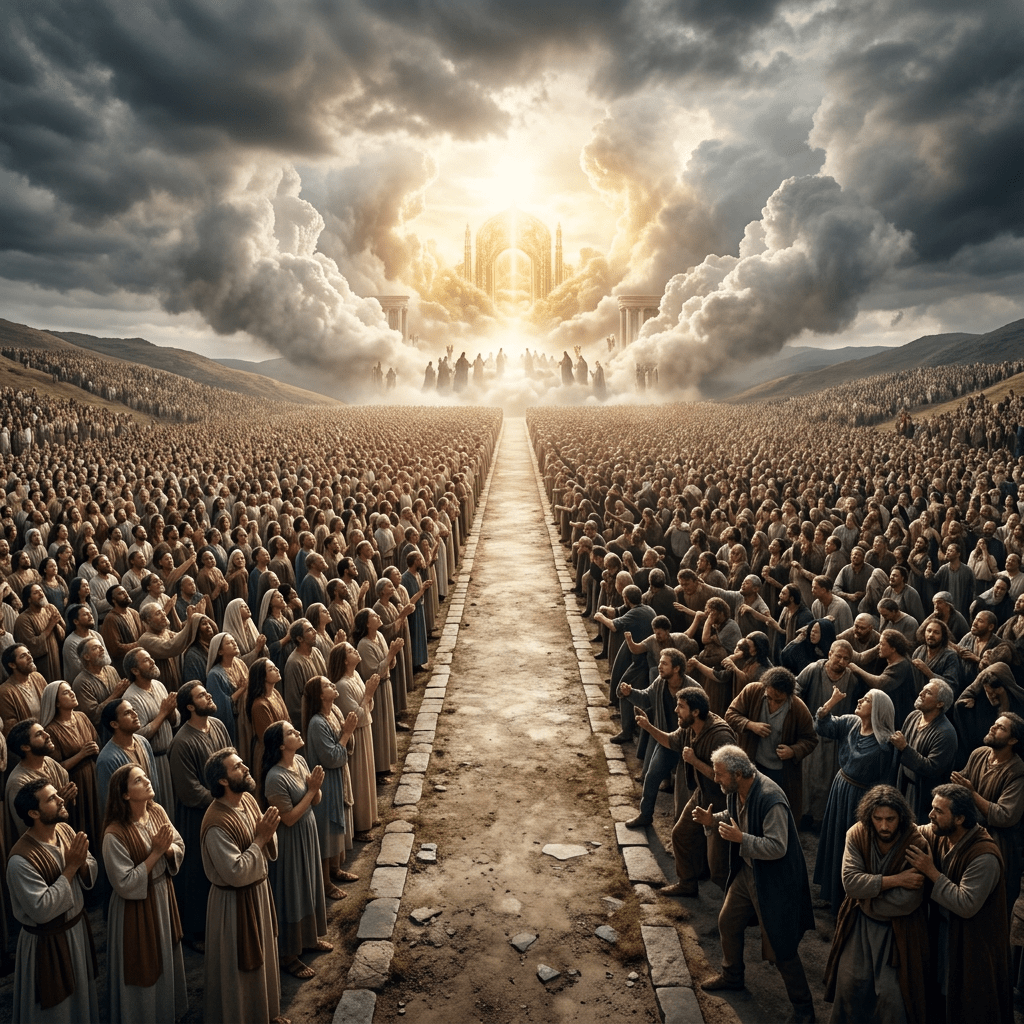
Knowing the “end” of this chapter of our story and of that of our loved ones can be a source of incredible strength. Losses like a tragic death are devastating. The boy’s death was upsetting to my brother-in-law, a mere bystander. It was far worse for the father, whom my brother-in-law saw fall to his knees. I sure they devastated the driver, who was keeping the law. We must grieve, but do not let such things destroy you. There is no point in that: it can have generation over generation negative effects, and it can imperil your salvation. If your understanding about life-after-death is strong and based on the tangible, reviewable evidence of God’s promise and action in Jesus, you will do much better. This isn’t a mind trick or wishful thinking. This is having right expectations about this life and the life to come.
 afterdeathsite