
Fear God

God has been my friend and my mentor since childhood. God has never done me wrong. Even in His seeming inaction, I have found hindsight eventually as to why He didn’t act. With that said, it is hard for me to have fear of God in the classic way we understand fear.

As part of a summer Bible reading program that I am doing in my congregation, we have recently read Luke 12 which has provided the topic for today:

“I tell you, my friends, do not fear those who kill the body, and after that have nothing more that they can do. But I will warn you whom to fear: fear him who, after he has killed, has authority to cast into hell. Yes, I tell you, fear him!

Luke 12 :4-5 (ESV)

Because I know what Jesus did and why, and have a firm belief in the promise of God and God’s character, I don’t think of my future as potentially including Hell (here the word is Gehenna, a reference to post-Judgment Day punishment), but it would be wise to do so at least in theory. People fall away from grace. It happens. They can mangle the Gospel until it is ineffective (see Galatians), fail to forgive when required, wilt under difficulty or choke out because the temptations of the world. I don’t think about that happening to me. I don’t ponder it. But I need to respect that God sticks to the letter of His Law even when it costs Him. I don’t want my connection to Christ to become compromised. I have only Christ’s righteousness as my hope.

The context in which Jesus speaks these words is one of the original disciples potentially being afraid of what Jewish leaders might do to them. It is scary to confess Christ in an environment where that is not going to be accepted. Worse, if it will probably be persecuted. I don’t live in a family or society where being a Christian is actively persecuted, but I would like to think that, if I did, I would be brave enough and certain enough to not be afraid to confess Christ. My confession would be based on a love of God, not a fear of God. But fear of God wouldn’t be without reason.

“And I tell you, everyone who acknowledges me before men, the Son of Man also will acknowledge before the angels of God, but the one who denies me before men will be denied before the angels of God.

Luke 12:8-9 (ESV)

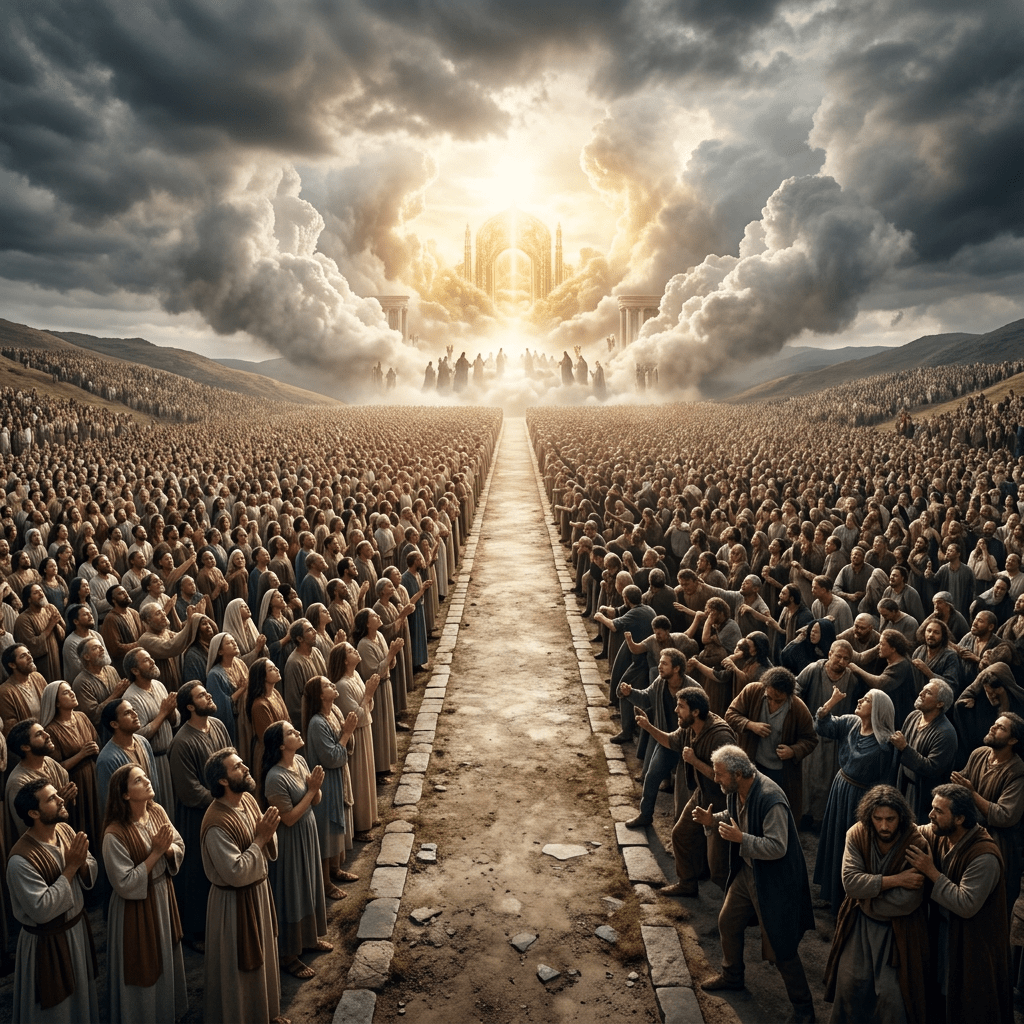
Here is a picture of Judgment Day that I don’t often ponder. People are separated to Jesus’ right and to His left. Some of those put on the left feel like they should be on the right. Before the angels of God, they are denied by Jesus. “I don’t know you”, is how it is expressed in a different passage. “I don’t believe/know Jesus”, is what got them there.

Denying Jesus is exactly what Peter did three times. Peter dared to hope for forgiveness, and he found it. Jesus gave Peter the chance to confess him three times a bit later. It was a chance to do things in reverse. There is forgiveness for being cowardly. It is tougher when the denial is adopting a different worldview that excludes Jesus as your Savior. Usually, people in that situation don’t seek forgiveness, but even in that situation, there can be hope.

All of these brushes with a Judgment Day disaster can be avoided with a healthy, non-surreal, fear of God. How can one get to that point? I think a great place to start is to ponder these words of Jesus and visualize being brave before you actually have to be brave. If you know that you are in a dangerous situation, ask God for bravery. Peter just thought he had it. There is also a difference between genuinely denying Christ and being clever enough to serve another day. God is not looking for people to invite martyrdom. Take comfort in these words if you are potentially in such a situation:

the Holy Spirit will teach you in that very hour what you ought to say.”

Luke 12:12 (ESV)

We are saved by God’s grace in the end, and not by being brave. Being brave may be pivotal in remaining with Christ. A healthy fear of God and the power of the Holy Spirit can provide these things.

Your Eternal Self

The post explores the concept of eternity through a theological lens, comparing God to a geometric line that exists infinitely. It discusses the nature of the spirit and body, eternal life, and the implications of sin on existence. It emphasizes God’s desire to recreate believers in a form suited for eternal life.

It is admittedly hard to conceptualize what “eternal” means. We can think of a long time, but not eternal. I sometimes use a math concept to get people to understand what they are. It helps.

God is like a line in geometry. I line goes infinitely in both directions. When Moses encountered God in the burning bush, he asked for God’s name:

14 God said to Moses, “Yahweh” And he said, “Say this to the people of Israel: ‘Yahweh has sent me to you.’”

Exodus 3:14

Yahweh is a verb form of “to be” not found in English. God always was, is, and always will be, is what is means. He is the whole line. People who don’t believe in eternal life think we are a segment. A clear beginning and a clear end in death. God has made us to be a ray. We do have a beginning at our conception. We do not pre-exist this except that God knows us. But we will have no end.

Our bodies clearly have an end. The body you have is a segment. You may feel the terminal point creeping up on you right now. We are more complicated than just a body. We are for now this body, our spirit, and the interface between the two, our soul.

Having a spirit is clearly a part of being created in the image of God. It is not cognition, intelligence, emotion, or imagination. It is something not properly a part of this universe. Our spirit is coupled with this body through a mechanism that has not been revealed to us. It is probably something on a very small scale, perhaps the micro-tubules found on our neurons.

What faculties are resident in our spirit? I’m not sure. It does become hard to sort. Things like memory, reason, consciousness, even senses can all be associated with parts of the brain which belongs to the body, but that doesn’t necessarily mean they are resident there. They may just interact with the body there. People having a Near Death Experience (NDE) can have all of the above without use of the body.

One thing I can say with certainty is a part of body and not the spirit is our sinful nature. The genetic damage we have all inherited that builds our body to be unreceptive to God and inclined to sin is cooked into the flesh. That is why we need to physically die. We need to get rid of this body when it is time.

Can our spirit simply float around without a body for long? Paul suggests that this wouldn’t be desirable:

For we know that if the tent that is our earthly home is destroyed, we have a building from God, a house not made with hands, eternal in the heavens. For in this tent we groan, longing to put on our heavenly dwelling, if indeed by putting it on we may not be found naked. For while we are still in this tent, we groan, being burdened—not that we would be unclothed, but that we would be further clothed, so that what is mortal may be swallowed up by life.

2 Corinthians 5:1-4 (ESV)

Being “unclothed” in verse 4 is being a spirit without a body. You really don’t want that. You want to be “further clothed”: to get rid of your current body/tent and upgrade to a body built for Heaven (v.1). I would assume that our spirit will interface with that body either through a similar means or something completely different.

Don’t think that you are done. God is very determined not to lose in the struggle for this time-space continuum. While your body for here is damaged and will die, He wants to remake this universe and remake a body for you for this universe.

How would that work? Now we are pushing a bit into a mystery. We don’t know how that will work. At the time of Judgment Day, Christ’s visible return, and the making of a New Heaven and Earth, there will a resurrection of the dead. Will God recycle what remains of earthly bodies? Not sure. I doubt it. He will make something that is uniquely us. Do we still have the “(body) eternal in the Heavens?” I would assume from the word “eternal” used in 1 Corinthians 5:1 that the answer is “yes”. I will be a spirit connected to a body or bodies at that time and forever.

Can I mess this up? Until we get rid of our sin-damaged body the answer is “yes”. We are saved completely by God’s action. Jesus kept the Law. Jesus absorbed the eternal punishment for our sin by being forsaken on the cross. The Holy Spirit has connected us (if we are connected) to Jesus. Normally, through the process of baptism. We can throw this away. The biblically listed methods of doing this are: distorting the Gospel (Gal. 5:2-4), being unrepentant despite the pleas of the Spirit (numerous verses), neglecting God’s means of keeping our connection viable (Parable of the Sower), refusing to forgive (Lord’s Prayer/Matthew 6). After our death, there is nothing to suggest the possibility of undoing our salvation. Isaiah 65:20 is meant to be rhetorical.

Is a damned person eternal? Their resurrected body doesn’t seem to be:

“For behold, the day is coming, burning like an oven, when all the arrogant and all evildoers will be stubble. The day that is coming shall set them ablaze, says the Lord of hosts, so that it will leave them neither root nor branch. But for you who fear my name, the sun of righteousness shall rise with healing in its wings. You shall go out leaping like calves from the stall. And you shall tread down the wicked, for they will be ashes under the soles of your feet, on the day when I act, says the Lord of hosts.

Malachi 4:1-3 (ESV)

They won’t need a body for the New Earth because they won’t be staying.

46 And these will go away into eternal punishment, but the righteous into eternal life.”

Matthew 25:46 (ESV)