

Angels and Demons

The text explores the nature of angels and demons, clarifying misconceptions about their existence and origins. It discusses how demons may be corrupted angels, influenced by Satan, while angels are distinct beings not derived from deceased humans. Both entities impact human life, with scripture referencing their roles in spiritual warfare and personal experiences of possession and intervention.

Most people, even if they are biblically illiterate, have heard of angels and Demons. They are known in other world religions as well, which is interesting. They are encountered by humans both in modern times, New Testament times, and ancient times. Are they real? And if so, what are they?

First, let’s say what they are not. Demons are not an ignorant understanding of mental illness. Mental illness is dysfunction of the brain. It can happen for a variety of reasons from genetics to trauma. I would not doubt that some trauma could be inflicted from spiritual (i.e. demonic) source, however. Angels, on the other hand, are not dead people. You do not die and become an Angel. Though the term, “angelus”, just means messenger, it is a term that is usually used to describe a certain species of being normally resident in Heaven. Angels are also not “Seraphim or Cherubim (in English: “burning ones” or “living ones”). These are synonyms for something of even higher capability than Angels.

It would appear that Demons are/were Angels. The information that we have is cryptic, but it appears that Satan (a Cherubim) managed to corrupt a large minority of Angels and turn them against God. Unlike humans where Satan was able to genetically corrupt the first set (Adam and Eve) and therefore corrupt every one of us, only a portion of Angels are corrupted. Perhaps this is because they don’t replicate, or that there were many Angels before Satan got to them.

What happened to Demons? This is very sketchy. Satan seems to have been able to hang on to residence in Heaven until Jesus’ victory on the cross. Nothing is said about Demons in this regard, except in Jude it says this:

And the angels who did not stay within their own position of authority, but left their proper dwelling, he has kept in eternal chains under gloomy darkness until the judgment of the great day—

Jude 6 (ESV)

From this passage we learn that Judgment Day isn’t just for people. Angels and Satan will receive their final disposition on that day as well. This passage can’t be about all fallen Angels, because many are shown creating problems on Earth. How is the timing of Jude 6 connected to this passage?

Now war arose in heaven, Michael and his angels fighting against the dragon. And the dragon and his angels fought back, but he was defeated, and there was no longer any place for them in Heaven. And the great dragon was thrown down, that ancient serpent, who is called the devil and Satan, the deceiver of the whole world—he was thrown down to the Earth, and his Angels were thrown down with him.

Revelation 12:7-9 (ESV)

Maybe these events are disconnected, maybe not. In the end, it would appear that we have both Angels and Demons among us. How do they contribute to our situations both positively and negatively?

On a personal level, the Bible records instances of demonic possession. There could also be lesser ways that a demon could affect a person. The most famous being the possession that inspired the book, “The Exorcist”. The Washington Post just happened to document this story back in the 1950’s. In that story the window that allowed the Demon to take hold was the dabbling in occultic practices by a “spiritualist” aunt and a boy’s use of a Ouija board to try to communicate to her after she died. I am not certain why and what occultic practices make this possible. They were also behind the scenes in all of the possessions encountered by Jesus. Pagan people lived very near or in Israel. People dabbled in these things and paid a price.

On a positive note, both the Bible and personal experiences account for angelic intervention. The most common being a helper that should not be there who assists someone in desperate need and then disappears.

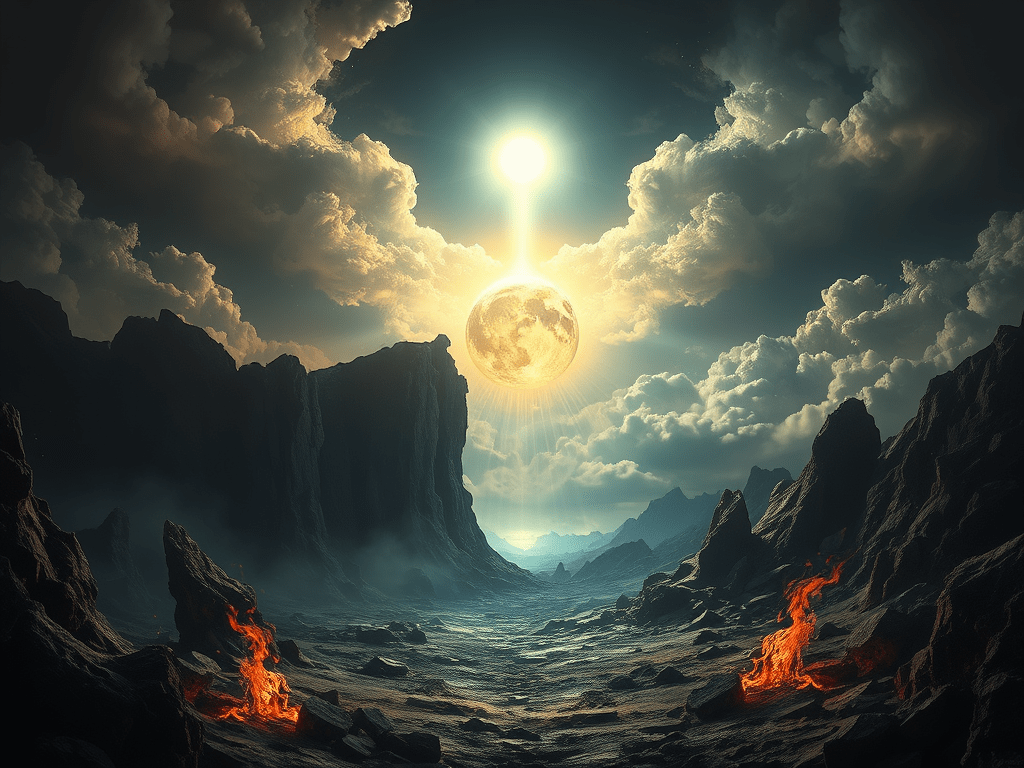
There is also some interesting stuff about Angels and Demons at the national level, but I would like to briefly address our interaction with them after our death. First, Angels do not have wings and neither will you. My piece of art above in generated by AI. I cannot convince the “AI” that Angels do not have wings since there is so much garbage on the internet that shows that they do. This idea is an addition mostly from Renaissance artists. Cherubim do have wings. Angels will be a regular part of our existence in Heaven. Much like humans, they will seem like neighbors.

Demons will not be in Sheol, they will either remain on Earth or be contained in someplace called “the Abyss” until Judgment Day. After Judgment Day they will not be tormenting people in Hell. They will be suffering as well.
Do Humans Have a Body in Hell and Sheol?

I bet you were lying in bed wondering about this very question. I grant you that it is an obscure issue for which we have little information but it is a parallel to the important issue of whether we have a body in Heaven (to which I say yes), and it connects to same verse in Scripture, which is 2 Corinthians 5:1f.

For we know that if the tent that is our earthly home is destroyed, we have a building from God, a house not made with hands, eternal in the heavens. For in this tent we groan, longing to put on our heavenly dwelling, if indeed by putting it on we may not be found naked. For while we are still in this tent, we groan, being burdened—not that we would be unclothed, but that we would be further clothed, so that what is mortal may be swallowed up by life.

2 Corinthians 5:1-4(ESV)

Our body that we have during this life is a “tent”. It houses our spirit, but it is a legitimate part of what we are. That is why there is a resurrection of the body. Paul says that we do not wish to be “unclothed”, which means without a body. Can such a situation even exist?

The Bible does not say where Heaven, Sheol, or the final Lake of Fire actually are. The ancients conceived of Sheol as the center of the Earth, and Heaven as being outside the furthest reach of the universe; but that does not make it so. Recent work in theoretical physics uses the concept of other dimensions. Albeit these dimensions are not observable because they are very small. There is no constraining reason why they must be small. What if they are unobservable just because we are constrained to live and observe in only three spatial dimensions. What if other dimensions do exist, explaining some of the odd behavior of gravity and quantum physics, but actually define the space of parallel universes. These universes would not have to be in lock-step with ours because they are only connected at the quantum level. This could define the space of Heaven, Sheol, the Abyss, and possibly Hell.

Going with this very unprovable theory, that would be why an “earthly” body is Earthly. It only can move in the dimensions of this space-time. And why a “heavenly” is Heavenly. It moves in Heaven’s dimensions. Could Sheol be its own space-time with a Sheol appropriate body. Not sure of the adjective for that one.

Descriptions of Sheol (please use the Search box if you are not familiar with this term to find posts about it) seem very physical. For example the rich man in Luke 16:

23 and in Hades (same as Sheol), being in torment, he lifted up his eyes and saw Abraham far off and Lazarus at his side. 24 And he called out, ‘Father Abraham, have mercy on me, and send Lazarus to dip the end of his finger in water and cool my tongue, for I am in anguish in this flame.’

Luke 16:23-24 (ESV)

Flame, water, cool, tongue all seem very physical. This would also connect to the general resurrection of the dead. The damned would need an earthly body to stand before God at Judgment Day on Earth. It would also connect to the destruction of those Earthly bodies:

“For behold, the day is coming, burning like an oven, when all the arrogant and all evildoers will be stubble. The day that is coming shall set them ablaze, says the Lord of hosts, so that it will leave them neither root nor branch. But for you who fear my name, the sun of righteousness shall rise with healing in its wings. You shall go out leaping like calves from the stall. And you shall tread down the wicked, for they will be ashes under the soles of your feet, on the day when I act, says the Lord of hosts.

Malachi 4:1-3 (ESV)

They won’t be needing those bodies where they are going next. Is the final Lake of Fire (i.e. Gehenna or Hell) also a “bodily experience”? Maybe it is not even connected to our multi-dimensional reality. Maybe “forsakeness” means total disconnection from creation? I think that is an interesting and disturbing thought.

One final thought. Paul speaks about being “unclothed”. The spirit of Samuel is “raised up” from the good neighborhood of Sheol by the Witch of Endor (1 Samuel 28:13-15). He seems “unclothed” in the bodily sense. He appears “wrapped in a robe”. What about ghosts? I don’t know how they would fit in the model given us by Scripture. Are they figments of a person’s imagination? Are they demonic? Are they people “brought up” from Sheol and left here? Are they just part of a tired sit-com (I prefer the British version)? The disciples thought they were seeing a ghost when Jesus came to them walking on the water. From where did such an idea come? I don’t know.

Again, most of this post is unproveable and unstated by Scripture verbatim. But it does make sense to me. I hope you find it thought provoking and may be only find through experience about the Heavenly body and your Resurrected body.

Satan and the Afterlife

In the classic 14th century poem, Dante’s Inferno, “Hell” is pictured as nine descending rings of torment. At the very bottom, Satan is seen frozen in ice and chewing on the worst traitors in history. So, I guess there is a “cold day in Hell”. Ancient poetry and renaissance paintings have influenced our ideas of Hell and Satan in eternity. Understandably, since the Bible was not available to most people, there is something lacking in the details.

The first thing I would like to re-emphasize is that there is a difference between Sheol/Hades, which is before Judgment Day, and “The Lake of Fire”/Gehenna which is the final destination of the damned. Their similarities (i.e. fire, suffering) lead many to conflate the two. But they are clearly distinct. Which should we call “Hell”. Honestly, it your pick. But I tend to think of the post-Judgment Day, lake of fire, as Hell. See more here: https://afterdeathsite.com/?s=Sheol

So where is Satan in all of this? Well, if we refer to The Far Side for our theological truth, he is ruling in Hell with all his junior Satans. The Bible would not support this view. Prior to Jesus’ victory on the cross, Satan and his angelic/demonic following seem to be able to either be in Heaven or on Earth. Following the loss of leverage that Satan had legally, he and his minions are cast out of Heaven. Revelation 12 shares that he is now on Earth.

Now war arose in heaven, Michael and his angels fighting against the dragon. And the dragon and his angels fought back, but he was defeated, and there was no longer any place for them in heaven. And the great dragon was thrown down, that ancient serpent, who is called the devil and Satan, the deceiver of the whole world—he was thrown down to the earth, and his angels were thrown down with him…Therefore, rejoice, O heavens and you who dwell in them! But woe to you, O earth and sea, for the devil has come down to you in great wrath, because he knows that his time is short!”

Revelation 12:7-9,12 (ESV)

Trustworthy details are scant. But it appears that not all of Satan’s followers make it to exile on the Earth.

And the angels who did not stay within their own position of authority, but left their proper dwelling, he has kept in eternal chains under gloomy darkness until the judgment of the great day

Jude 6(ESV)

It doesn’t say where this “gloomy darkness” is. I would not conclude that it is the same place as the souls of the disobedient who Jesus preaches to after His crucifixion. (1 Peter 3:19) Look at that topic starting here: https://afterdeathsite.com/2017/03/14/christs-descent-into-hell-part-1/

I think the angels’ prison is part of what the Bible calls “the abyss”. Still, where is Satan? That depends on the meaning of the first paragraph of Revelation 20. It is also in Revelation 20 where we find the eternal destination of the one who kicked off this whole corruption of God’s creation. There are interpretations of Revelation 20:1-3 that understand Satan to be currently bound. If so, I would conclude bound in the Abyss. There are also interpretations that make this a future event. I lean toward the former. But there is little ambiguity of where he ends up.

and the devil who had deceived them was thrown into the lake of fire and sulfur where the beast and the false prophet were, and they will be tormented day and night forever and ever.

Revelation 20:10 (ESV)

This is formally “Hell” in my lexicon. It is post-Judgment Day and it is the ultimate destination of both corrupted angels and unredeemed people. The people have been in Sheol/Hades to this point.

14 Then Death and Hades were thrown into the lake of fire. This is the second death, the lake of fire. 15 And if anyone’s name was not found written in the book of life, he was thrown into the lake of fire.

Revelation 20:14-15 (ESV)

Satan is not there to reign or torment. He is there is suffer like everybody else. As bad as fire and sulfur sound, the phrase “second death” takes us to the ultimate penalty of sin which is to be forsaken by God. Hell is place. Forsaken is a condition. Jesus was forsaken on the cross, so that those who are connected to Jesus don’t need to suffer this themselves.

Satan does not seem to be connected to Sheol/Hades. He is either here on Earth, in the Abyss, or ultimately in the lake of fire/Gehenna/Hell. Neither he nor his demons seem to have the recourse that people have. Though we are sinful and rebellious as well, God’s love has created a way of forgiveness through Jesus. That is the way that I want and have. I am perfectly satisfied reading about Satan. I don’t need to meet him.

Where Is Satan?

Many people, including many Christians, regard Satan as a mythical being. It is right to say that Satan is not mentioned often in the Bible. Should he be? Need he be? The Bible makes us aware that such a being exists, but it is not about him. Satan is not the equivalent of God. Satan is a thinking, powerful, personal being–not just the personification of evil. Satan is the originator of rebellion within God’s creation. He is created by God as well. Both Jesus and the Gospel writers refer to Satan. Where is he now and what is his impact on our eternity?

We first see Satan in the Garden of Eden, which was on Earth. He tempts Eve, then Adam to question the honesty of God, and floats the idea that being like God was achievable for humans. That was the bait that sank the hook. The hook was the vast alteration of humans and all creation by the Tree of the Knowledge of Good and Evil. It seems mythy (my word–so you can’t use it for Scrabble), but Jesus does not cast doubt on the book of Genesis, so I will accept it as historical. Could it be real? Why not? An being of advanced being of great knowledge and power could create the means to genetically alter two human beings with direct contact. That we can almost do. How he manages to alter the rest of creation is more of a mystery.

Satan had access to Earth, now he held dominion over it. Evil and death would be the norm. In the rest of the Old Testament, you only see Satan twice for sure and possible two more times. In Job and in Zechariah you see Satan in Heaven as an accuser. In Job, he also has access to Earth as a disrupter and tempter. Two other “maybe it’s Satan” passages tell his backstory. Isaiah 14:9-16 and Ezekiel 28:14-19 do not refer to Satan directly, but rather the king of Babylon and the King of Tyre. The descriptions seem too much for a human. Could these men have been possessed by Satan himself or even been incarnations of Satan? If so, we learn that Satan is a cherubim/seraphim and that his downfall was essentially pride and wanting to be God. Sound familiar?

The arrival of Jesus, the incarnate Son of God, changes things. Satan was still the dominate spiritual force on Earth, but he is no match against the Son of God, except perhaps in the fact that Jesus has human flesh. The goal of Jesus is to fulfill God’s law for all of humanity and to suffer the required punishment for sin, at least the demand for God to forsake (remove from His presence entirely), all humanity. The counter move for Satan must have been to get Jesus to fail or quit. Killing Jesus was attempted via King Herod, via Jesus himself during Jesus’ formal temptation, and lastly through the crucifixion. Did Satan understand that killing Jesus at the crucifixion was playing right into God’s hands? I think he figured it out, but too late.

Revelation speaks of Satan being driven from Heaven. This is somehow connected to Jesus’ work on Earth and likely Jesus’ death:

Now war arose in heaven, Michael and his angels fighting against the dragon. And the dragon and his angels fought back, but he was defeated, and there was no longer any place for them in heaven. And the great dragon was thrown down, that ancient serpent, who is called the devil and Satan, the deceiver of the whole world—he was thrown down to the earth, and his angels were thrown down with him.

Revelation 12:7-9 (ESV)

So Satan no longer has access to Heaven. Why would he in the first place? It doesn’t say, but I would surmise that it had something to do with Satan knowing that God wanted to save humans and Satan using that as leverage to delay is own judgment.

Satan is cast to Earth. Again, why? It seems that at least some of Satan’s angelic followers are thrown into “prison” :

For if God did not spare angels when they sinned, but cast them into hell[a] and committed them to chains[b] of gloomy darkness to be kept until the judgment;

2 Peter 2:4 (ESV)

I left the footnote annotation in this quote because it matters. Both the ESV and KJV choose the word “hell”, but the Greek word is different from any other in the Bible. I think “Gehenna” refers to what we think of as Hell–the post-Judgment Day place of eternal punishment. This is not “Sheol or Hades” either. They refer to the post death, pre-Judgment Day destination for human condemnation. This word is “Tartarus”, which is borrowed from Greek mythology. It was a prison for souls or specifically for the Titans. Here Peter uses it for a place that is possibly equated to the “abyss” found in Luke 8:31. Why isn’t Satan there? Instead, it appears that he is here with us.

Revelation 20:1-3 holds out this information:

Then I saw an angel coming down from heaven, holding in his hand the key to the bottomless pit (Abyss) and a great chain. And he seized the dragon, that ancient serpent, who is the devil and Satan, and bound him for a thousand years, and threw him into the pit, and shut it and sealed it over him, so that he might not deceive the nations any longer, until the thousand years were ended. After that he must be released for a little while.

Revelation 20:1-3 (ESV)

The timing of this is greatly debated and beyond the scope of this blog. It would appear that Satan himself or at least some aspect of his power or following is still at work influencing the affairs of mankind. How much of the evil in this world is our own doing and how much can we say, “The Devil made me do it?” is unknown.

Satan’s final disposition is most relevant to the topic of this blog. In Revelation 20:7-10, we get the end of it:

 And when the thousand years are ended, Satan will be released from his prison and will come out to deceive the nations that are at the four corners of the earth, Gog and Magog, to gather them for battle; their number is like the sand of the sea. And they marched up over the broad plain of the earth and surrounded the camp of the saints and the beloved city, but fire came down from heaven and consumed them, 10 and the devil who had deceived them was thrown into the lake of fire and sulfur where the beast and the false prophet were, and they will be tormented day and night forever and ever.

Revelation 20:7-10 (ESV)

Cartoons and even great works of art can depict Satan as the ruler of Hell, joyfully tormenting the damned of mankind. That is not the case. Satan suffers with the damned. To be forsaken by God is a torment even for God’s first and greatest enemy.

Satan is on a misery loves company campaign. God is still saving people with the Gospel, and Satan is still opposing it using every avenue at his disposal. There is no need for you to share his fate.

The Fate of Angels

If you don’t know the Bible hardly at all, you might think that people become angels when they die. This errant idea is told to children when somebody dies. It is propagated by movies (i.e. It’s a Wonderful Life), songs, and even art (like the George Floyd mural seen on the news). It cuts against popular culture to say this but angels seem to be a species of their own, you can’t become an angel, angels are not described as having wings, angels and cherubim are not the same thing, and evil angels don’t share the same fate as evil people until Judgment Day.

We can say that some angels sinned:

For if God did not spare angels when they sinned, but cast them into (hell) and committed them to chains of gloomy darkness to be kept until the judgment…

2 Peter 2:4 (ESV)

I put parentheses around the word “hell”, because it is used too liberally as an English translation for many words in Hebrew and Greek in my opinion. At least ESV footnotes this translation. One would expect Hades was the translated word, but it is not. A new word shows up: Tartarus.

There are a number of words or phrases that are place names associated with existence after death or at least existence outside of life on Earth: Sheol, Hades, Heaven (ouranos), Gehenna, lake of fire, Tartarus, and the Abyss . It is confusing as to what are synonyms and what describes distinct places. Context and comparing translations are the only way to figure it out. We know the Hades and Sheol are the same from a Hebrew to Greek translation of the Old Testament called the Septuagint. Also you can tell that Hades and the “lake of fire” are distinct things from Revelation 20:14 where Hades is thrown into the lake of fire. Then they are not distinct anymore. What does Gehenna describe? I think context suggests that Gehenna is Jesus’ word for the lake of fire.

What do we mean by “Hell”. I mean that place of final judgment. That would then be English for Gehenna or lake of fire. If you mean the place of immediate judgment. Then use it for Sheol or Hades, but using it for all of the above covers up the fact that there are distinct places. Is Tartarus another synonym? It is only used once. Like Hades it is word borrowed from Greek mythology. Tartarus was an abyss used for suffering of the wicked and the prison for the Titans. Using the world “Tartarus” sounds like borrowing from another religion, just as the use of “Hades” does. I have another theory. That other cultures have similar ideas of what exists beyond our universe by the use of forbidden cultic practices that permitted communication with the dead.

Peter’s choice of the word “Tartarus” wasn’t adopting Greek mythology, but was using a commonly understood word to describe some place that was actually there. Further, using the context of the Bible, I think we can equate “Tartarus” here in 2 Peter with (abyssou) the abyss used in Revelation 9:2, 9:11, 11:7, 20:1, 20:2. This is different than how Job and Jonah used what could be translated as abyss. In those cases, it is more a concept of being in the “deep”.

So if we work with that theory, what is Tartarus? It would seem to be another realm of reality that is segregated from our universe, Heaven, and Hades/Sheol at the present time. It seems to be used as a prison for evil angels. Peter says that they are being kept there until the judgment (Judgment Day), for a final destination of Hell, with Satan and with people (Matt25:41). A further description of the angels in prison is given in Jude:

And the angels who did not stay within their authority, but left their proper dwelling, he has kept in eternal chains under gloomy darkness until the judgment of the great day…

Jude 1:6

If there are disobedient angels in Tartarus, then what are demons? Revelations 12:9 does the most to equate demons with some segment of disobedient angels.

And the great dragon was thrown down, that ancient serpent, who is call the devil and Satan, the deceiver of the whole world–he was thrown down to the Earth, and his angels were thrown down with him.

Revelation 12:9

So some disobedient angels end up in Tartarus and some here. Incidentally, a common understanding of the sin referred to in 2 Peter is what is described in Genesis 6:2–sexually crossing over to humans.

Revelation gives the idea that there is some sort of breakout or that there could be (depending on how Revelation is to be understood.) Since Tartarus is a place, could not the whole contingent of Satan and his angels have been placed there?

Either this all seems too complex or mythological for you or it makes you wonder how we fit in a broader struggle between God and part of His creation, and what is possible in that struggle.

The ugliness of this world can and should be accepted as a human product, but I wonder how much is initiated and antagonized by forces beyond our recognition. Jesus and the New Testament writers speak of this broader scale war. Our information about it is very limited. Clearly the methods of conventional warfare cannot remove the spiritual enemy only the people who are co-opted by it. Spiritual warfare as described by Paul in Ephesians 6 and the extension of the Gospel to new people, seems to be our role.