You’re Invited to a Wedding Feast

As a pastor I would estimate that I have done around 200 weddings in my career. Here is a bit of a confession. I don’t usually enjoy weddings that much. I’m not much of a dancer, I shouldn’t drink to excess, the food is usually OK no better, and the room is often loud, so conversation is hard. That said, maybe a wedding feast isn’t the best metaphor for conveying the joy that awaits me in Heaven and the New Earth. Probably a Packer football game would be a better metaphor for me, except this week.

For many people in many cultures, however, weddings are a blast. Probably the most anticipated social event of the year. For this reason, Jesus uses a wedding feast to convey not only the joy to be expected but several other aspects. Let’s take a look at them.

We will start with Jesus’ first miracle at Cana (John 2). While this is not obviously a statement about eternal life, the significance of Jesus making this His first public miracle suggests that it is more than a miraculous favor for the wedding hosts. Jesus creates the “best of wines” and in an overflowing abundance (120-180 gallons). The message? God is preparing the best for last for His people. It will not only be quality, it will be quantity.

In Matthew 22, Jesus tells a parable about a wedding banquet. Again, the banquet is unmistakably speaking about eternal life with God and a wedding is used as a metaphor to convey the party nature of eternal life. The point of the parable is different, however. In this case, it is about the snubbing that the initial set of guests give to the invitation. This is about the Jewish rejection of Jesus as the Messiah. The invitation then goes to everybody else:

Then he said to his servants, ‘The wedding feast is ready, but those invited were not worthy. Go therefore to the main roads and invite to the wedding feast as many as you find.’ 10 And those servants went out into the roads and gathered all whom they found, both bad and good. So the wedding hall was filled with guests.

Matthew 22:8-10

Notice that the invitation is to both “good” and “bad”. It speaks of the time of evangelization in which we are currently living. Behavior or character is not a pre-condition. Obviously, many non-Jews reject the Gospel as well, but the end result is still a “wedding hall filled with guests.” Jesus’ death and God’s promise could save so many more than will be saved. People foolishly reject it as fiction or choose other priorities.

A problem exists with one guest:

11 “But when the king came in to look at the guests, he saw there a man who had no wedding garment. 12 And he said to him, ‘Friend, how did you get in here without a wedding garment?’ And he was speechless. 13 Then the king said to the attendants, ‘Bind him hand and foot and cast him into the outer darkness. In that place there will be weeping and gnashing of teeth.’

Matthew 22:11-13

The wedding garment is representative of the righteousness that Jesus provides for us. We don’t do anything ourselves. It is a gift, but absolutely necessary. Though invited, this guest also rejects the Gospel and consequently finds himself in Hell which is described as “outer darkness..(where) there will be weeping and gnashing of teeth.”

This is wedding that you don’t want to miss, and don’t have to. The invitation is extended to you. The necessary righteousness is given to you. Why would people reject it and face the only alternative? You tell me.

The other wedding metaphor used to describe eternal life is in Matthew 25:1-13. Here a common wedding week game is used to teach. In Jesus’ culture the bridegroom would go away and build a room for he and his wife at his parents’ home. Then he would sneak back to the bride’s town where the wedding was held. The game was that the bridesmaids had to catch him returning. In this parable the bridegroom comes at night, and lamps that represent a person’s faith in Jesus as their Savior have to remain lit. The problem is that the bridegroom and Jesus’ return is a long time in coming. Some of the lamps run out of oil just as some people’s faith, when unfed, dies out.

When the festivities kick off the following happens:

10 And while they were going to buy, the bridegroom came, and those who were ready went in with him to the marriage feast, and the door was shut. 11 Afterward the other virgins came also, saying, ‘Lord, lord, open to us.’ 12 But he answered, ‘Truly, I say to you, I do not know you.’

Matthew 25:10-12

The promise of eternal life through Jesus is out there now. It has to create faith in a person now. It is too late after you die or when Jesus is visibly returning. It is a disaster to be shut out.

These comparisons of eternal life with God to a wedding feast are definitely double-edged. First, it will be great to be a part of it–a party, a joy. The invitation is extended. The requirements for entrance covered by God. But the other edge is a warning of disaster. To reject it or to be shut out due to neglect is the worst thing that can happen to a person. May it not happen to you.

What Do Jewish People Believe About the Afterlife?

Recently I was watching the movie Silence by director Martin Scorsese. It is a movie about Jesuit missionaries in Japan during a period when the Japanese rulers wanted to eradicate Christianity. It is a disturbing movie as you might guess. The rulers wanted Japan to be Buddhist. They were afraid of losing their culture primarily, so they did some very un-Buddhist things to Christians. In the course of history so called Christians have also done some very un-Christian things to pagans and also to Jews. Early on Jews did the same to Christians.

The covenant that God made through Moses is the centerpiece of Judaism. It is completely focused on prosperity in this life. I have often wondered what Jewish people believed about life after death beyond an expectation of a bodily resurrection, which is clearly promised in the Old Testament.

I came across a recent article in the Jerusalem post by Rabbi Stewart Weiss https://www.msn.com/en-us/lifestyle/mind-and-soul/what-do-jews-believe-about-the-afterlife/ar-AARVwFc?ocid=entnewsntp&pc=U531 It is an interesting explanation of Jewish belief. One thing that sadly didn’t surprise me is that most Jews don’t believe in life after death at all. They don’t believe the Old Testament. They may still cling to the culture and their Jewish identity, but theologically they are less Jewish than I am. Many, I am sure, are agnostic and a fair percentage are oddly Buddhist.

Let me rant for a moment about the value of culture. Many people strongly identify with a religion when they in fact only identify with a culture. Culture is important, but when weighed against whether we have an eternity with God or an eternity exiled from God culture is an insignificant thing. Culture changes all the time. You can have a distinct culture and cultural identity but share the same knowledge of God with people outside your culture. If the rulers of Japan in the movie were interested in being Buddhist, they would not have tortured anyone. The same can be said for the current government of Myanmar. Truth about God is far more critical than anything else. The truth about the God who created us all is that He does not tolerate sin let alone torture. Doing it in His name makes the offense many times worse.

Now back to the question of the Jewish understanding of the afterlife. I found that there are more parallels to my Christian belief than I expected. The article spoke of four phases of existence. The first we are experiencing now. The next is known as Gan Eden (Heaven or Paradise).

The second phase is Olam Haba, or Gad Eden (heaven or paradise). This may be a spiritual paradise where we experience an overwhelming closeness to God, or, in some opinions, a kind of “holding zone” for our souls, awaiting an eventual reordering of the universe.

The Jerusalem Post, Stewart Weiss

This is much like Heaven as I have described it. We enter a paradise in the presence of God. It is “spiritual” in the sense that it is not of this dimensional space. It is also experienced during the Intermediate Period between our death and Judgment Day. I would add that it might also be part of our experience after Judgment Day.

Weiss has a third phase that would equate with the Millennium in some Christian theologies. This is something that occurs on Earth, pre-Judgment Day. It is where the Messiah radically changes humanity for the better. Weiss does not say if this is experienced only by the living. Some Christian theologies sneak an extra resurrection of the righteous in at this point. Others leave it as a primarily Jewish affair. Amillennialists, of which I would count myself, don’t expect a future worldly rule of the Messiah until after Judgment Day. References to a “1000 years”, and to knowledge of God spreading over the world are seen as happening now as the Gospel is spread.

Finally, there is the resurrection of the dead. He does not share details, but I would agree that the Bible both Old and New Testaments speak of this as the final, eternal phase.

The big difference, not mentioned in the article, is how one gets to take part in all of this. Jesus is not recognized as the Messiah or as the necessary atoning sacrifice for sin. Entry into the bliss of Heaven and the Resurrection is based on being good enough and that God will “balance the scales”.

The description of what is to come matters little if we are not a part of it. Redemption has come. The Messiah came to win redemption. Jewish or not, don’t miss out on what Jesus has won for us. Especially, don’t ignore this salvation for the sake of culture.

Who Will Be Saved and Who Could Have Been?

The Bible is a considerably large body of knowledge, still there are times when I think, “So little information and so many questions.” I wish the Bible gave me more on a specific topic, but I and everybody else are left with a mystery.

Today’s mystery for your consideration is a seeming contradiction within the pages of Scripture. One set of passages seem to suggest that God will only save a rather small minority of people which He foreknew. Another set of passages seem to suggest that God wants all to be saved and that there is hope that over time a significant portion of those people can be saved. Those are opposing views at least on the surface. They have given birth to different theological traditions with different approaches to ministry. I believe that the Bible doesn’t contradict itself. Apparent contradictions are just failures to understand. How do these passages come together?

Here are some of the passages that suggest a very limited salvation:

13 “Enter by the narrow gate. For the gate is wide and the way is easy that leads to destruction, and those who enter by it are many. 14 For the gate is narrow and the way is hard that leads to life, and those who find it are few.

Matthew 7:13-14

Jesus doesn’t just give good news. This is arguably the worst news from his mouth. Another to consider:

 But if it is by grace, it is no longer on the basis of works; otherwise grace would no longer be grace.

What then? Israel failed to obtain what it was seeking. The elect obtained it, but the rest were hardened, as it is written,

“God gave them a spirit of stupor,
    eyes that would not see
    and ears that would not hear,
down to this very day.”

Romans 11:6-8

This passage contains the term “elect”. The elect are those God chooses for eternal life and actually foreknows before the creation of the world. Here, speaking specifically about certain generations among the Jews, it also speaks of God shutting down or at least not opening up these people to saving faith.

There are more passages like these, but for the sake of brevity, let’s show some of the opposite.

This is good, and it is pleasing in the sight of God our Savior, who desires all people to be saved and to come to the knowledge of the truth.

1 Timothy 2:3-4

The Lord is not slow to fulfill his promise as some count slowness, but is patient toward you, not wishing that any should perish, but that all should reach repentance.

2 Peter 3:9

The 2 Peter passage has always bothered me. If Matthew 7 above is true, aren’t we not sending more people to damnation the longer God let’s this world move on? Also, does God really desire everyone to be saved when he clearly declared that certain groups of people had crossed a line and would never be included?

The Apostle Paul, author of two of these passages on either side of this issue, declares at one point, “The mystery of faith is great”. Even he struggled to understand how this all goes together. So we should set our expectations of full understanding rather low.

Here are the parts that can be drawn from this mystery. God never created human beings to damn a portion of them. He takes no pleasure in doing it. God is a being who strongly abides by his own law. He doesn’t compromise it because he can. As such, the giving of a truly free will to our common ancestors, Adam and Eve, has resulted in billions of people who cannot know or believe God at all on our own. Further, the majority will not come into a necessary faith in God’s Son even with the help of God’s Holy Spirit. Why not? I know not.

Certain generations or people groups have proven so corrupt and provocative to God that God has declared that he would not even try with them. These blanket disownings are found in the Old Testament, but the main one affecting certain Jews persists until Jesus’ time at least. This suggests that the problem could be genetic at the core of it.

The toughest thing to wrap your mind around is how can God foreknow and call “elect” those who will be saved before the creation of the world and in “real time” act and ask us to act as though anybody and everybody can be saved? This where we have to admit that we cannot fathom what it is like to be God.

It is pretty clear from Scripture that people will be damned even though Jesus died for everyone’s sin. The breakdown in saving everyone comes in making the connection between people and Jesus. Forming that bond has its limits. The result is significant losses and even though it deeply grieves God and everybody who cares, God will not use his unlimited power to fix this.

It is not right to develop a form of fatalism in response to the first set of passages I quoted. Unlike God, I do not know who will believe the promise that a person can have eternal life with God and immediate forgiveness of their sinfulness simply by believing God’s promise and baptism into Jesus’ death. I will only continue to proclaim this to people because I care about them and hope that they can believe.

The way God dealt with the problem of human sin through Jesus was a surprise. Maybe God still has another surprise to deal with unbelief.

May you be one of the elect.

Why Not Reincarnation?

A large chunk of the population of the world expects to be reincarnated. This includes Hindus, Buddhists and many other who have incorporated this idea into their “spirituality”. Reincarnation gives the promise of continued life. While judgment or karma is expected and is meant to motivate an unselfish life, reincarnation gives hope for self-progress and self-redemption in the end. It also gives reason to judge people for their current condition and creates a fatalistic attitude with not much motivation to change the world. It is an interesting idea, but is real?

Experience doesn’t settle the question. All of the Near Death Experiences (NDE) that I am aware of have given the individuals who had them an experience of Heaven or Sheol. None have said, I was a dog, worm or even another person. There are some who claim other “memories” experienced in dreams, flashback type of experiences that do give the impression that the person had a previous life. How can this be explained? Perhaps one experiences what they expect in certain neural states. Either type of experience may possibly be introduced by outside spiritual forces (i.e. God, Satan, angel, demons, etc.) to inform or deceive. Whatever the answer, experience is not conclusive.

The Bible rules out reincarnation by giving us a picture of Heaven or Sheol immediately upon death and by these words:

And just as it is appointed for man to die once, and after that comes judgment, so Christ, having been offered once to bear the sins of many, will appear a second time, not to deal with sin but to save those who eagerly wait for him.

Hebrews 9:28

Many people are choosing a mixed, and consequently inconsistent, system of beliefs that merge Jesus and reincarnation. Granted these people are hardly what you would call theologians. It is clear for those who know the Bible, that reincarnation is not a part of the human experience if the Bible is truth. Here you have to look at the weight of evidence and have the help of God to understand why the Bible is to be trusted versus any of the writings of Eastern religion.

Jesus comes from a determined place and time, not some vague story. He backed his teachings with miracles before eye-witnesses. He rose from the dead and was seen by both friends, skeptics, and enemies. His coming was accurately foretold by prophets who lived long before him. I don’t think any other self-proclaimed revelation from God can claim such support.

The biggest difference between what the Bible presents as our eternal destiny versus Eastern religions is not the one life versus many. It is that God saves us out of love and does the work Himself versus a system where you raise yourself through lifestyle and knowledge. Wisdom, knowledge, kindness and good works have their place in Christianity, but not as the cause of being saved. They are the result of being saved. We are motivated by love and a sense of God-given mission.

Ironically, Eastern religions are very do-it-yourself compared to Christianity, but the goal is to cease to exist as an individual. One ultimately merges with an impersonal God. In Christianity, Jesus merges you to Himself for the sake of making you righteous and worthy of eternity. He does so without eliminating you as a person. Rather he emphasizes just how valuable you are.

Do not count on having another life and another chance. Definitely don’t count on your own abilities to merit eternal life. Count on Christ.

The Way That We Are Made

What makes a human being special, if anything? A Materialist would say that nothing is special. We are just a biological robot doing what chemistry is forcing us to do with no specific purpose. Materialism is a very disparaging philosophy that doesn’t fit our experience. I don’t believe it at all. I experience myself making choices, contemplating my existence, living with purpose; and even though I have not died and returned from the dead yet, I have a sense that I am not limited to my physical lifespan. That may lack scientific vigor, but the atheistic claims of a Materialist do as well, and are clearly rubbish.

Human beings are more than interesting chemistry. Complex chemistry is a part of our being, but not the whole of it. Most people have thought so. The dissenters have a clear bias–they don’t want God to exist.

The Bible says something different about humans. It says we were created in the “image of God”. What does that mean? I don’t think it is the common meaning of the term “image”. The Bible declares several times that God is a spirit or is spirit. While the meaning of “spirit” is also vague, I would gather from usage that it means that God is not set in his appearance by a defined physical form. Part of being created in the “image of God” is having a part of our being not connected to a defined physical form.

Our bodies are a “defined physical form” the way I am using the phrase. The Bible speaks of humans as also having a “spirit”. Our spirit may be what we experience as consciousness. But our spirit is not the whole of us. We are body, and possibly bodies, and spirit. Our spirit can be liberated from connection to our body. That is what death is. Our spirit can interact with our body. That is why we can control it and that is what is observed when mapping brain activity.

We know that our earthly body can die and decay. Our spirit cannot, which is another aspect of being made in the image of God. We are eternal. While I do not believe in reincarnation, I understand the Bible to say that we can have a heavenly body (1 Corinthians 15:40, 2 Corinthians 5:1). In that case, our spirit is interacting with a body made for the physical dimensions of Heaven. I also know from the Bible that we will have a “resurrected” body. In this case, our spirit is interacting with a recreated, indestructible body built for the physical dimensions of this universe. Being eternal, we will never lapse into non-existence.

Being created in the image of God means, among still other things, that we have an eternal, non-material part that can interact with material bodies that can exist within their respective physical realms. This is theorizing that Heaven is a parallel universe to this universe rather than a remote part of it. The same can be said for Hell. How we will spend eternity depends on our relationship with God.

Humans were not created by God to be in an antagonistic or forsaken relationship to Him. We were created for Him, to be with Him. But that relationship was broken a long time ago. When we come into being at our conception, we do not arrive with a good relationship and with an unblemished image of God. God creates us, but in the sense that He created the biological system of reproduction that makes us. We do not start from scratch. As such, we inherit physically a nature that is antagonistic to God and under God’s judgment. (Romans 7, Psalm 51:5 et al). The only fix for us is Jesus. Jesus’ actions created the opportunity to repair our relationship with God. God seeks us out to connect us to Jesus; and, if successful, to restore us to what we were originally intended to be.

Would we know this without being told about it by God? I doubt it. We would only experience a vague sense of something amiss. We would see a troubled and often ugly world made painful by human actions. We would walk blindly into our own deaths, perhaps expecting the end of our existence. Finding instead a far worse continued existence.

Created in the image of God is what we are for better or worse. Thank God, He did not abandon us to a hopeless fate.

The Folly of Flying Blind

Imagine that you are an airplane pilot and that you need to land your plane. Only today there is a low cloud blank over the airport. You cannot see where you are going. Luckily, modern instrumentation can tell you your location and altitude and speed. You can land blind if you rely on your instrumentation. Imagine if it wasn’t working.

With a large degree of certainty, you know that the ground is somewhere below you. Just go for it, right? Landing a plane is not an activity without high stakes. Hitting the ground in the wrong way in the wrong place has serious consequences.

Many people approach death this way. With a high degree of certainty they will die. Still, they approach death as if nothing can go wrong. Ignoring the topic, living in denial at least makes them happy for the moment. But death is an experience where you would prefer not to have a crash landing. Information is critical.

We can assume that every outcome is positive. People like that. But that is hardly proof that every outcome is positive. You can dismiss all evidence and revelation as unreliable. You can hedge your bets by being a “moral” person. You can convince yourself that there is nothing to be known about what comes next, and just “land the plane”, but that is folly.

Since we will all die, we should all be hungry for information about what, if anything, happens to us next. Don’t be quickly convinced that we simply cease to exist. The methods of materialistic inquiry may not serve you well in this instance. Reported near death experiences and revelations about God, Heaven, Hell or reincarnation all have to be carefully weighed as to their reliability. While you can’t arrive at an absolutely conclusive experiment or definitive experience, I believe that God can give you the certainty and clarity that you need.

Only God can give us the information we seek and confidence to trust it. The experiences of others may give some corroboration. For me, the weight of the information points to a judgment of each of us at death; and it is a judgment that we will fair poorly in without forgiveness from God.

The good news is that God is a being eager to forgive and eager to bless people with an existence after death that far exceeds in both length and quality what we are experiencing now. That eagerness manifested itself in the life and death of Jesus Christ. Jesus’ life and death were part of a plan that provided a way for God to fulfill His laws and still forgive the sins of people. A connection to Jesus is a critical and necessary part of landing safely.

The objective of this blog has been to give you information about what the Bible says exists beyond this life. It is a more complicated scenario than most people realize. The complexity is caused because humans decided to rebel against God. Without the original sin of Adam and Eve, we would simply live forever in a world with no problems, new adventure and direct interaction with God. That is the end that God still desires for us. Jesus makes it possible.

Reward In Eternity

The idea of receiving some sort of reward, honor or earned responsibility in either Heaven or the New Earth really bothers some people. It should make us uncomfortable a little. It is a fundamental truth that we don’t deserve to experience the joys of Heaven or the freedom of a new creation. We are sinners and we can only gain access to these places as a gift.

Still, the Bible (primarily Jesus) speaks of reward, treasure, and commendation frequently. So how can being saved by grace and receiving an earned reward go together?

It starts with serving as a disciple. One cannot even be a true disciple of Jesus without understanding that we are so chosen by grace. The same is true of being a “steward”. You don’t have the job unless you’ve been hired by God. So for a successful disciple/steward the right attitude is required. Jesus puts it this way:

So you also, when you have done all that you were commanded, say, “We are unworthy servants, we have only done what was our duty.”

Luke 17:10

There is no room for entitlement, competition, or pride. We serve Jesus because we love Jesus, we believe in Jesus’ work, we are commanded to serve, and if we receive nothing for it, it was still the appropriate reaction to how Jesus has served us by His life and death. That said, it doesn’t mean that Jesus can’t reward or honor whoever he wishes.

Just looking at the word “reward” as it refers to something that is given after death, we come up with this list:

Matthew 5:12/Luke6:23 Enduring persecution because of Jesus

Matthew 5:46/Luke 6:35 Loving your enemies

Matthew 6:1-4 Giving to the needy secretly

Matthew 6:5-6 Praying secretly (Could be an earthly reward as well)

Matthew 10:40-41 Supporting the workers of God’s Kingdom

Matthew 10:42 Giving a cup of cold water to a child (Indicating the scope of what God rewards)

1 Corinthians 3:14 Building on the foundation of grace in Christ honorably

1 Corinthians 9:17 Accurately and willingly sharing God’s Word

Colossians 3:24 Doing anything well as for the Lord

Speaking generically about God rewarding: 2 John 1:8, Revelation 11:18

Jesus speaks about laying up treasures in Heaven: Matthew 6:19-21, Matthew 19:21 (for giving to the poor)

1 Timothy 6:19 Treasures in eternity by being rich in good works

Receiving a “commendation” from God:

1 Corinthians 4:5

Hebrews 11:2

Matthew 25:21,23

A reward, treasure or commendation is something earned. Entrance into Heaven or the New Earth is something given through the forgiveness of sins, because there is no way we could earn it.

It is clear that for those saved by Jesus, Judgment Day is about reward and not about salvation. Salvation has already been determined. It seems that God’s reward, whatever it is, can be received while living, in Heaven, or after Judgment Day. But what is it?

For good reasons the Bible is not specific. I think our sinful nature would be tempted to abuse thoughts of specific reward. The Bible does refer to honor coming through commendation. It also speaks of heightened responsibility in the New Earth for good stewardship here. (Parable of the Talents) One last idea is that reward can be connected to the people we assist. Paul speaks of the Thessalonians as his “hope or joy or crown of boasting…our glory and joy.” The thought of ongoing joyful relationships as a reward is particularly appealing.

One counterpoint often cited to the idea of reward is the parable of the “Workers in the Vineyard”. (Matthew 20:1-16) In this story workers are hired throughout the day to work in God’s vineyard. At the end of the day, they are all paid the same; giving the idea that eternal life is egalitarian. While equality in many respects will be the feeling in the Kingdom of God, since sinful competition and favoritism will be a thing of the past, this story speaks primarily of grace and love and not reward. Late comers to God’s Kingdom are as valued as those who have been there (as a people) for centuries.

One final verse to bring out on this topic is 1 Corinthians 3:15. This is a picture of Judgment Day for those who are saved. The section speaks of building on the foundation of Christ with gold, silver, costly stones, wood, hay or straw. In other words, living in a way that is changed and honors God or simply receiving grace and being largely unchanged. Judgment Day will reveal how well our lives have been spent “by fire”. This describes some sort of supernatural judgment process. Verse 15 concludes the section in a way that shows the value of grace and the value of good discipleship:

If anyone’s work is burned up, he will suffer loss, though he himself will be saved, but only as through fire.

1 Corinthians 3:15

What does awareness of this dynamic of God’s Kingdom do for us? It helps us trust in mercy of God for one. It also shows a value of our lives that does confuse salvation with good living. I take away peace that I belong to God and eternal life with Him is mine, even if I frequently fail. I also take away excitement about having a God-given purpose of life. It is my hope to please God and make a difference. It is my duty.

What Is Eternal Life?

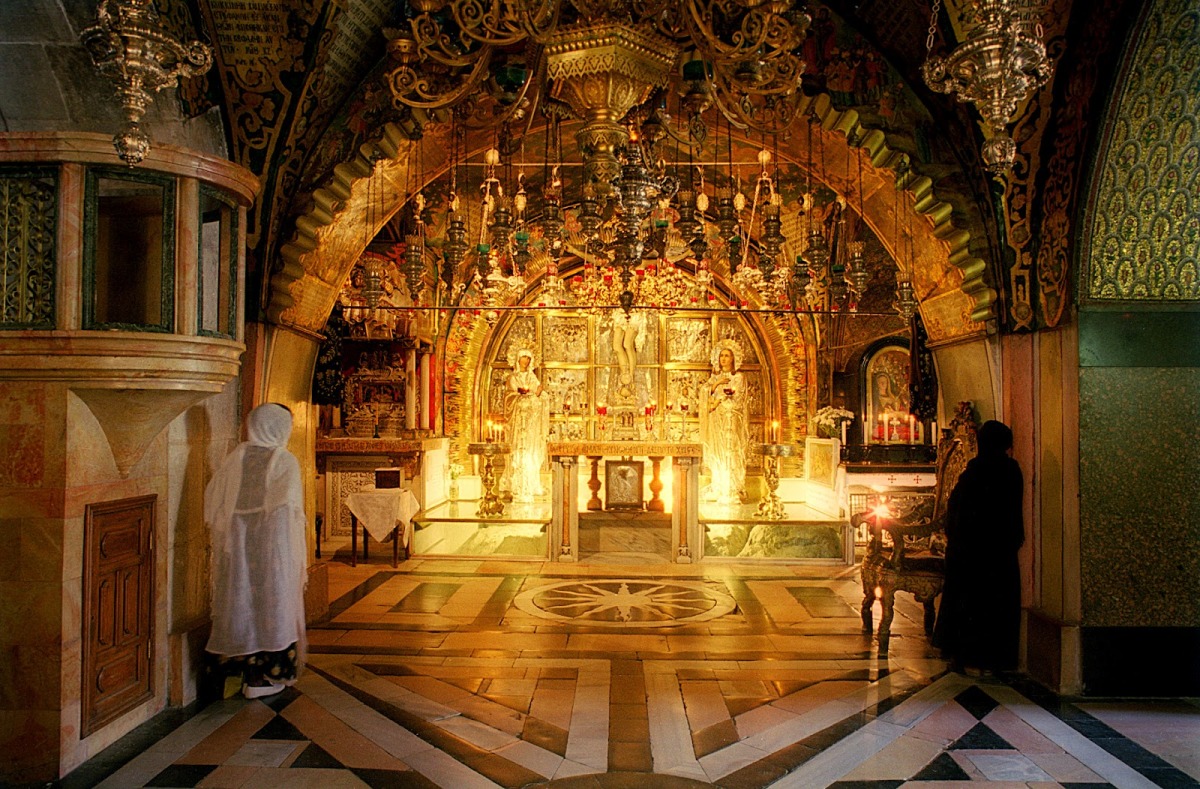
I want to tell you of an encounter I had on Golgotha, the place where Jesus was crucified. I am not speaking metaphorically here. I was in Jerusalem a couple of years ago. We were visiting the Church of the Holy Sepulcher. This is a church in the old city of Jerusalem, where the traditional site of Jesus’ crucifixion and of Jesus’ burial lie within one building. Many people, including me, don’t appreciate that Golgotha and the rich man’s tomb were so close together; but John’s gospel records that the place of crucifixion was in a garden. It was an ugly act placed in a beautiful place near the gate of the city. I expect it was to show Roman dominance.

When you enter at the ground level through the main door, the top of Golgotha (the place of the skull) is just up about the equivalent of two normal floors of a building to your right. The tomb is around a corner to your left. Our group went up to the Chapel on top of Golgotha first. The chapel is a somewhat sad story of in-fighting among the groups that control the church. There are three altars. The far right altar is Roman Catholic, the middle Orthodox, the left Arminian. We were in the middle and a group (presumably Catholic) was in the right portion of the chapel. I couldn’t help but overhear the presentation being made by the priest, who sounded American. To my shock he said, “I don’t know what eternal life is, but I think it has something to do with this Earth; we live on in the memories of people.”

I almost had a stroke. Here we are on the likely place where Jesus died and a member of the clergy suggests that eternal life is being remembered. In reflection on the statement made by the priest, I guess I assumed that everyone is clear about the nature of eternal life; and, clearly, I assumed too much. When we let worldly doubts, fears, and academic criticism get into our heads, we can believe that real existence beyond our deaths is impossible. The Jews also had a group, the Sadducees, who did not believe in the resurrection of the body. When this becomes your worldview, references to eternal life are nothing more than wishful thinking or, as the priest said, memories.

My question is, “What would Jesus’ dying on a cross 2000 years ago have anything to do with whether people remember me or not?” The answer is, “It doesn’t.” On that rock on which we stood Jesus literally suffered being forsaken by His Father. That selfless act enabled a promise of God to work. God extends to humans the opportunity to be connected to Jesus. When connected through baptism in the name of Jesus (not some other ridiculous formula), the forsakeness of Jesus becomes the fulfillment of what God’s law requires of us. Because we have not kept God’s Law, we are required to be damned (forsaken). Jesus takes that sentence for us. Having been made right with God, we can live with God in the joy and glory of Heaven (a real place and thus capitalized) and also in the New Earth (also real and as a proper noun capitalized). If you can’t tell, the failure of many books and bible translations to capitalize both Heaven and Earth when referring to the place is a pet peeve of mine.

It is also important to note here that eternal life does not just mean existence. After your death you will exist regardless of your standing with God. That is how you are made. You will actually exist, not just in memory. It is just that if you exist as a being forsaken by God, the experience will be so hopeless and horrifying that calling such an existence “life” is a gross disservice to the word. The Bible is not even thrilled with called our current existence “life”. Existence in Heaven and the New Earth is real life. Once there you will not care if people remember you. You will be having too much fun. Life after death is not some version of the Disney movie, “Coco”. Maybe that is where the priest learned his theology.

So take heart. Jesus has opened the door to life. This is not some vague concept. It is more concrete that you are now.

Grief and Christmas

As a pastor I can tell you that deaths do not happen evenly over the course of a year. Death seems to be concentrated into the colder months. At my congregation we would typically have 8 to 12 funerals a year. This year, since mid-October we have already had 9 deaths with no doubt more to come before Spring. Covid only partially explains the rise.

This reality means that many deaths happen around the holidays, leaving grief perpetually connected with a day that is supposed to be happy. The same type of association can happen with hymns. We often play a person’s favorite hymn at their funeral, which often ruins it for us. “How Great Thou Art” is a hymn that many people can’t listen to for that reason.

Having a painful association points to having an incomplete and ineffective grieving process. Remembering shouldn’t hurt after a while. If we are still hurting, then we are dwelling on what we have lost versus focusing on the promise of eternal life and a future reunion. This, of course, hinges on having eternal life through Jesus.

The Christmas season will be the source of many cherished family memories. It should be. But the Christmas season is misspent if it is focused primarily on family and not focused on Christ. Celebrating the birth of Christ is celebrating God coming into the world to give a most precious gift.

The Son of God became a human to place himself under the jurisdiction of God’s Law. He came as the child of a virgin so that he would not be born with a sinful nature like the rest of us. Instead, he could remain sinless for life. He then could do something for us that is an incredible act of sacrificial love. When dying on the cross, Jesus was forsaken by his Father as a substitute for his Father forsaking us. To be forsaken, utterly abandoned by God, is the punishment required for sin. If you are connected to Jesus through baptism, your eternal punishment is done.

If your loved one died as a believer in Jesus as their Savior, they are alive with Jesus. Do not look back, look forward. If you also are in Christ, then there are more good times, even better than the best ahead. Let the celebration of the birth of a Savior take you there, at least for awhile. Be sure to also make the most of those who are still alive and with you.

I would say the same for “How Great Thou Art”, or any hymn for that matter. It sure not remind you of loss but rather of gain. Train your brain to do this. Catch yourself when you think about the loss, remind yourself of God’s promise and then imagine what you still cannot see. Do not wallow in loss. It is not forgetting your loved one, it is remembering them properly.

Prepared for Your Death

You are in good health. Maybe you are even young. Why should you think about death? The obvious answer is that all you have to be is alive in order to die. There is no particular age or way that it comes, and you are not guaranteed that you will grow old before death. But there is a better answer for why you should consider your own mortality. That is because living like you will die someday (and you will), will cause you to truly consider the purpose of life and help you to live fully and wisely.

If it were a fact that we just die and cease to exist, then truly life would be without purpose. In that case do whatever you want and can get away with. But that is not the case. Both the Bible and Near Death Experiences around the world confirm that we go on. The Bible also confirms that life has a purpose and it is a purpose often neglected by people.

When you don’t consider your mortality, or more accurately your immortality, you tend to do mostly what pleases you. Your life is measured by the number and quality of your experiences or the accumulation of your wealth. There is a bumper sticker that reflects this default philosophy, it says, “He who dies with the most toys wins.” If that is on your car, you may want to scape it off before I see it. I will mock you.

Wealth simply passes through our fingers. We enjoy it only temporarily. Life isn’t a contest either. You don’t win anything for being the richest or having many toys. Some of the richest people in history have even concluded that dying with massive wealth was a source of shame and not honor. It certainly hasn’t done much for family dynamics as people quarrel over the estate.

Legacy is a concern of those who truly doubt the reality of eternal life. To be remembered well isn’t a bad thing, it is just not something that will enhance your existence. It is like having a great looking monument on your grave. Others will see it and not care. You won’t see it at all.

The most important quality of both life and death is to right with your Maker. Running a course independent of that chosen by God may feel like freedom but it is actually slavery to our inherent evil. If our death deposits us into the judgment of a Being we have denied and rebelled against, then nothing else matters. We are doomed. If on the other hand, we move from a life that has always been tainted into the arms of a Being that loves us and has compensated for our inherent evil, then that is the most fundamentally important thing in life. The meaning of life is connected to whatever comes next.

The good news is that God does favor the human race. We aggravate Him. We provoke Him. We do our best to write Him out of history. But God is a different kind of being. When He has decided to love someone or something, then He loves them regardless of their response. Despite ourselves, God has enacted a plan that puts a joyful, fun, social and unblemished life after death in our laps. He just has to get through our tough defenses to make it a reality for us personally. A connection to Jesus is the most valuable and indispensable asset we can have, and it is a gift that God is trying to give.

If you have a faith in Jesus as a Savior who has given Himself to die for your sins, then God has done it. He has broken through to you. Every other preparation for death is small by comparison, but there are more. The upcoming blogs will talk about how life impacts afterlife when you are connected to Jesus through faith and baptism. I hope you are curious enough to read them.