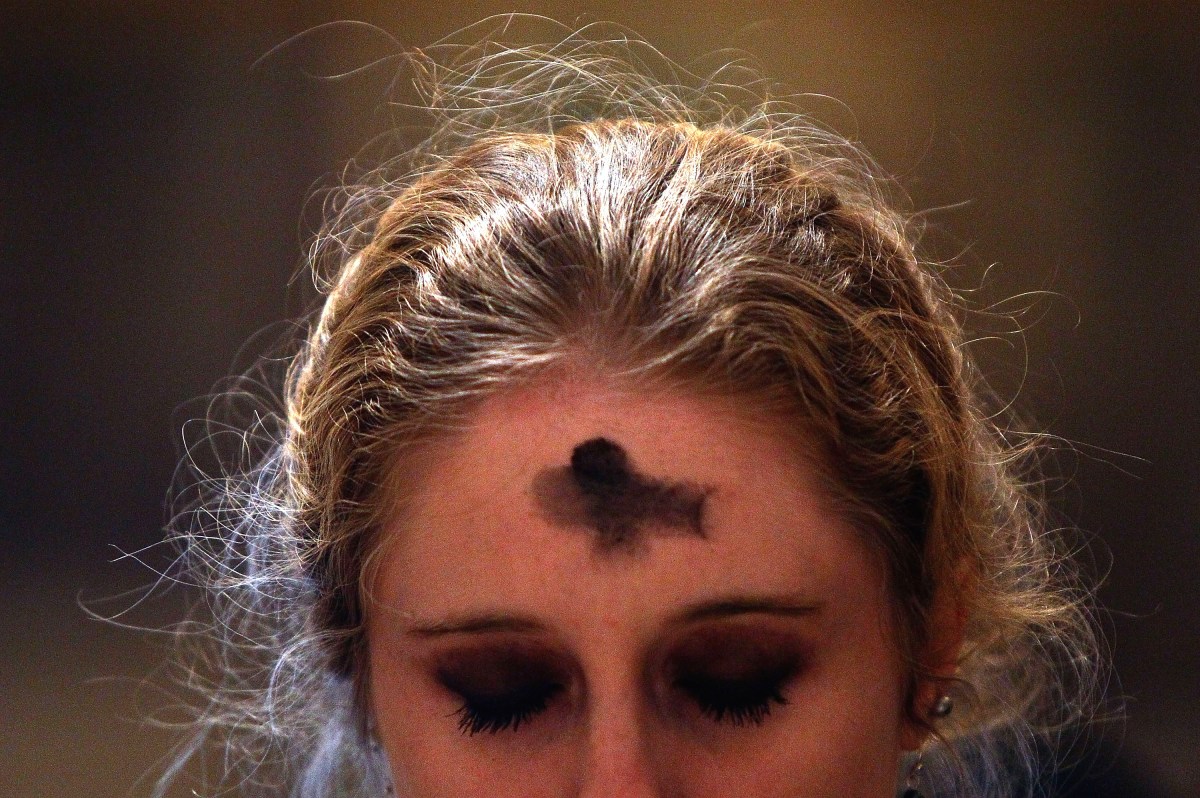
You Are Dust and to Dust You Shall Return

The title of this blog are the words we say when applying the ash cross on the forehead of a person on Ash Wednesday.  Which is today.  It is a reminder of something, of which we strangely need to be reminded:  We will die.

Death can seem to be surreal.  We re-spawn in video games.  For all the violence seen on TV, we really don’t look at death but for a moment.  It has the effect of de-sensitizing us about our mortality, more than making us aware of it.  Death happens in hospitals and nursing homes and behind police tape.  Most of us don’t see it nearly enough.

But without a doubt, we will die.  Even if we live to be very old, it will come for us faster than we ever imagined.

Remembering that we will die is important.  It forces us to confront what will come next.  If makes us consider what is the purpose of this brief life we live on Earth.  If we don’t consider that we will die, will we really live correctly?

The Ash Wednesday ritual doesn’t just speak morbid reality at us, and put a black mark on our heads.  The mark is in the shape of a cross.  Ironically, a cross was originally a form of torturous capital punishment.  But God used it to creatively fulfill an unbreakable law on the behalf of everyone who would be connected to Christ.  Jesus was forsaken so that we would not have to be.  The result is eternal life with God.

Yes.  I will die.  My body still has to die and is built to die.  But I won’t have to be exiled from the one source of all good.  More than that, my body, which will decay away, will be resurrected by the power of God.  That is His promise.  It is regrettable that death is a process I must endure.  My sin makes this so.  But Jesus Christ has created a real solution to my dilemma.  Death no longer has permanent power over me.  In fact, I kind of look forward to it.  The best part of my existence is on the other side.

Ash Wednesday is the beginning of Lent, and, yes, it is a little dark.  But it is a darkness with a very bright light that is following it.  With a black, ugly, ashen cross smeared on my forehead, I am remind and I proclaim that I am dust; but I am dust that will rise again.

If you are in the area and read this today, we invite you to our Ash Wednesday services.  At Redeemer, Evansville, they are at noon and 6pm at 1811 Lincoln Avenue.  At Redeemer, Newburgh the service will be at 6pm at 7811 Oak Grove Road, up on the hill on the south side of the road.

Resurrection? Are You Sure?

What is your expectation of life after death?  Reincarnation? A spiritual existence? A dream state? Heaven? Nothing?

What is the basis of your expectation?  Observation? Real or imagined experience? Your upbringing?  Revelation from God?

From observation you might conclude that we merely cease to exist or that we experience some sort of spiritual liberation from the body.  The ravages of what we see happen to our body, lead several world religions to  teach that escape from the body is the goal, even if it takes several cycles to achieve it.

How strange it is for God to reveal in the Bible that eternal life in a body is the goal.  Both Old and New Testaments speak of the resurrection of the body.  Many Christians don’t even have that as part of their model for eternity.  They hold to a semi-heretical view that we live in Heaven as some sort of spirit.  This is not biblical, but is an inherited worldview from other cultures.

It is hard to imagine both the how and the why of the resurrection of the body.  This is especially true if you understand that Heaven and a heavenly body will come first most likely.

God hasn’t provided the all the details, but here is what we know.  The resurrection of the body will include both those who have been forgiven and those who have not.  People who are still alive at the date of Christ’s return will be instantly changed from a living, but flawed body, to a resurrected body.  A resurrected body isn’t just a repaired version of what we have now.  Some people have been “raised” only to die again at a later date.  To this point, only Jesus has a resurrected body.  So “resurrected” isn’t the same as “reconditioned”.

For those who have been forgiven through their connection to Jesus, the resurrection and life in a new Heaven and new Earth will be the ultimate experience.  How can it be an upgrade from Heaven?  We will have to wait and see, won’t we.

The Bible gives just enough information to be intriguing.  Add to it, if you wish, the reports that come from Near Death Experiences.  The upgrade from this life, where we have pain, illness, aging, interpersonal strife and sin, to Heaven, where there is none of this, is staggering.  Can there even be a further upgrade?

God is good and God is creative, so I am confident that the answer is yes.  From the vantage point of our current ignorance, I can say that the Bible sees us as both body and soul.  Even with a heavenly body, that does not leave us “naked” (2 Corinthians 5:3), our current body is still a part of us.  It is not completely redeemed until the resurrection.

Will God use our remains to make this resurrected body?  Should we be careful about how we dispose of our remains?  The bible puts no restrictions on the disposal of dead bodies, so I think we can conclude that nothing that happens with our remains is an obstacle for God in resurrecting us.

Here is just a theory.  Our genetics produce our body.  The Bible speaks of inheriting a sinful nature from our conception.  So it follows that our genetics have been altered from what they would have been had sin never entered the equation.  Our ideal genetics are like the Word of God speaking us into existence.  They are His information coding our design.  God will “re-speak” our ideal genetics and thus resurrect the ideal us.  It may or may not include any existing material from our remains.  We may or may not resurrect where we are “laid to rest”.  But we will resurrect, and it will be great for those who belong to Jesus.

Respecting the Danger

Imagine this.  It is a beautiful night for a walk in your neighborhood.  It is dark, but in your experience your neighborhood is a safe place for an evening stroll.  But tonight, this is not the case.  Danger is waiting for you.  Would you rather know about the danger or would you prefer to believe what you want to be true is true?

It should be self-evident that if there are a bunch of villanous thugs, or rabid dogs, or a giant sinkhole that is now part of the neighborhood, we would want to know about it.  Danger is bad, but danger we are unprepared for is the worst.  Still, many people approach death with such a wishful and ignorant attitude.  We must take the walk of death someday, but we don’t want to think about it or even hear what could await us.  As a result, many will pass through death expecting something heavenly, or to be non-existent, or to reincarnate; and that won’t happen for them.  It doesn’t matter what you believe, it is what exists.

My point is that it makes sense to think about and study claims about death, because we definitely will do it, and it will prove to be the most important thing in our existence.  I am not saying I expect all to believe the Bible on this topic.  But beware of the bias caused by what you want to be true.  The Bible actually puts forward something that I definitely don’t want to be true.  Jesus says,

Enter through the narrow gate.  For wide is the gate and broad is the road that leads to destruction, and many enter through it.  But small is the gate and narrow is the road that leads to life, and only a few find it. (Matthew 7:13-14)

I would love to deny that this is true.  But I do feel that the Bible, especially Jesus, has credibility.  This comes not only from historical and archeological evidence, but also from reason and, in the end, from the Spirit of God.  This is the giant pothole in the neighborhood.  So I definitely want to be a part of the “few” and I want you to be a part of the few as well, even if I never met you.

This narrow road is Jesus.  Oddly, God would rather this not be the fact either.  God loves people, but people willfully became sinful and this matters.  God is also a being who lives by His Law.  He doesn’t compromise it.  Jesus’ incarnation, life, death and resurrection create a path by which God can both save and fulfill the requirement of the Law.  It’s the only path.

If you don’t believe this yet or don’t understand it, please fully investigate it.  Ask God for help.  Even if you are not sure there is such a being. Understanding death, what comes after it and why, is an existence defining body of knowledge.  It deserves our time and effort. Not only will we avoid a bottomless sinkhole, we will have a redefined life and death will be but the beginning of the best part of our experience.

No More “Oi!”

Perhaps you have heard the Yiddish expression “Oi Vey”.  It is an expression of  frustration that literally means, “Woe to us”.  In Isaiah 6, Isaiah has an experience of Heaven.  What kind of experience isn’t clear, even to Isaiah.  It seems like an actual field trip.  What could be cooler than a field trip to Heaven!  Isaiah probably thought that way at first until his unworthiness to be there set in.  At that point he exclaims, “Oi li!”, “Woe to me”, “for I am a man of unclean lips and I live among a people of unclean lips.”  Isaiah didn’t need a napkin at that moment.  He realized that a sinner didn’t belong with the holy, and he was a sinner because of what he had said and more.

Isaiah’s experience was both terrifying and exhilerating.  A Seraphim flys to him and touches Isaiah’s lips with a burning ember from the altar.  “See this has touched your lips, your guilt is taken away and your sin atoned for.”  From that point Isaiah felt like he belonged.  There was no more “Oi!”

As it turns out, Isaiah saw and felt all these things without actually being in Heaven.  It was a vision of some sort.  Jesus said in John 3:13, “No one has ever gone into Heaven except the one who came from Heaven–the Son of Man.”  We can add “up to this point.”  Isaiah had not gone.  Daniel had not gone. Elijah and Enoch had not gone.  To this point no Old Testament person had gone because the true atonement for sins, which is represented by the coals in the altar, is Jesus’ death and resurrection.  They all would really go when Jesus accomplished what He came for.

When we are connected to Jesus through faith and baptism, then the “coal” has already touched our lips.  We are made holy by Jesus and belong in a holy place like Heaven.

Some people have out of body experiences of Heaven.  It is hard to say for sure what they are.  Are they a vision, a field trip or something else?  It is possible that they don’t have an “Oi” experience because of Christ.  This is certainly the experience we all should wish to have upon our death.  We certainly don’t want to experience an “Oi” because we have landed in Sheol without forgiveness and without a Savior.  That need never happen because Christ came to save “the world”.  While many are called but few are chosen, it is not because God doesn’t want us.  Those who reject Jesus will have the full “Oi” experience.

Life After Death Impossible?

In an article published on the British website Express, Sean Carroll a physicist at California Institute of Technology categorically states the life after death is impossible because we are subject to the laws of physics and, of course, the laws of physics are completely understood.

Perhaps this is a misquote, but how many times in history have scientists been arrogant enough to say physics is completely understood only to find out that they really didn’t understand it at all.  If it is completely understood we should stop spending money on physics research projects.

The problem with Mr. Carroll is his devotion to a flawed philosophy–Materialism.  The belief that all that is real is measurable pervades the scientific community, but does it represent reality?  Perhaps the point of greatest contention is the understanding of our own consciousness.  Many people, including atheists, find the materialistic answer unsatisfying.

Scientists feel confident that consciousness is nothing more than the chemical reactions in our brain.  They feel this way because artificial stimulus of various parts of the brain can cause false experiences.  But this does little to show that consciousness is actually resident in the brain.  The same would be expected if the brain was merely the material interface with the conscious.

The philosophical viewpoint also diminishes Near Death Experiences (NDE) and out of body experiences as merely the fading memories of a dying brain.  This does not explain how people can experience sights and sounds while the brain is essentially shut down and the eyes are closed.  People have experienced travel outside of their bodies and accurately described surroundings without the use of their eyes.

Looking for proof one way or another about life after death using scientific methods is using the wrong tools for the job.  The hard part for science minded people is admitting that science does have its limits.  It is great for exploring the material universe but blind otherwise.  Even science posits the existence of other universes, yet can say basically nothing about them.

There are two ways to know about life after death: dying or revelation.  Dying makes it tough to change if change is needed.  God’s revelation about life after death can be trusted or not trusted. May God Himself give you insight on where to put your trust.

The Special Status of Martyrs

The word “martyr” gets in the news these days in the context of suicidal Muslim terrorists.  It is ironic that such people are called “martyrs”.  The word actually means “witness”.  What does their actions and their death say about their theology?  I hear, “God is full of hate”, “I am full of hate”, and “I will do anything to advance my selfish ambitions for the afterlife.”  Not exactly a compelling witness.

Christians have long used the word “martyr” for those who lost their lives because of their faith.  They did not commit suicide or even seek death, their lives were taken from them out of hatred for God or his message.  Their witness was “The gift of eternal life is better than this life”, and “I am not afraid to die because I trust God”.  That is a very different witness.

Martyrdom for Christians is not something isolated to the first century.  While the Romans took their share, genuine disciples of Jesus have been killed through the centuries, sometimes even by nominal Christian institutions.  Today, Christians are under the greatest threat of death in Muslim and Communist countries.

A strong theme, maybe even the main theme, of the book of Revelation is that martyrdom for the sake of Christ is well worth it.  Martyrs get special mention in Revelation 6:9-11, 12:11 and 20:4.  What do these passages teach us about this special class of people?

When he opened the fifth seal, I saw under the altar the souls of those who had be slain because of the word of God and the testimony they had maintained.  They called out in a loud voice, “How long Sovereign Lord, holy and true, until you judge the inhabitants of the earth and avenge our blood?  Then each of them was given a white robe, and they were told to wait a little longer, until the number of their fellow servants and brothers who were to be killed as they had been was completed. (Rev. 6:9-11)

This passage is important because it rules out the idea of soul sleep or that we go immediately to Judgment Day at our death.  It also lines out one of the criterion for the timing of Judgment Day–there are a preset or pre-known number of martyrs.  You might think this a strange and morbid standard, but to be a martyr is a high honor.  Those who experience this are chosen for this.  Their location “under the altar” brings to mind where the blood of the sacrifices was poured.  Only the sacrifice of Christ has merit in saving others.  But the death of the martyrs hasn’t historically deterred faith in Christ but it has counter-intuitively advanced it.  They are a sacrifice pleasing to God in the sense that they truly trusted him, and their deaths advanced the Gospel.

The gift of a “white robe” is common for all who die in Christ.  It is probably not clothing but a reference to a heavenly body that is pure.  The desire for judgment may be a surprise.  It doesn’t feel like love for your enemy.  Such judgment is just, however.  It doesn’t preclude the possibility of repentance and forgiveness.

In Revelation 12 the martyrs are honored and their praise is sung.  In Revelation 20 it speaks specifically of souls who were beheaded.  This is probably synecdoche and actually refers to all martyrs.  Here they have the honor of reigning with Christ.  What is that?  In this context, it would seem that they are part of God’s divine council, which actually participates in making decisions executable on Earth.  This honor would make sense since their lifetimes were cut short on Earth.

Is Heaven Somehow Incomplete?

Many people have a biblically naive understanding of the afterlife.  That is one of the motivations for this blog.  It is typical to believe that immediately at death you go to Heaven if you were “good” and Hell is you were “bad”.  Heaven is commonly viewed as “perfect”.  Whatever “perfect” is.  That belief is folk religion, and biblically wrong in so many ways.

Most importantly, you are not destined for Heaven or Hell based on whether you are good or bad.  To God’s standard we are all bad–all tarnished by sin.  We are saved based on whether we have forgiveness or not, and the only way to have forgiveness is to have Jesus’ sacrifice of himself apply to us personally.  Jesus died for all, but God has to also be able to connect us to Christ through faith and baptism.

Popular conceptions of Heaven and Hell are a bit muddled as well.  The Bible makes you aware that there is an intermediate state, which is essentially the time between your death and Judgment Day.  Post Judgment Day the destination of God’s people is a “New Heaven and Earth”  with resurrected physical bodies.  The post-Judgment Day destination of the unforgiven is described as:  a lake of fire, Gehenna (which evokes a picture of a burning garbage dump), and a condition of being forsaken by God.  God won’t hang around to torment you.  Rather, God will permanently forget you.  That place and condition is what I prefer to call “Hell”

So where is Heaven in all of this?  It is the current dwelling place of God and the angels.  It will persist until Judgment Day when Heaven itself will be modified.  It is the immediate destination of those who die (I don’t buy the “soul sleep” paradigm and address that in a later blog), but there are some things incomplete about Heaven and our experience of it.

Don’t get me wrong, the experience of Heaven will leave our experience of life so far in dust.  We will see God, be without sinful nature, have no exposure to Satan, possess a heavenly body and no longer experience the discomforts of the curse.  It is hard to even imagine how good all that will feel compared to current life, so it is even harder to imagine what will be lacking.  While we consciously experience Heaven, our earthly bodies will still be in some state of decay or ash, and our earthly bodies are a part of what makes us.  The final release from the consequences of sin will happen at the resurrection.

For that matter, it would seem that the same is true for Heaven, the place.  Heaven has not been perfect.  Heaven hosted Satan’s rebellion and the corruption of a large minority of angels.  Heaven has experienced war.  God isn’t just going to make a New Earth.  He is going to make a New Heaven.

If you search the internet on the topic of Heaven, you will get a wide variety of interpretations, including mine.  You will encounter quite a few who suggest that we never will see Heaven, rather we are destined only for the resurrection and the New Earth.  They are right in saying that this was the Jewish, Old Testament expectation.  They might also state that the idea of our souls inhabiting Heaven forever is a Greek idea.  I agree in part.  The folk Christian idea is heavily influenced by the Greeks.  The Bible shares God’s revelation, which is the only reliable source on this topic.  It does speak of Heaven, even a Heaven we can inhabit, but it is a temporary dwelling with something even better to follow.

Life That Is Truly Life

I have no experience beyond what we all experience as being alive:  I am self-aware, my body carries out its functions, I experience a range of sensations and emotions and so forth.  It is not all good, but it certainly isn’t all that bad either.  At present, given the choice, I would choose to remain alive.  But it doesn’t take too much imagination to image something better, and what if there are experiences that I can’t even imagine because I have no frame of reference?

Paul, who had an out of body experience, throws out an intriguing phrase in 1 Timothy 6:

As for the rich in the present age, charge them not to be haughty,, nor to set their hopes on the uncertainty of riches, but on God, who richly provides us with everything to enjoy.  They are to do good, to be rich in good works, to be generous and ready to share, thus storing up treasures for themselves as a good foundation for the future, so that they may take hold of life that is truly life.

What does God have in store for those that He saves?  Can there be a life so good that it would seem ridiculous to call our current experience “life”?  Imagine life free of pain, illness, hunger, thirst, exhaustion, boredom.  Imagine interacting with God face-to-face.  Imagine an existence with rich relationships with everyone: no conflicts, biases, loneliness or alienation.  These are just things readily imaginable.

There also can be breathtaking beauty.  Even in this world, you can see the creative genius of God and it is gorgeous.  Look into deep space and you can see God’s creative outlets, there for us to see from afar.  What beauty will surround us in Heaven and the New Earth?

The Timothy text speaks of “treasures”.  If you understand Scripture at all, you understand that we don’t deserve or earn a place with God.  We are sinners.  We deserve exile.  But the death of Jesus gives us a place with God.  It is a gift.  It is grace.  No further treasure beyond admittance should be expected, but the Bible frequently speaks of treasure and reward for faithful stewardship of what God gives us.  What could this treasure be?  Whatever it is, Jesus makes it clear that it is worth any sacrifice or suffering experienced here.

As we get closer to the end of our life on Earth, few of us are as forward thinking as we should be.  Because of our limited experience we long for the past and prefer to stay here, even if we are in pain.  The Words of the Bible try to turn us around to think about a future that is truly life.  Even the experiences of those who have had out of body experiences of Heaven affirm that the sights, sounds and feelings they had far outstrip the experiences of this life.

In length, in quality, in richness of experience, there is more.  There is life that is “truly life”, and Jesus makes it possible.

Check out my other blog, “Giving Christ”, which has many more articles about the role of Jesus and the power of God’s plan, the Gospel.Giving Christ

Suicide and Eternal Judgment

Loss of purpose, chronic pain, no hope, distorted thinking, escape, punishing somebody else, the list is lengthy.  They are the reasons why somebody can be willing to take their own life.  It happens far too much.

It is hard to truly say that you can empathize unless you have been there yourself.  The point of contemplating suicide is a lonely and desperate position.  Usually it is done with a focus on what is wrong with the world.  It doesn’t consider seriously enough what lies beyond death.

Why isn’t taking our own life our prerogative?  It is our pain.  It is our body.

Suicide leaves pain and guilt in its wake.  It is a sin against others.  As humans we are uniquely important to God and His work in the world.   Suicide does not trust God to work even through bad circumstances.  Suicide does not imagine the God-given purposes that will be left undone.  Suicide is therefore sin.

Is it an automatically damning sin?  Proponents of this view misunderstand the nature of grace.  When we are connected to Jesus through faith and baptism, the sins of our whole life are covered by the death of Jesus.  While we are commanded to confess our sins and offered ongoing forgiveness of sins, this doesn’t mean that grace is parceled out to us.  It is not necessary that the last thing we do is receive forgiveness.   Being sinners, it is highly likely that the last thing we do is sin, even if the sin is not suicide.  So suicide isn’t necessarily damning because it is the last thing you do.

Suicide may speak poorly of your connection to God.  A suicidal person may have rejected God, grace, or have fallen away, but we are not in position to judge that.  A saved person destined for Heaven could commit suicide, but at a cost.  Salvation depends on Jesus alone.  We are saved by grace.  God still does judge our deeds or the lack of them.  This is part of the Judgment Day experience.  Suicide will cost you at least part of your reward. 1 Corinthians 3:11-15 speaks of this:

For no one can lay a foundation other than that which is laid, which is Jesus Christ.  Now if anyone builds on this foundation with gold, silver, precious stones, wood, hay, straw–each one’s work will become manifest, for the Day will disclose it, because it will be revealed by fire, and fire will test what sort of work each one has done.  If the work that anyone has built on the foundation survives, he will receive a reward.  If anyone’s work is burned up, he will suffer loss, though he himself will be saved, but only as through fire.

Is it ever worth escaping current miserable conditions if it means abandoning part of what God has prepared for us to do and passing on a part of an eternal reward?  We do well to understand what our lives mean to God.  What is our purpose.  If we are alive, we still have a purpose.  Ask God to help you to identify it, if you are unsure.  Painful situations are often ripe opportunities to do the work of God.  Others don’t have to love you.  God loves you.  The best advice is to become outward rather than inward focused.  Your value is assured by a connection to Jesus.  Make every moment of life worthy of your eternal calling.


Living with an Eternal Perspective

I suspect that most people think about their future.  How far out do you think?  I am 56 years old right now.  Sometimes I think about what it will be like when I am 70 something.  My dreams are far more glorious than the reality, I am sure.  Do you ever think farther out?  I am not talking about your 80’s or 90’s.  I am talking a 1000 years out.  You don’t, do you.  Without experience, death creates this impenetrable wall.  For many people’s thoughts, our existence ends.

The Bible flatly denies that this is true.  We have an eternal existence, because we are made that way.  It will be with God or without Him.  Because God loves us and wants us, He has provided the way for our eternal existence to be eternal “life”.  An existence of joy, comfort, abundance, love, fun, relationships and knowing God.  Do you ever try to imagine it?

Paul writes in 2 Corinthians 4:17-18:

For our light and momentary troubles are achieving for us an eternal glory that far outweighs them all.  So we fix our eyes not on what is seen, but on what is unseen.  For what is seen is temporary, but what is unseen is eternal.

Eyes are for seeing, obviously.  How does one set your eyes on what is unseen?  What Paul is talking about is becoming so certain of the promises of eternal life given in the Bible that we can look forward to our own death as just a milestone and not the end of us.  We can dream about future that is real, exciting, mysterious but comforting.  Such confidence comes with time spent reading the Bible.  It comes with prayer and experience serving God.  It is empowering.

Most people have to deal with their obvious aging by living in denial.  They imagine that they will be healthier and that their physical and mental limits will expand.  This is not realistic in the long-term.  We will become more aged and limited until we die.  That is a fact.  Science may modestly delay the process, but it won’t save us from the inevitable.  Jesus has already saved us from the inevitable.  Jesus makes our death nothing more than the small part of a mandatory sentence for sin, and in effect transforms death into a glorious transition–one you can count on.

Fixing your eyes on what is unseen is not wishful thinking.  It is taking God at His word, understanding our eternal nature, and planning for a glorious eternity that is not that far off.  It does not involve forsaking the here and now.  In fact, having eternal security gives meaning to what we doing now.  We are saved by our connection to Jesus, but our actions today are doing the work of God and are rewardable in Heaven and the New Earth.

Fixing our eyes on what is unseen also gives you power to handle the difficulties of this life.  Every problem is temporary.  Every problem is an opportunity.  God can use anything for an ultimate good.  There is no need to be discouraged, because you can see beyond the current situation.

Fixing your eyes on the unseen is one of the reasons I write this blog.  It is hard to imagine what we have never seen.  So we must rely on the little bit of information that we have been given, and try to create a mental picture.  Our picture may be somewhat inaccurate and our imagination not up to the task, but that will only make our actual arrival in Heaven more breathtaking.

So look to the future–the deep future.  In Christ, you actually have one.