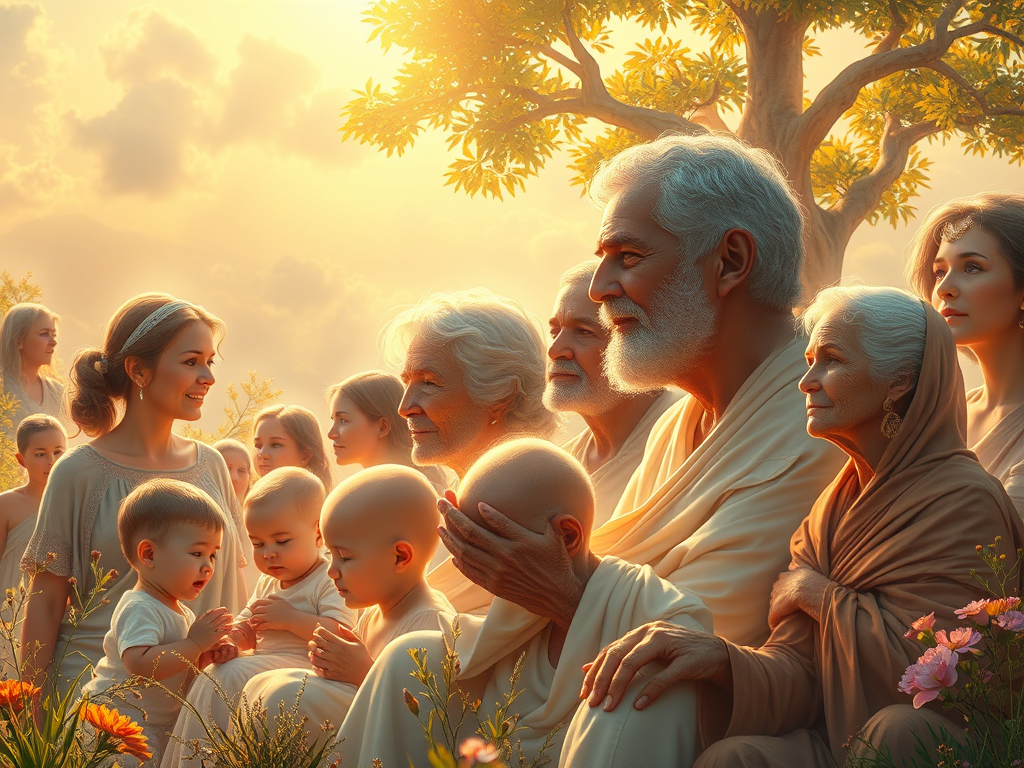

Your Eternal Self

The post explores the concept of eternity through a theological lens, comparing God to a geometric line that exists infinitely. It discusses the nature of the spirit and body, eternal life, and the implications of sin on existence. It emphasizes God’s desire to recreate believers in a form suited for eternal life.

It is admittedly hard to conceptualize what “eternal” means. We can think of a long time, but not eternal. I sometimes use a math concept to get people to understand what they are. It helps.

God is like a line in geometry. I line goes infinitely in both directions. When Moses encountered God in the burning bush, he asked for God’s name:

14 God said to Moses, “Yahweh” And he said, “Say this to the people of Israel: ‘Yahweh has sent me to you.’”

Exodus 3:14

Yahweh is a verb form of “to be” not found in English. God always was, is, and always will be, is what is means. He is the whole line. People who don’t believe in eternal life think we are a segment. A clear beginning and a clear end in death. God has made us to be a ray. We do have a beginning at our conception. We do not pre-exist this except that God knows us. But we will have no end.

Our bodies clearly have an end. The body you have is a segment. You may feel the terminal point creeping up on you right now. We are more complicated than just a body. We are for now this body, our spirit, and the interface between the two, our soul.

Having a spirit is clearly a part of being created in the image of God. It is not cognition, intelligence, emotion, or imagination. It is something not properly a part of this universe. Our spirit is coupled with this body through a mechanism that has not been revealed to us. It is probably something on a very small scale, perhaps the micro-tubules found on our neurons.

What faculties are resident in our spirit? I’m not sure. It does become hard to sort. Things like memory, reason, consciousness, even senses can all be associated with parts of the brain which belongs to the body, but that doesn’t necessarily mean they are resident there. They may just interact with the body there. People having a Near Death Experience (NDE) can have all of the above without use of the body.

One thing I can say with certainty is a part of body and not the spirit is our sinful nature. The genetic damage we have all inherited that builds our body to be unreceptive to God and inclined to sin is cooked into the flesh. That is why we need to physically die. We need to get rid of this body when it is time.

Can our spirit simply float around without a body for long? Paul suggests that this wouldn’t be desirable:

For we know that if the tent that is our earthly home is destroyed, we have a building from God, a house not made with hands, eternal in the heavens. For in this tent we groan, longing to put on our heavenly dwelling, if indeed by putting it on we may not be found naked. For while we are still in this tent, we groan, being burdened—not that we would be unclothed, but that we would be further clothed, so that what is mortal may be swallowed up by life.

2 Corinthians 5:1-4 (ESV)

Being “unclothed” in verse 4 is being a spirit without a body. You really don’t want that. You want to be “further clothed”: to get rid of your current body/tent and upgrade to a body built for Heaven (v.1). I would assume that our spirit will interface with that body either through a similar means or something completely different.

Don’t think that you are done. God is very determined not to lose in the struggle for this time-space continuum. While your body for here is damaged and will die, He wants to remake this universe and remake a body for you for this universe.

How would that work? Now we are pushing a bit into a mystery. We don’t know how that will work. At the time of Judgment Day, Christ’s visible return, and the making of a New Heaven and Earth, there will a resurrection of the dead. Will God recycle what remains of earthly bodies? Not sure. I doubt it. He will make something that is uniquely us. Do we still have the “(body) eternal in the Heavens?” I would assume from the word “eternal” used in 1 Corinthians 5:1 that the answer is “yes”. I will be a spirit connected to a body or bodies at that time and forever.

Can I mess this up? Until we get rid of our sin-damaged body the answer is “yes”. We are saved completely by God’s action. Jesus kept the Law. Jesus absorbed the eternal punishment for our sin by being forsaken on the cross. The Holy Spirit has connected us (if we are connected) to Jesus. Normally, through the process of baptism. We can throw this away. The biblically listed methods of doing this are: distorting the Gospel (Gal. 5:2-4), being unrepentant despite the pleas of the Spirit (numerous verses), neglecting God’s means of keeping our connection viable (Parable of the Sower), refusing to forgive (Lord’s Prayer/Matthew 6). After our death, there is nothing to suggest the possibility of undoing our salvation. Isaiah 65:20 is meant to be rhetorical.

Is a damned person eternal? Their resurrected body doesn’t seem to be:

“For behold, the day is coming, burning like an oven, when all the arrogant and all evildoers will be stubble. The day that is coming shall set them ablaze, says the Lord of hosts, so that it will leave them neither root nor branch. But for you who fear my name, the sun of righteousness shall rise with healing in its wings. You shall go out leaping like calves from the stall. And you shall tread down the wicked, for they will be ashes under the soles of your feet, on the day when I act, says the Lord of hosts.

Malachi 4:1-3 (ESV)

They won’t need a body for the New Earth because they won’t be staying.

46 And these will go away into eternal punishment, but the righteous into eternal life.”

Matthew 25:46 (ESV)

Will Good People Be Lost?

The text discusses challenging biblical concepts, particularly the harsh consequences of sin and the unpredictability of salvation. It highlights that both minor and major sins lead to damnation unless atoned for by Jesus. It explores divine love and justice, emphasizing God’s plan for salvation, the unique role of Jesus, and the urgency of sharing this message with others.

There are a couple of things that God reveals in the Bible that are tough to accept. One is the severity of the punishment for sin. Sin can manifest itself in people in ways that are not that destructive. Still, unless it is atoned for by Jesus minor sins are as damning as major ones, and damnation is serious and permanent.

The other difficult thing is that some fairly serious criminals can come to faith and be saved, while other nice people never do and, yes, they are lost. That doesn’t seem fair to us, but we have the wrong perspective on the situation. It is almost inherent to our being to feel that good people deserve good things and bad people deserve bad things. Other world religions fall in line with this tendency. But that is not how it always works in this situation.

If I were to add a third difficult thing to accept it would be that a God of love would accept this arrangement. To sort this out, we have to take a deep dive into the character of the being who has created all things and who is the ultimate judge of what is good and evil.

The first thing to note is that God didn’t create any being in order to damn them. He foresaw that certain individuals would rebel against His primacy and that sin and evil would be a real thing, but rather than scrap Creation God had a plan from the beginning.

For he chose us in him before the creation of the world to be holy and blameless in his sight.

Ephesians 1:4 (NIV)

The plan wasn’t for every creature. It doesn’t have a way to save or reform Satan, a cherubim/seraphim. It doesn’t have a way to save rebellious angels/demons. Their rebellion is different in a way. They choose out of a completely free will to reject God. Adam and Eve did not conceive of evil on their own. Satan deceived them. The rest of us are deeply influenced by our “sinful nature”. This is some sort of genetic abnormality created by the Tree of Knowledge of Good and Evil (Genesis 3) and passed along to everyone. Other creatures are dragged into this cycle of sin, death, and decay unwillingly.

The plan shows the primary characteristics of God, which is love and justice. He is willing to make to ultimate sacrifice to save. The Son of God becomes a human and absorbs the main penalty for sin Himself. But God doesn’t just forgive because He can. He keeps His law in tact. Jesus even asked if this could be done a different way as He prayed in the Garden of Gethsemane. The Father’s commitment to not arbitrarily change His own law led to Jesus going through with the plan.

25 God presented Christ as a sacrifice of atonement, through the shedding of his blood—to be received by faith. He did this to demonstrate his righteousness, because in his forbearance he had left the sins committed beforehand unpunished— 26 he did it to demonstrate his righteousness at the present time, so as to be just and the one who justifies those who have faith in Jesus.

Romans 3:25-26 (NIV)

He is “just” (i.e. He won’t change the Law), and the justifier (He makes a sacrifice out of love to save.)

A further statement about God’s intent is found in the most famous passage in Scripture:

16 For God so loved the world that he gave his one and only Son, that whoever believes in him shall not perish but have eternal life.17 For God did not send his Son into the world to condemn the world, but to save the world through him.

John 3:16-17 (NIV)

Because of the nature of the plan, Jesus is not an option. He is the only way to stand before God as sinless. Even very good people are sinful. We all do something contrary to God’s will every day. We are all modified physically from what we are meant to be. When we call somebody “good” or think of ourselves as “good”, we are speaking relative to others we have known or heard about. We don’t meet that criteria relative to God.

“Why do you ask me about what is good?” Jesus replied. “There is only One who is good.”

Matthew 19:17 (NIV)

Even knowing the interplay between God’s love and God’s justice, the situation of those who are not connected to Christ can be disturbing. Especially if we know them personally. It is not a bad thing to be disturbed. God is disturbed. It should move us to do what we can. We can tell people of the pertinent parts of Jesus’ story and urge them to read it if they can. We can tell of the promise and the Bible’s description of our human situation. We can even share the rational proofs for the reality of the Bible’s revelation. (Please look at my other blog: http://givingchrist.com for some of these.). We can also demonstrate the love of God through action. God must do the rest. If there is a chance of connecting them to Christ, God will do whatever He can during life and possibly beyond it until Judgement Day. But people will be lost, and some of them will be “good people”.

How Do You Thank God for Eternal Life?

Thanksgiving in the United States, established by Lincoln, is a time for family gatherings and feasting, but often lacks true reflection. The author emphasizes gratefulness for life’s blessings and the importance of recognizing their impermanence due to sin. True thankfulness arises from understanding eternal life through Jesus, which motivates a life aligned with God’s commandments.

Next week in the United States we are celebrating Thanksgiving. For many people it is time to get together with family, eat too much, maybe go to a parade and then watch football. There isn’t much thankful reflection. But the national holiday was established by Abraham Lincoln in 1863 for thankful reflection.

Because God has reached me, I have a connection to Jesus. I know that I am saved by His life and death. I currently have eternal life. That is significantly different from eternal existence that every human has. I have a place with God. I haven’t experienced Heaven, being rid of my limited and sinful body, having a heavenly body, or a resurrected earthly body yet. But I will. My lack of experience does dampen my thankfulness, however.

Can I get past my lack of experience? Here is where reflection comes in. I want to be thankful for all the good things currently in my life. There are plenty of them. I also want to acknowledge that these things are temporary and not perfect. Everything and everyone is impacted by sin and the curse. My life would be utterly meaningless without something good coming after my death. Just read the book of Ecclesiastes and see how depressed Solomon, who is a very accomplished, wealthy and wise person, feels about his life without a knowledge of eternal life through Jesus. I have knowledge of eternal life through Jesus. I am aging, but my “glory days” are all ahead of me, and they are really a big deal. Reflect on that for a bit.

You can say or sing thanks. You can go to church. We at least have a worship service on Thanksgiving. But if you would ask Jesus, “How can I thank you, Lord?” He would tell you:

15 “If you love me, you will keep my commandments.”

John 14:15 (ESV)

There are many motivations to do what God teaches us is good and right. Love of God and thankfulness rise to the top. Don’t limit this to Thanksgiving Day. It deserves better. Thank God with your life.

Do keep in mind, that keeping God’s commandments can no longer save you. You had to do it perfectly, and ship sailed for you long ago. Now you have a different motivation. Jesus did the heavy lifting that you could not do. You can respond thankfully.

We really don’t appreciate the scope of what has been done for us. We don’t grasp the difficulty of what Jesus did. We don’t understand the depth of horror that awaits those who go to Judgment Day without the forgiveness of their sins. We don’t understand how great eternal life without sinful nature, without the curse, in the vast creativeness and beauty of what God has prepared for us. And we don’t fully appreciate how enthralling it will be to see God face-to-face. Yet, for the little we can imagine, we have plenty of reason to be happy and thankful.

If you don’t know much about what comes next for those who belong to Christ, then explore the articles of this blog. Use the search bar and look for Heaven, the New Earth, and then look at other things in the topic column.

Have a great Thanksgiving.

God’s Declaration In Isaiah 66

The content discusses the prophetic insights of Isaiah, emphasizing accurate predictions concerning Jesus and His significance beyond Israel. It highlights themes of eternal life and the New Earth, expressing God’s promise to reach all nations. The conclusion warns of the consequences for those rejecting Jesus, presenting a stark contrast to the hope provided in faith.

Looks into the future within the Old Testament are common. That is what prophecy is. We are living far enough in the future from the time of Isaiah that almost everything in it we can examine through hindsight. Almost.

Isaiah had warnings for the people of Israel and for the surrounding nations. It has all come true to my knowledge. It is so accurate that skeptics conclude that Isaiah had to be written after the fact, but there is no proof of this. Isaiah also spoke a lot about the coming of Jesus: virgin birth, living in Galilee, heir of David, widely rejected by the Jews, put through a judgment process where He did not defend himself, crucified for the salvation of others, and buried with the rich. They would be impossible or undesirable events to stage.

Toward the end of Isaiah there is a large and confusing section about the New Earth which is still future even to us. Check out my take on this section here: https://afterdeathsite.com/2022/05/24/wrestling-with-isaiah-65/

Then there are the final verses of the last chapter. It speaks about some stuff that is in our rear-view mirror and some that is not. It starts like this:

18 “For I know their works and their thoughts, and the time is coming to gather all nations and tongues. And they shall come and shall see my glory, 19 and I will set a sign among them. And from them I will send survivors to the nations, to Tarshish, Pul, and Lud, who draw the bow, to Tubal and Javan, to the coastlands far away, that have not heard my fame or seen my glory. And they shall declare my glory among the nations.

Isaiah 66:18-19 (ESV)

It is intriguing (to me) to ponder what constituted the right time to send Jesus to fulfill the Law and create an opening for people to have eternal life with God starting with Heaven and then later adding the New Earth. With this event comes a spreading out of knowledge about the God who encountered Israel for millennia, the events around Jesus’ life, and the promise of eternal life. God didn’t keep His promise within the borders of a chosen people. He opened the doors to everyone starting most likely 33AD. His description of “the nations” is strange to us, but must have been well known to the contemporaries of Isaiah. “They” in verse 19 must be the early disciples. The communication of God’s actions and the promise of eternal life continues with the disciples of Jesus today all around the world.

20 And they shall bring all your brothers from all the nations as an offering to the Lord, on horses and in chariots and in litters and on mules and on dromedaries, to my holy mountain Jerusalem, says the Lord, just as the Israelites bring their grain offering in a clean vessel to the house of the Lord. 21 And some of them also I will take for priests and for Levites, says the Lord.

Isaiah 66:20-21 (ESV)

Not only was it surprise to hear that God would reach out to other nations, but an even bigger surprise that some of them would be used like the priests and Levites. This chosen group served in the temple as their sole occupation. They were chosen because of the faithfulness of one clan during the Exodus. In the future this would be opened up. I am such a person.

Another surprise is that these saved foreigners would be “your brothers”. This is not a promise to gather the dispersed Jewish people but rather to gather the elect from every nation. These are people whom God can foresee that He will be able to reach. Not everyone will embrace the promise of Jesus. This is sadly observable. Why? I’m not sure the cause or causes. But some will.

The weird modes of transportation are interesting too. I have never brought somebody to church on a dromedary. But this isn’t transportation to a place exactly. This is being involved in diverse ways in people’s lives so that they are connected to Jesus and when we all move past Judgment Day and to the New Jerusalem (Revelation 21-22), we will be like a grain offering that makes God very happy. The New Jerusalem is a place. We just help bring people to Jesus.

“For as the new heavens and the new earth
    that I make
shall remain before me, says the Lord,
    so shall your offspring and your name remain.
23 From new moon to new moon,
    and from Sabbath to Sabbath,
all flesh shall come to worship before me,
declares the Lord.

Isaiah 66:22-23 (ESV)

Eternal life with God is just that–eternal. That is the consistent message of the rest of Scripture. This passage speaks of the permanence of the New Heavens and New Earth, the offspring of the people of faith within Israel, and their name. Part of our experience in Heaven and the New Earth will be worship. Don’t relate that to times you were bored in church. It is also notable that it is “all flesh”. Humans aren’t complete as a disembodied spirit. Paul calls that being “naked” (2 Corinthians 5). We will have a Heavenly Body and a resurrected Earthly body. Worship will be an immersive and positive experience. Everyone will do it. Everyone who is saved that is.

24 “And they shall go out and look on the dead bodies of the men who have rebelled against me. For their worm shall not die, their fire shall not be quenched, and they shall be an abhorrence to all flesh.”

I don’t think that we will make it a part of our eternal routine to observe “dead bodies”. The Bible says that everybody (saved and not) will be a part of the resurrection of our earthly bodies. While this may seem like an amazing and hopeful moment, those who stand judgment bearing their own sin rather than the righteousness we receive from Jesus will find their resurrected bodies are not indestructible. Malachi 4 speaks about them being turned to ash. That will be observable on Judgment Day, probably not after it.

The spirit of a damned person then experiences the ultimate consequence for sin that was completely avoidable. By rejecting Jesus they allowed themselves to bear the full consequence of the Law. They will experience an unending decay (the worm does not die), a fire that is never quenched, be abhorrent to themselves and others, and forsaken by God.

For my part, I wish this ended at verse 23. I can’t deny verse 24 and others like it. Jesus says many will enter destruct and few into life. I hope those relative terms do not mean like they sound. It sure sounds like the majority will experience verse 24.

Declining to Our Physical Departure

Aging can bring physical decline and loss, leading to a struggle with self-identity and health. Yet, faith in God provides hope. Through Jesus Christ, believers can embrace eternal life beyond death. This perspective encourages acceptance of life’s purposes, focusing on the glory promised in Heaven, making the aging process less daunting.

Nobody likes aging. It doesn’t hit you that this is your problem until usually your 30’s (a little) and with every decade that passes it gets worse. When our physical decline results in actual loss, we struggle to cope. It seems that suddenly we cannot eat like we used to without consequence. We used to be so attractive and now we are attractive “for our age”, which is often the same as not attractive. Eventually we cannot run without pain. We forget stuff. We can’t sleep or we sleep all the time. We are no longer competent to drive. We are no longer safe to live independently. It is a dark decline.

I would like to give you a little perspective that I hope helps. We are created to be eternal creatures. Our bodies age, decline and die; but that is because of “sin”. I’m not saying that we would necessarily live longer or healthier if we behaved better. I am saying that we are all genetically altered from the way God originally created human beings. The result is that our current bodies must die. This would create a hopeless situation for us if not for the fact that God wants us to have eternal life with Him, and has done something about it.

Jesus Christ is God’s Son who became human for a very specific purpose. He kept God’s Law perfectly, which is what God requires for people who would be with Him eternally. He also absorbed the worst consequence of sin on the cross. He was forsaken by His father, which would be our fate. Now we can be “connected” to Jesus through God creating faith in us and Jesus “baptizing us into His death”. That phrase means that God creates some sort of “supernatural” connection to us where Jesus’ life and Jesus’ death are ours. When we are “in Christ” the only thing left for us to do is to go through physical death. The rest of the way to a glorious, happy, eternal existence has been given as a gift from Jesus.

With that as a backdrop, declining toward death shouldn’t have to be so bad. Yes, it still hurts. Yes, you feel loss. But you are heading toward something great. This impacts certain decisions and attitudes.

First, if you are facing any challenge, especially a medical challenge, you can tell yourself that it is only temporary and if it ends in death, you will actually gain from it.

You don’t have to insist that the medical community do everything possible to keep you alive. Your goal is to naturally die. Their efforts would probably only give you an extended painful, useless, modest extension on this life. You don’t even want that.

Rather than be always looking back at the “good old days”, you can be forward thinking toward the glory of what God has prepared for you in Heaven and ultimately also a New Earth.

You can understand your purpose in life as something that is dynamic but always God-given. When you retire, you move from one purpose to another that is God-given. As you lose independence, you may lose one purpose but acquire another. Life is for accomplishing whatever God has prepared for you and then you get to experience real life.

This is hard to embrace, but when you study what God has promised us you develop a genuine excitement for it. That is what this blog is all about. My life matters, my aging and decline matters, and my passing away matters. I am heading toward an increasing glory.

16 So we do not lose heart. Though our outer self is wasting away, our inner self is being renewed day by day. 17 For this light momentary affliction is preparing for us an eternal weight of glory beyond all comparison, 18 as we look not to the things that are seen but to the things that are unseen. For the things that are seen are transient, but the things that are unseen are eternal.

For we know that if the tent that is our earthly home is destroyed, we have a building from God, a house not made with hands, eternal in the heavens.

2 Corinthians 4:16-5:1 (ESV)

Accepting the Reality of Eternal Existence

For some there is no doubt. At least verbally. We will go on beyond our death. These people tend to error on the side of thinking everybody has something good waiting for them. For others, there is a great deal of doubt. We usually don’t get a preview. People who have a Near Death Experience are almost all in on eternal life. The rest of us just see the impact of death on our flesh, and it is sobering.

Certainty that we die and then disappear, is equally hard to maintain. Many are very bold about it until death looms near. Then they are not quite as enthusiastic about the prospect and begin to hope for more.

Certainty is not the same thing as faith. Faith is several things. It is first a Holy Spirit bypass of whatever keeps us from being receptive to God because of our sinful condition. Then it is a God-produced connection between us and Christ. Then that connection produces a growing trust in all of God’s promises, His capabilities, and His character. It also generates certainty in the reality of eternal life and what will happen to you in your eternal existence.

The power of God’s Word is a driving force in having certainty in eternal life.

“Let not your hearts be troubled. Believe in God; believe also in me. In my Father’s house are many rooms. If it were not so, would I have told you that I go to prepare a place for you?

John 14:1-2 (ESV)

Who has reliable information on this topic? Even Near Death Experiences could be an illusion of a dying brain or a delusion created by Satan. Jesus raised people from the dead, was raised from the dead himself, and demonstrated that He was God through clear and observable miracles. Furthermore, His character was on display for all around him. For us, it is the power of the Word with the in-person accounts that give us the ability to “believe” in both Father and Son in this regard.

God could have created us to live and to die and be gone. He has nothing to gain by lying to us about this fact of our nature. Jesus says in the above passage that He would have told us if eternal life in Heaven was not on the table. It is on the table. That is why Jesus became one of us in the first place.

Our certainty comes with understanding the Gospel and God developing in us a deeper faith through the Word. First, it is our nature to be eternal because we are more than a body. We are a body and soul. I think that you can experience this much. Minimizing our will, memory, all conscious thought to chemical reactions in the brain, does not make sense. If our thoughts were just the product of brain chemistry and electrical activity then we would have no will. We clearly have a will. We are not “meat robots”. That is wrong.

It does take revelation from outside of ourselves to know about things that are beyond our sensory capabilities, beyond death, and probably beyond our space-time. Does the account of Jesus and the revelation that comes with Jesus have any credibility? Seek out the arguments. They are hard to dismiss unless you have a bias and want to dismiss them. God tells us what comes next. This whole blog covers it. There is eternal life (eternal existence with God) and eternal death (not non-existence but exile from God as in Hell). Eternal life is God’s gift predicated on what Jesus has already accomplished . God has proven to be trustworthy.

The only qualification to the certainty that we can have is that people can fall away. I must respect the theoretical possibility that I will abandon God’s gift. God gives plenty resources enough to never fall away, but people still manage it. I don’t doubt because I know that God is enough. When actually facing my final hour, there is no need to look at myself and ask if I have done enough. Jesus is enough. I don’t do anything. Therefore I am certain.

Angels and Demons

The text explores the nature of angels and demons, clarifying misconceptions about their existence and origins. It discusses how demons may be corrupted angels, influenced by Satan, while angels are distinct beings not derived from deceased humans. Both entities impact human life, with scripture referencing their roles in spiritual warfare and personal experiences of possession and intervention.

Most people, even if they are biblically illiterate, have heard of angels and Demons. They are known in other world religions as well, which is interesting. They are encountered by humans both in modern times, New Testament times, and ancient times. Are they real? And if so, what are they?

First, let’s say what they are not. Demons are not an ignorant understanding of mental illness. Mental illness is dysfunction of the brain. It can happen for a variety of reasons from genetics to trauma. I would not doubt that some trauma could be inflicted from spiritual (i.e. demonic) source, however. Angels, on the other hand, are not dead people. You do not die and become an Angel. Though the term, “angelus”, just means messenger, it is a term that is usually used to describe a certain species of being normally resident in Heaven. Angels are also not “Seraphim or Cherubim (in English: “burning ones” or “living ones”). These are synonyms for something of even higher capability than Angels.

It would appear that Demons are/were Angels. The information that we have is cryptic, but it appears that Satan (a Cherubim) managed to corrupt a large minority of Angels and turn them against God. Unlike humans where Satan was able to genetically corrupt the first set (Adam and Eve) and therefore corrupt every one of us, only a portion of Angels are corrupted. Perhaps this is because they don’t replicate, or that there were many Angels before Satan got to them.

What happened to Demons? This is very sketchy. Satan seems to have been able to hang on to residence in Heaven until Jesus’ victory on the cross. Nothing is said about Demons in this regard, except in Jude it says this:

And the angels who did not stay within their own position of authority, but left their proper dwelling, he has kept in eternal chains under gloomy darkness until the judgment of the great day—

Jude 6 (ESV)

From this passage we learn that Judgment Day isn’t just for people. Angels and Satan will receive their final disposition on that day as well. This passage can’t be about all fallen Angels, because many are shown creating problems on Earth. How is the timing of Jude 6 connected to this passage?

Now war arose in heaven, Michael and his angels fighting against the dragon. And the dragon and his angels fought back, but he was defeated, and there was no longer any place for them in Heaven. And the great dragon was thrown down, that ancient serpent, who is called the devil and Satan, the deceiver of the whole world—he was thrown down to the Earth, and his Angels were thrown down with him.

Revelation 12:7-9 (ESV)

Maybe these events are disconnected, maybe not. In the end, it would appear that we have both Angels and Demons among us. How do they contribute to our situations both positively and negatively?

On a personal level, the Bible records instances of demonic possession. There could also be lesser ways that a demon could affect a person. The most famous being the possession that inspired the book, “The Exorcist”. The Washington Post just happened to document this story back in the 1950’s. In that story the window that allowed the Demon to take hold was the dabbling in occultic practices by a “spiritualist” aunt and a boy’s use of a Ouija board to try to communicate to her after she died. I am not certain why and what occultic practices make this possible. They were also behind the scenes in all of the possessions encountered by Jesus. Pagan people lived very near or in Israel. People dabbled in these things and paid a price.

On a positive note, both the Bible and personal experiences account for angelic intervention. The most common being a helper that should not be there who assists someone in desperate need and then disappears.

There is also some interesting stuff about Angels and Demons at the national level, but I would like to briefly address our interaction with them after our death. First, Angels do not have wings and neither will you. My piece of art above in generated by AI. I cannot convince the “AI” that Angels do not have wings since there is so much garbage on the internet that shows that they do. This idea is an addition mostly from Renaissance artists. Cherubim do have wings. Angels will be a regular part of our existence in Heaven. Much like humans, they will seem like neighbors.

Demons will not be in Sheol, they will either remain on Earth or be contained in someplace called “the Abyss” until Judgment Day. After Judgment Day they will not be tormenting people in Hell. They will be suffering as well.

Do Humans Have a Body in Hell and Sheol?

I bet you were lying in bed wondering about this very question. I grant you that it is an obscure issue for which we have little information but it is a parallel to the important issue of whether we have a body in Heaven (to which I say yes), and it connects to same verse in Scripture, which is 2 Corinthians 5:1f.

For we know that if the tent that is our earthly home is destroyed, we have a building from God, a house not made with hands, eternal in the heavens. For in this tent we groan, longing to put on our heavenly dwelling, if indeed by putting it on we may not be found naked. For while we are still in this tent, we groan, being burdened—not that we would be unclothed, but that we would be further clothed, so that what is mortal may be swallowed up by life.

2 Corinthians 5:1-4(ESV)

Our body that we have during this life is a “tent”. It houses our spirit, but it is a legitimate part of what we are. That is why there is a resurrection of the body. Paul says that we do not wish to be “unclothed”, which means without a body. Can such a situation even exist?

The Bible does not say where Heaven, Sheol, or the final Lake of Fire actually are. The ancients conceived of Sheol as the center of the Earth, and Heaven as being outside the furthest reach of the universe; but that does not make it so. Recent work in theoretical physics uses the concept of other dimensions. Albeit these dimensions are not observable because they are very small. There is no constraining reason why they must be small. What if they are unobservable just because we are constrained to live and observe in only three spatial dimensions. What if other dimensions do exist, explaining some of the odd behavior of gravity and quantum physics, but actually define the space of parallel universes. These universes would not have to be in lock-step with ours because they are only connected at the quantum level. This could define the space of Heaven, Sheol, the Abyss, and possibly Hell.

Going with this very unprovable theory, that would be why an “earthly” body is Earthly. It only can move in the dimensions of this space-time. And why a “heavenly” is Heavenly. It moves in Heaven’s dimensions. Could Sheol be its own space-time with a Sheol appropriate body. Not sure of the adjective for that one.

Descriptions of Sheol (please use the Search box if you are not familiar with this term to find posts about it) seem very physical. For example the rich man in Luke 16:

23 and in Hades (same as Sheol), being in torment, he lifted up his eyes and saw Abraham far off and Lazarus at his side. 24 And he called out, ‘Father Abraham, have mercy on me, and send Lazarus to dip the end of his finger in water and cool my tongue, for I am in anguish in this flame.’

Luke 16:23-24 (ESV)

Flame, water, cool, tongue all seem very physical. This would also connect to the general resurrection of the dead. The damned would need an earthly body to stand before God at Judgment Day on Earth. It would also connect to the destruction of those Earthly bodies:

“For behold, the day is coming, burning like an oven, when all the arrogant and all evildoers will be stubble. The day that is coming shall set them ablaze, says the Lord of hosts, so that it will leave them neither root nor branch. But for you who fear my name, the sun of righteousness shall rise with healing in its wings. You shall go out leaping like calves from the stall. And you shall tread down the wicked, for they will be ashes under the soles of your feet, on the day when I act, says the Lord of hosts.

Malachi 4:1-3 (ESV)

They won’t be needing those bodies where they are going next. Is the final Lake of Fire (i.e. Gehenna or Hell) also a “bodily experience”? Maybe it is not even connected to our multi-dimensional reality. Maybe “forsakeness” means total disconnection from creation? I think that is an interesting and disturbing thought.

One final thought. Paul speaks about being “unclothed”. The spirit of Samuel is “raised up” from the good neighborhood of Sheol by the Witch of Endor (1 Samuel 28:13-15). He seems “unclothed” in the bodily sense. He appears “wrapped in a robe”. What about ghosts? I don’t know how they would fit in the model given us by Scripture. Are they figments of a person’s imagination? Are they demonic? Are they people “brought up” from Sheol and left here? Are they just part of a tired sit-com (I prefer the British version)? The disciples thought they were seeing a ghost when Jesus came to them walking on the water. From where did such an idea come? I don’t know.

Again, most of this post is unproveable and unstated by Scripture verbatim. But it does make sense to me. I hope you find it thought provoking and may be only find through experience about the Heavenly body and your Resurrected body.

How Will We Be Like Him?

The author contemplates the transformative experience of Heaven and the New Earth, focusing on how believers will resemble Christ in character and have new, indestructible bodies free from sin. They explore the uniqueness of individual personalities, potential cognitive abilities, recognition, and the non-divisive nature of gender and race in the afterlife.

I think that it is exciting to think about what I will be like in Heaven and the New Earth. It is not just our environment that will change, but we will be changed. The classic teaser passage about this is 1 John 3:2,

Beloved, we are God’s children now, and what we will be has not yet appeared; but we know that when he appears we shall be like him, because we shall see him as he is.

1 John 3:2 (ESV)

My question for this article is, “How will we be like Him”? Jesus is the incarnate Son of God. He became human and all indications is that He remains human to this day. I am human and when I pass I will remain human. I will not become an Angel. Angels are a separate yet similar species. I will be a human with a heavenly body (2 Corinthians 5:1). That will be a body very different than I one I now have. It will not have the genes or the structures formed by sinful nature. That is a big plus. It will be a body formed to exist in the dimensional space of Heaven and not this universe. That may not be noticeable to me. What else?

When Jesus rose from the dead, He had a resurrected, human body and also was the incarnation of the Son of God. I am not sure that I will have the same properties when I have a resurrected body that is built for this universe. What can we say about our heavenly body and our resurrected earthly body or just “our self” after death in Christ?

Our character will be like Christ, not just “sort of” like Christ as we are now? I will have all of the fruit of the Spirit to the full:

22 But the fruit of the Spirit is love, joy, peace, patience, kindness, goodness, faithfulness, 23 gentleness, self-control; against such things there is no law.

Galatians 5:22-23 (ESV)

Beyond this there are many other personality qualities listed in the New Testament. These won’t make us into personality clones of each other. We will just be great people. I expect that we will retain certain personality traits that make us unique now–positive ones.

My body(ies) will be indestructible and eternal. No more sickness, aging, or death. I’m looking forward to that. Anything else? The rest is strictly hypothetical.

1 Corinthians 15:42-44 speaks about the resurrected body, not necessarily the heavenly body:

42 So is it with the resurrection of the dead. What is sown is perishable; what is raised is imperishable. 43 It is sown in dishonor; it is raised in glory. It is sown in weakness; it is raised in power. 44 It is sown a natural body; it is raised a spiritual body. If there is a natural body, there is also a spiritual body.

1 Corinthians 15:42-44(ESV)

I’m going to say “glory” in verse 43 means in part “beautiful”. Most of us will not leave pretty corpses. Some of have been unattractive even as babies. It will be equal, yet diverse, forms of beautiful. How will we know each other then? If you die looking awful. Will you be unrecognizable? I hypothesize that we will have a gift of recognition not based on seeing faces. This would be great for those who are currently “face blind”. Peter, James and John knew Moses and Elijah at the Transfiguration. We are not told of introductions or name tags.

The quote above uses “powerful”. I expect both bodies to be “powerful”. But with what powers? No fatigue? Able to move fast? Able to lift heavy stuff? I am not really sure what “powerful” all entails. But we will in no way be feeble.

Will we retain gender or race? God desires people from every nation and Revelation 7 says:

After this I looked, and behold, a great multitude that no one could number, from every nation, from all tribes and peoples and languages, standing before the throne and before the Lamb, clothed in white robes, with palm branches in their hands,

Revelation 7:9 (ESV)

I expect that the answer is yes, but it will in no way be divisive or diminishing.

What about cognitive abilities? Not sure. Muscle memory and athleticism? Exciting to think about, but I don’t know. Abilities that have no analog with our abilities now? I sure hope so. The resurrected Jesus seems to either blind people’s recognition abilities or to be a shape-shifter. That may be a God quality. Might we able to present as a child, adult, or good-looking senior? It’s an intriguing idea.

There is much to look forward to when you are connected to Christ and have God’s grace covering you.

Purpose In the Kingdom of God

The content explores the concept of purpose in life and after death, emphasizing the importance of serving God and others. While earthly pleasures may seem fulfilling, true satisfaction comes from meaningful engagement. It highlights biblical passages about eternal life, suggesting that purpose exists beyond rest, with joyful, fulfilling activities in Heaven and the New Earth.

What would you do if money and health were not issues? If you had no other purpose than to enjoy yourself, would you be happy? I think I would be for awhile. I would travel, golf, hangout with my kids and grandkids, hike, explore, ski, and much more. Many people think of retirement like that, only to be disappointed by restrictions and a nagging need for purpose.

As a person who is already a part of the Kingdom of God. There is an enormous amount of purpose to be had. We glorify God through doing a great job at our job. We are to show kindness and forgiveness to others. We are to be good stewards of time, money, skills, our body, our planet, our knowledge of Scripture, our relationships and more. We are to make disciples. We are to counteract evil. If you can’t find something to do as a disciple of Jesus, you are not looking hard enough.

But what about after death? Eternity is a long time. Will we be able to experience new things and enjoy fun things we already enjoy? I expect so. Will there be purpose? While there is never enough information about our existence in Heaven and the New Earth for my taste, there actually is more about purpose than there is about entertainment.

But let’s start with this passage:

13 And I heard a voice from heaven saying, “Write this: Blessed are the dead who die in the Lord from now on.” “Blessed indeed,” says the Spirit, “that they may rest from their labors, for their deeds follow them!”

Revelation 14:13 (ESV)

This passage has unintentionally put into people’s minds that eternal life is a bunch of naps. “Resting from labors” is not sitting around. It is no longer experiencing the physical drag of work. When I have something to do, even something I will enjoy, there is a part of me that doesn’t want to do it. My body doesn’t want to give up the energy. That experience will be done. Nothing will be laborious. There will be purposeful, comforting, exhilarating, entertaining, loving, bonding, but not laborious.

I am not sure about the experience of being damned. The Bible speaks of fire and decay(worms). Jesus’ experience speaks of being abandoned by God and hopelessness. I would expect purposelessness and maybe laborious activity.

Can we know anything more specific about the purpose of the redeemed?

“Therefore they are before the throne of God,
    and serve him day and night in his temple;
    and he who sits on the throne will shelter them with his presence.

Revelation 7:15 (ESV)

This is still rather vague. What type of “service” does God need? Honestly nothing. But just as we are allowed to be a part of God’s work here, we are also allowed to be in the direct presence of God and with purpose. Don’t read into this that direct worship is all that we do. Also, don’t pull into it visions of working a night shift here. This service is fundamentally different.

Another purpose section comes from Isaiah 65. Isaiah 65 is a hard passage to interpret in light of other Scriptures. See a bigger discussion here: https://afterdeathsite.com/2022/05/24/wrestling-with-isaiah-65/ But Isaiah, speaking of the New Earth, includes a number of familiar functions.

They shall build houses and inhabit them;
    they shall plant vineyards and eat their fruit.
22 They shall not build and another inhabit;
    they shall not plant and another eat;
for like the days of a tree shall the days of my people be,
    and my chosen shall long enjoy the work of their hands.
23 They shall not labor in vain
    or bear children for calamity,
for they shall be the offspring of the blessed of the Lord,
    and their descendants with them.

Isaiah 65:21-23 (ESV)

This section is about the New Earth. It says so. Will we build and plant and have kids? Looking at other Scriptures, I can say that our days won’t be limited like a tree. We have eternal life. Will we go through cycles or does Isaiah 65 just compare the sorrows of current life to the absence of sorrows in the New Earth? It is hard to say, but I would not count out any of the purposes listed here.

Obviously, there is much we have left to discover about life in Heaven and the New Earth. It will be an experience that is “truly life”, and that includes purpose. Probably it includes familiar things and things that we have never imagined. None of it will be laborious. It will be joy.