Is There Such a Thing as Purgatory?

This article examine the origin of the doctrine of Purgatory, which is unique to the Roman Catholic Church. It looks at Scriptural, Apocryphal, and human reason and understanding. It also examines the question of where sin resides in our being.

Yes. But we call it “seminary”. That is just a joke. The doctrine of purgatory, which is unique to the Roman Catholic Church is no joke. I think it is somewhat dangerous. But let’s look at the origin, andthe proof, which is very thin.

The idea is that there is a place and a period in your existence where you have been saved by the grace of Christ but to reach your Heavenly state of perfection you have to go through some suffering in purgatory. How long this will take varies from person to person. It is also something that might be shortened based on the actions of others on your behalf. It is not punishment, per se, it is more polishing.

The doctrine of purgatory does not arrive on the scene until the 12th century. It doesn’t get endorsement until the 13th at the Council of Lyon (1274AD). That is long ago, but awfully late. Could the Holy Spirit wait to reveal a truth until nearly 1300 years after Christ. Sure. Is that what happened? I personally doubt it.

The source of this teaching comes from two things that are owned by the Roman Catholic Church, a likely third thing, and I expect a dangerous fourth.

First, this:

11 For no one can lay a foundation other than that which is laid, which is Jesus Christ. 12 Now if anyone builds on the foundation with gold, silver, precious stones, wood, hay, straw— 13 each one’s work will become manifest, for the Day will disclose it, because it will be revealed by fire, and the fire will test what sort of work each one has done. 14 If the work that anyone has built on the foundation survives, he will receive a reward. 15 If anyone’s work is burned up, he will suffer loss, though he himself will be saved, but only as through fire.

1 Corinthians 3:11-15 (ESV)

I love quoting this verse. They see this event as something that happens immediately upon death. I would argue that this is our Judgment Day experience. Judgment Day is described in a couple of places as a judgment of our works, and here you have detail. The fire is a way of revealing our acts and motives. It is not a means of purging our sinful acts and motives. Consider the end of this one:

10 But the day of the Lord will come like a thief, and then the heavens will pass away with a roar, and the heavenly bodies will be burned up and dissolved, and the earth and the works that are done on it will be exposed.

2 Peter 3:10 (ESV)

This is clearly of Judgment Day description with the “works that are done on it” being exposed. That is what 1 Corinthians 3:13 is describing. The person whose works are “burned up” is still saved. Why? Because we are saved by Jesus, not our works. We are rewarded for our works.

One other thing gets dragged into the reasoning for the teaching of Purgatory, and it is from a source that wasn’t even considered Scripture in the 13th century.

43 And making a gathering, he sent twelve thousand drachms of silver to Jerusalem for sacrifice to be offered for the sins of the dead, thinking well and religiously concerning the resurrection,44 (For if he had not hoped that they that were slain should rise again, it would have seemed superfluous and vain to pray for the dead,)45 And because he considered that they who had fallen asleep with godliness, had great grace laid up for them.

46 It is therefore a holy and wholesome thought to pray for the dead, that they may be loosed from sins.

2 Maccabees 12:43-46 (Douay-Rheims 1899 American Edition)

2 Maccabees is a part of the Apocrypha which isn’t included in the Roman Catholic canon of Scripture until the Council of Trent (1563). The reasoning is that someone is praying for the dead in hopes that they might “rise again”. This story’s context is that some of the Jews who lived in the 2nd century BC prayed for some of their men killed in battle. Would these people be in Purgatory? No. This brings me to the third likely source of the doctrine of Purgatory. Purgatory is a misunderstanding of Sheol. https://afterdeathsite.com/2025/07/22/sheol-as-a-waiting-room/. (There is more about Sheol/Hades on this website. Use the search box to look it up or click “Sheol” in the topic section and scroll down)

Sheol is not a place of purging. For the Old Testament righteous, it is a reasonably nice place to wait for the atonement of sins which will happen with Jesus. They are in the “good neighborhood” of Sheol. The Roman Catholic Church has this. They call it “The Limbo of the Fathers”. Some church bodies just use the term from the story of Lazarus and the Rich Man and call it “the bosom of Abraham”. For the damned, Sheol was and is a place of suffering waiting for Judgment Day.

Why pray for the dead? First, I don’t recognize 1 Maccabees as Scripture. Then, I think you have to be careful about how you interpret a narrative, even in Scripture. Just because they did it, doesn’t make it right. That said people in the Limbo of the Fathers really wouldn’t need prayer nor sacrifice. They just needed Jesus to arrive and do what he did.

Is it wrong or pointless to pray for the dead? A person in Heaven doesn’t need it. What about the bad neighborhood of Sheol? Are they judged and damned and beyond hope? That all comes down to the meaning of 1 Peter 4:6.

For this is why the gospel was preached even to those who are dead, that though judged in the flesh the way people are, they might live in the spirit the way God does.

1 Peter 4:6 (ESV)

The context of this passage is Jesus’ decent into “Hell” (which should be “Sheol”)https://afterdeathsite.com/2017/03/14/christs-descent-into-hell-part-1/. (There are five parts to this). Does this say that the currently damned in Sheol might still be redeemed by Christ? It would explain why Jesus preached to people from Noah’s day (1 Peter 3:18-20). This is not nullified by Hebrews 9:27, which seems to be the one proof text for those who want to say otherwise.

27 And just as it is appointed for man to die once, and after that comes judgment,

Hebrews 9:27 (ESV)

The context of this verse does not suggest that final judgment comes immediately on death. It is simply talking about Jesus only needing to die once.

The idea of needing to be purged raises the question of where sinfulness actually resides. Is it in the earthly body, our spirit, or both? “Sinful nature” seems to suggest the body; even specifically our DNA which is the source of our nature. Paul blames the body in Romans 7. Jesus’ virgin birth also points to the need for a body without the starting contamination of sin. What about our “will”? Using the definition of what we are as body, soul, and spirit. The soul seems to be the interface of spirit and body. That is where I would surmise the “will” resides. Its connection to the body is why we don’t have a perfectly free will.

The body is the problem. We purge the body by dying. There is no need for something further.

A final reason, and a dangerous one, for the teaching of Purgatory I fear is a misunderstanding of grace. It is tough to accept salvation as a gift. It feels like we need to add something or experience something to complete it. This idea gets close to the error of the Galatians. The Galatians believed in salvation through Christ but requiring circumcision. That was enough to invalidate the Gospel.

Look: I, Paul, say to you that if you accept circumcision, Christ will be of no advantage to you. I testify again to every man who accepts circumcision that he is obligated to keep the whole law.You are severed from Christ, you who would be justified by the law; you have fallen away from grace.

Galatians 5:2-4 (ESV)

This is why the teaching of Purgatory, even holding to it as tradition, seems dangerous on top of erroneous to me. It does not pass the scrutiny of Scripture and falls into a category where people come up with it via bad logic. The Judaizers appealed to tradition to argue for circumcision being added to grace. Their understanding of the value of tradition was fatal.

What Is Hell Fire?

The post contemplates the concept of Hell, defining it as a place of eternal suffering for those without Jesus’ atonement. It explores metaphors used in scripture, such as fire and Hades, to convey the nature of divine judgment. Ultimately, it emphasizes the profound severity of separation from God’s presence in Hell.

It’s a name of a missile, right? It is, but I want to contemplate something else. First, let’s establish a meaning for the word, “Hell”. When I speak of Hell, I am talking about the final place of eternal judgment. It is a post-Judgment Day actual place. It is a place of suffering that includes all who have rebelled against God and have an eternal nature (they don’t just cease to exist) and do not have Jesus’ atonement for their sins. It includes people, Satan, and demons. Jesus uses the word “Gehenna” to refer to it. Revelation calls it the “Lake of Fire”.

Fire, as we have experienced it, is a rapid oxidation resulting in an exothermic reaction. Light a match, that is what is happening. Is that what is happening in Hell, or on Judgment Day (1 Corinthians 3:10f, 2 Peter 3), or even in Sheol? Just a lot of combustion? I doubt it.

When the Bible needs to introduce a concept to us for which we have no frame of reference, it has to use something we know as a metaphor. Fire, as we have experienced it, is similar to the things mentioned above in some way, but it is not necessarily oxidation. I could do this with something in our physical world to help someone with no knowledge of it. I could call nuclear fission a fire. They are both hot.

Let’s start with Sheol/Hades. If you are not familiar with these terms, type them in the search box in the top right of this page. In Luke 16:19-31, Jesus tells the account of the Rich Man and Lazarus. Both are in Hades but one on the “good” side of the chasm and one on the bad side. The Rich Man describes the bad side this way:

24 And he called out, ‘Father Abraham, have mercy on me, and send Lazarus to dip the end of his finger in water and cool my tongue, for I am in anguish in this flame.’

Luke 16:24 (ESV)

Maybe it’s combustion, does it matter? It helps to understand that while all of these use “fire” or “flames”, they are not the same thing and this adds to our understanding of what will happen. Hopefully, we never experience what the Rich Man is experiencing. Jesus is the way to not experience it. For me, it raises the questions of where Sheol is and what is a person’s nature within it. I think it is obvious that Sheol/Hades is not in the center of the Earth as the ancients imagined it. Volcanic activity was just an available metaphor. If it is other dimensional, then do we have a body for Sheol that experiences heat. If this is just their spirit. What can a spirit experience? It suffers to the intensity of being in the scorching heat of a volcanic chamber.

How about the destruction of the universe in 2 Peter 3?

But by the same word the heavens and earth that now exist are stored up for fire, being kept until the day of judgment and destruction of the ungodly.

But the day of the Lord will come like a thief, and then the heavens will pass away with a roar, and the heavenly bodies will be burned up and dissolved, and the earth and the works that are done on it will be exposed.

2 Peter 3:7,10 (ESV)

The destruction of the universe does sound like a nuclear-type reaction. If fact, during the Cold War, people read this as a nuclear destruction of our own doing. Even nuclear reactions leave molecular remains of slightly less mass. If this verse is being that technical, then this “fire” may go further than even a nuclear fission process.

How about this fire?

13 each one’s work will become manifest, for the Day will disclose it, because it will be revealed by fire, and the fire will test what sort of work each one has done.

1 Corinthians 3:13 (ESV)

This fire doesn’t consume anything. It tests and reveals the historical actions of one’s life. More like the Goblet of Fire in Harry Potter. Here the point of comparison may be appearance, just like “tongues of fire” resting the disciples heads on the day of Pentecost. There is some discomfort with this. This is the judgment of our deeds. While not the determining factor in our salvation, it is a probing evaluation of life which will be less than perfect and somewhat embarrassing.

Finally, we get to Hell:

14 Then Death and Hades were thrown into the lake of fire. This is the second death, the lake of fire. 15 And if anyone’s name was not found written in the book of life, he was thrown into the lake of fire.

Revelation 20:14-15 (ESV)

This is the fire most to be feared. Yet, it is a fire that doesn’t seem to consume anything. Neither combustion nor fission, it deals out eternal suffering. The same questions I applied above to Sheol/Hades apply here. Where is it? Most likely some other dimensional plane that is not connected to the New Universe nor Heaven. Is it just the same as Hades? Here I would refer to what Jesus experienced on the cross to spare us from this fate. He is forsaken by the Father.

The presence of God is a very complicated thing. There is the full blown presence of Heaven at present, but even in Sheol/Hades there is some element of His presence (see Psalm 139). Now Hades is dumped into Hell. Is this somehow completely forsaken and removed entirely from the presence of God? What happens to any part of reality in that situation? Do even spirits burn? The point of contact is clearly the suffering connected with a burn. Is that just the best one can do to describe what happens in a relatable way? The resurrected body, which all receive if briefly (Daniel 12) and is referred to as indestructible (1 Corinthians 13) does prove to be destructible for the damned (Malachi 4). In Hell as person does not have this body. Stripped down in their nature to probably just the spirit, Satan, rebellious angels, and the damned among mankind experience what it is like to be forever out of the presence of God. I don’t care to have a fully relatable experience to this.

Sheol As a Waiting Room

Sheol is a Hebrew term for the waiting place of the dead, distinct from Hell, and appears in the Old Testament. Both the righteous and unrighteous go there. The understanding of Sheol is often obscured by translations. Some believe it offers a second chance for salvation post-Judgment Day, but interpretations vary widely.

Many people are not aware of what Sheol is, so first let me give you a quick primer. Sheol is a Hebrew term used 65 times in the Old Testament. Its Greek equivalent “Hades” shows up another 10. It is not a reference to “Hell” as most people think of Hell. It is more the waiting room for Hell. It is not “purgatory” either. Though I would bet that an ancient misunderstanding of Sheol led to the development of the idea of purgatory.

Sheol has escaped many people’s understanding thanks to some lousy translating. Many versions of the English Bible cover over the word by translating it as “the grave” or “the pit”. This is garbage. Sheol is a place and a proper noun. Leave it as is.

In the Old Testament everyone expected to go to Sheol whether they were considered righteous or unrighteous. It was the place of the dead. Jesus’ account of the rich man and Lazarus (Luke 16:19f) gives us the best glimpse into Sheol as it was.

22 “The time came when the beggar died and the angels carried him to Abraham’s side. The rich man also died and was buried.23 In Hades, where he was in torment, he looked up and saw Abraham far away, with Lazarus by his side.

Luke 16:22-23 (ESV)

Notice that both the rich man and Lazarus are in Hades (Sheol) but in significantly different conditions. Lazarus is in “the bosom” of Abraham, and the rich man is in torment. He explains the torment as being because of fire. Thus the confusion with the post-Judgement Day “lake of fire”, which we think of as Hell.

Lazarus, Abraham, and the rest of the Old Testament righteous are waiting. For what? For Jesus to complete atonement for their sins on the cross and for Jesus to complete the Law in a way that they did not with His life. Timing actually matters. You didn’t suffer in this part of Sheol. The Roman Catholic Church refers to this place as “The Limbo of the Fathers”. Others prefer “Abraham’s bosom”. I like “the good neighborhood of Sheol. It reminds you where it is. What did they do there (some for millennia)? Don’t know.

When Jesus had completed His work, He set them free.

As for you, because of the blood of my covenant with you,
    I will free your prisoners from the waterless pit.
12 Return to your fortress, you prisoners of hope;
    even now I announce that I will restore twice as much to you.

Zechariah 9:11-12 (ESV)

You can see that they were rewarded for their patience and faith. Want to read more about Jesus’ descent into Sheol read here: https://afterdeathsite.com/2017/04/04/christs-descent-into-hell-part-4/

People like the rich man were/are waiting too. Without the forgiveness of Christ you are stuck in the bad neighborhood of Sheol until Judgment Day. Could actual Hell be any worse? Read this: https://afterdeathsite.com/2023/11/14/how-is-sheol-different-than-hell/

Those who now die connected to Jesus will never go to the “waiting room”. Eternal life in Heaven begins immediately.

Is there any hope once you find yourself in the bad neighborhood of Sheol. Many people and denominations say “no”. To be honest there is not a lot of Scriptural information on the topic. Those who say no are depending on one verse, which I think they misapply. It is Hebrews 9:27:

27 Just as people are destined to die once, and after that to face judgment, 28 so Christ was sacrificed once to take away the sins of many; and he will appear a second time, not to bear sin, but to bring salvation to those who are waiting for him.

Hebrews 9:27-28 (ESV)

You can see that the context is about how many times Christ is sacrificed. The answer is one. Similarly, how many lives do we live before judgment–one. It does not say the final judgment is immediate. There is the waiting room. The one Bible passage that suggests some measure of hope is 1 Peter 4:6:

For this is the reason the gospel was preached even to those who are now dead, so that they might be judged according to human standards in regard to the body, but live according to God in regard to the spirit.

1 Peter 4:6 (ESV)

“The gospel was preached to those now dead” is not a great translation. It is more like “for indeed the dead ones were evangelized (declared the good message)”. The context of “the dead ones” is found in 1 Peter 3:20. They are the disobedient people killed by Noah’s flood. They waited in the bad neighborhood of Sheol until Jesus declared the promise of salvation to them. Then some, if not all, were made alive to God.

How far does this second chance go? I don’t know. I hope far. It is clear that many make it through the waiting room all the way to their appointment at Judgment Day. Hell won’t be empty, and that is regrettable since what Christ did was big enough for all.

Angels and Demons

The text explores the nature of angels and demons, clarifying misconceptions about their existence and origins. It discusses how demons may be corrupted angels, influenced by Satan, while angels are distinct beings not derived from deceased humans. Both entities impact human life, with scripture referencing their roles in spiritual warfare and personal experiences of possession and intervention.

Most people, even if they are biblically illiterate, have heard of angels and Demons. They are known in other world religions as well, which is interesting. They are encountered by humans both in modern times, New Testament times, and ancient times. Are they real? And if so, what are they?

First, let’s say what they are not. Demons are not an ignorant understanding of mental illness. Mental illness is dysfunction of the brain. It can happen for a variety of reasons from genetics to trauma. I would not doubt that some trauma could be inflicted from spiritual (i.e. demonic) source, however. Angels, on the other hand, are not dead people. You do not die and become an Angel. Though the term, “angelus”, just means messenger, it is a term that is usually used to describe a certain species of being normally resident in Heaven. Angels are also not “Seraphim or Cherubim (in English: “burning ones” or “living ones”). These are synonyms for something of even higher capability than Angels.

It would appear that Demons are/were Angels. The information that we have is cryptic, but it appears that Satan (a Cherubim) managed to corrupt a large minority of Angels and turn them against God. Unlike humans where Satan was able to genetically corrupt the first set (Adam and Eve) and therefore corrupt every one of us, only a portion of Angels are corrupted. Perhaps this is because they don’t replicate, or that there were many Angels before Satan got to them.

What happened to Demons? This is very sketchy. Satan seems to have been able to hang on to residence in Heaven until Jesus’ victory on the cross. Nothing is said about Demons in this regard, except in Jude it says this:

And the angels who did not stay within their own position of authority, but left their proper dwelling, he has kept in eternal chains under gloomy darkness until the judgment of the great day—

Jude 6 (ESV)

From this passage we learn that Judgment Day isn’t just for people. Angels and Satan will receive their final disposition on that day as well. This passage can’t be about all fallen Angels, because many are shown creating problems on Earth. How is the timing of Jude 6 connected to this passage?

Now war arose in heaven, Michael and his angels fighting against the dragon. And the dragon and his angels fought back, but he was defeated, and there was no longer any place for them in Heaven. And the great dragon was thrown down, that ancient serpent, who is called the devil and Satan, the deceiver of the whole world—he was thrown down to the Earth, and his Angels were thrown down with him.

Revelation 12:7-9 (ESV)

Maybe these events are disconnected, maybe not. In the end, it would appear that we have both Angels and Demons among us. How do they contribute to our situations both positively and negatively?

On a personal level, the Bible records instances of demonic possession. There could also be lesser ways that a demon could affect a person. The most famous being the possession that inspired the book, “The Exorcist”. The Washington Post just happened to document this story back in the 1950’s. In that story the window that allowed the Demon to take hold was the dabbling in occultic practices by a “spiritualist” aunt and a boy’s use of a Ouija board to try to communicate to her after she died. I am not certain why and what occultic practices make this possible. They were also behind the scenes in all of the possessions encountered by Jesus. Pagan people lived very near or in Israel. People dabbled in these things and paid a price.

On a positive note, both the Bible and personal experiences account for angelic intervention. The most common being a helper that should not be there who assists someone in desperate need and then disappears.

There is also some interesting stuff about Angels and Demons at the national level, but I would like to briefly address our interaction with them after our death. First, Angels do not have wings and neither will you. My piece of art above in generated by AI. I cannot convince the “AI” that Angels do not have wings since there is so much garbage on the internet that shows that they do. This idea is an addition mostly from Renaissance artists. Cherubim do have wings. Angels will be a regular part of our existence in Heaven. Much like humans, they will seem like neighbors.

Demons will not be in Sheol, they will either remain on Earth or be contained in someplace called “the Abyss” until Judgment Day. After Judgment Day they will not be tormenting people in Hell. They will be suffering as well.

Do Humans Have a Body in Hell and Sheol?

I bet you were lying in bed wondering about this very question. I grant you that it is an obscure issue for which we have little information but it is a parallel to the important issue of whether we have a body in Heaven (to which I say yes), and it connects to same verse in Scripture, which is 2 Corinthians 5:1f.

For we know that if the tent that is our earthly home is destroyed, we have a building from God, a house not made with hands, eternal in the heavens. For in this tent we groan, longing to put on our heavenly dwelling, if indeed by putting it on we may not be found naked. For while we are still in this tent, we groan, being burdened—not that we would be unclothed, but that we would be further clothed, so that what is mortal may be swallowed up by life.

2 Corinthians 5:1-4(ESV)

Our body that we have during this life is a “tent”. It houses our spirit, but it is a legitimate part of what we are. That is why there is a resurrection of the body. Paul says that we do not wish to be “unclothed”, which means without a body. Can such a situation even exist?

The Bible does not say where Heaven, Sheol, or the final Lake of Fire actually are. The ancients conceived of Sheol as the center of the Earth, and Heaven as being outside the furthest reach of the universe; but that does not make it so. Recent work in theoretical physics uses the concept of other dimensions. Albeit these dimensions are not observable because they are very small. There is no constraining reason why they must be small. What if they are unobservable just because we are constrained to live and observe in only three spatial dimensions. What if other dimensions do exist, explaining some of the odd behavior of gravity and quantum physics, but actually define the space of parallel universes. These universes would not have to be in lock-step with ours because they are only connected at the quantum level. This could define the space of Heaven, Sheol, the Abyss, and possibly Hell.

Going with this very unprovable theory, that would be why an “earthly” body is Earthly. It only can move in the dimensions of this space-time. And why a “heavenly” is Heavenly. It moves in Heaven’s dimensions. Could Sheol be its own space-time with a Sheol appropriate body. Not sure of the adjective for that one.

Descriptions of Sheol (please use the Search box if you are not familiar with this term to find posts about it) seem very physical. For example the rich man in Luke 16:

23 and in Hades (same as Sheol), being in torment, he lifted up his eyes and saw Abraham far off and Lazarus at his side. 24 And he called out, ‘Father Abraham, have mercy on me, and send Lazarus to dip the end of his finger in water and cool my tongue, for I am in anguish in this flame.’

Luke 16:23-24 (ESV)

Flame, water, cool, tongue all seem very physical. This would also connect to the general resurrection of the dead. The damned would need an earthly body to stand before God at Judgment Day on Earth. It would also connect to the destruction of those Earthly bodies:

“For behold, the day is coming, burning like an oven, when all the arrogant and all evildoers will be stubble. The day that is coming shall set them ablaze, says the Lord of hosts, so that it will leave them neither root nor branch. But for you who fear my name, the sun of righteousness shall rise with healing in its wings. You shall go out leaping like calves from the stall. And you shall tread down the wicked, for they will be ashes under the soles of your feet, on the day when I act, says the Lord of hosts.

Malachi 4:1-3 (ESV)

They won’t be needing those bodies where they are going next. Is the final Lake of Fire (i.e. Gehenna or Hell) also a “bodily experience”? Maybe it is not even connected to our multi-dimensional reality. Maybe “forsakeness” means total disconnection from creation? I think that is an interesting and disturbing thought.

One final thought. Paul speaks about being “unclothed”. The spirit of Samuel is “raised up” from the good neighborhood of Sheol by the Witch of Endor (1 Samuel 28:13-15). He seems “unclothed” in the bodily sense. He appears “wrapped in a robe”. What about ghosts? I don’t know how they would fit in the model given us by Scripture. Are they figments of a person’s imagination? Are they demonic? Are they people “brought up” from Sheol and left here? Are they just part of a tired sit-com (I prefer the British version)? The disciples thought they were seeing a ghost when Jesus came to them walking on the water. From where did such an idea come? I don’t know.

Again, most of this post is unproveable and unstated by Scripture verbatim. But it does make sense to me. I hope you find it thought provoking and may be only find through experience about the Heavenly body and your Resurrected body.

Are There Levels of Hell?

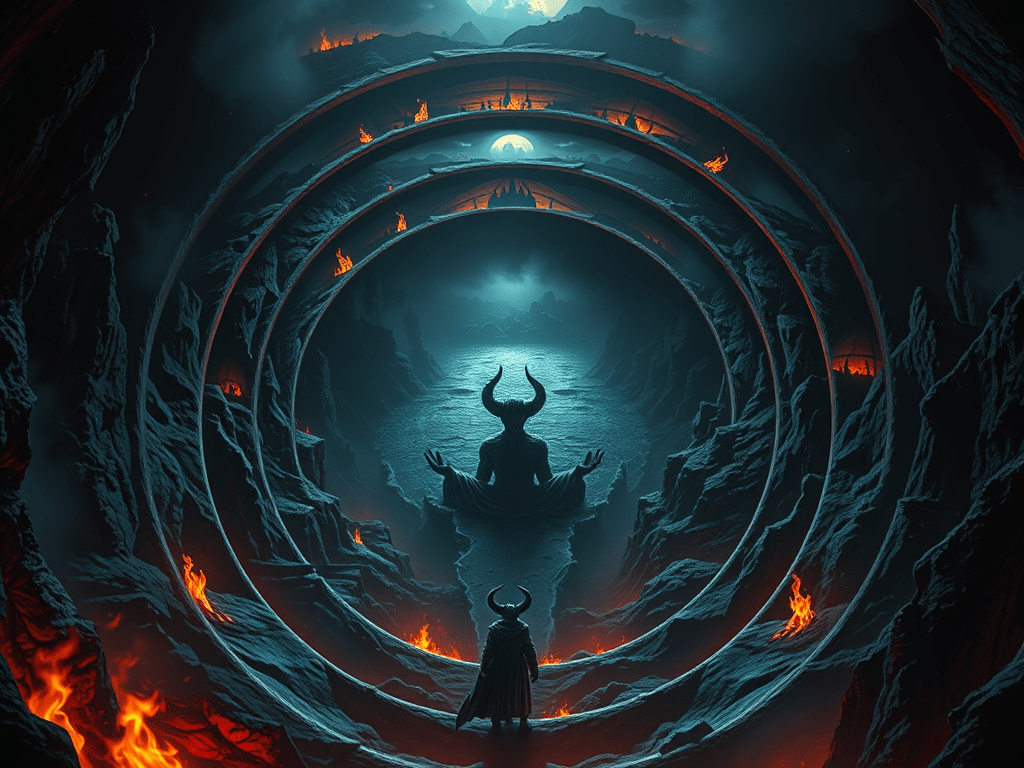
In the classic poem, Dante’s Inferno, Dante pictures Hell as nine concentric circles of increasing suffering. Each based on a person’s predominate sin. Satan is at the bottom frozen into a lake. So there would be a “cold day in Hell” if Dante were correct.

The Bible has very little to say about the final place of judgment for the damned. Revelation describes it as a “lake of fire”. Jesus’ word for it, Gehenna, describes a burning garbage dump. Jesus describes it as a place of flames and where the worm does not die. “Eternal” suffering is also stated. We can also infer from Jesus’ suffering on the cross that the punishment for sin is both a physical death and a spiritual death, where spiritual death is being forsaken by God. That is enough to know that I don’t want a tour let alone to permanently end up there.

The only passage to possibly suggest a variation of suffering comes from Jesus:

20 Then he began to denounce the cities where most of his mighty works had been done, because they did not repent. 21 “Woe to you, Chorazin! Woe to you, Bethsaida! For if the mighty works done in you had been done in Tyre and Sidon, they would have repented long ago in sackcloth and ashes. 22 But I tell you, it will be more bearable on the day of judgment for Tyre and Sidon than for you. 23 And you, Capernaum, will you be exalted to heaven? You will be brought down to Hades. For if the mighty works done in you had been done in Sodom, it would have remained until this day. 24 But I tell you that it will be more tolerable on the day of judgment for the land of Sodom than for you.”

Matthew 11:20-24 (ESV)

I think the key of understanding this passage is that it speaks of it being “tolerable” on the “day of Judgment”, and not after. The people in Chorazin, Bethsaida, and Capernaum had seen Jesus do miracles. They will know that they had unrefutable proof before their eyes and still rejected it.

It is suggested that Tyre, Sidon, Sodom, and Gomorrah would have repented had they been able to see this. At least, many people in these cities would have repented. The other cities had their opportunity and blew it.

Will it be a similar situation for those who heard the Gospel? Maybe even had family members plead with them. They may have heard the considerable proof that comes with Christian apologetics. Still, they rejected the opportunity of salvation. There will be fear and regret, for sure, only too late.

These realizations have to arrive on a person long before Judgment Day. It should be evident at death if you find yourself in Sheol. https://afterdeathsite.com/2023/11/14/how-is-sheol-different-than-hell/

Is there another level of “tolerability” that comes with the possible hope that still exists in Sheol? The cities that Jesus condemns had their opportunity to see and believe. Many other cities, though very evil, had not. What does 1 Peter 4:6 and Jesus’ actions in 1 Peter 3:19-20 say about a possible witness and repentance post-mortem?

19 in which he went and proclaimed to the spirits in prison, 20 because they formerly did not obey, when God’s patience waited in the days of Noah, while the ark was being prepared, in which a few, that is, eight persons, were brought safely through water.

1 Peter 3:19-20 (ESV)

In this part the people who were drowned in Noah’s flood get a witness from Jesus while in Sheol. They were not known for their virtue. All they could claim is ignorance. Then just a few verses later:

For this is why the gospel was preached even to those who are dead, that though judged in the flesh the way people are, they might live in the spirit the way God does.

1 Peter 4:6 (ESV)

This reads like a post-mortem opportunity to me. The use of Hebrews 9:27 to counterpoint this is clear misapplication of a verse. If opportunity did/does exist for Tyre, etc. or other people who die in ignorance, then it is certainly “more tolerable”. Faith is a strange thing, however. The reaction of the people who saw the miracles but still did not believe proves it. Even those who would receive witness in Sheol would not necessarily repent.

This topic only interests me because I care. I would rather that no one experiences Hell. I feel that way because God feels that way. But the Law is something that God doesn’t change. He fulfills it for us through Christ. To receive what He has done makes all the difference.

Biblical Stories of Being Raised from the Dead

The Easter story celebrates Jesus’ unique resurrection, contrasting it with other instances of being raised from the dead, like Lazarus and others. While Lazarus and others experienced repair or temporary returns, Jesus’ resurrection signifies a transformative experience, promising believers a future spiritual body and a restored existence in Heaven and Earth.

On Easter we celebrate Jesus being raised from the dead, but the Easter story is not the only story about being raised from the dead. The Easter story is unique, however, because Jesus isn’t just raised, He is resurrected. This is a very different thing. Perhaps in the course of your lifetime you might be clinically dead. You may even experience leaving your body. But modern medicine will bring you back. You will not come back as resurrected. You will merely be repaired, at least enough to get you by for a while.

The second most famous story is the raising of Lazarus in John 11. Jesus intentionally drags His feet on going to help His sick friend. The raising of Lazarus is going to be a powerful sign of what God can do. By the time Jesus arrives at the scene, Lazarus has been in the tomb for four days. Everybody expects physical decay to have begun. Has it? Not beyond the ability of Jesus to fix it. Where was Lazarus these past four days? Technically, Lazarus dies (the first time) before the atonement for sins is complete. I would expect that he had a brief stay in the good neighborhood of Sheol (aka The Bosum of Abraham or The Limbo of the Fathers)https://afterdeathsite.com/2021/05/11/an-expectation-of-sheol/ . Would that be upsetting to be recalled? I am not sure about the quality of existence in this space. It is a sort of waiting room for Heaven and may not be that different than living here. Lazarus was no doubt honored to be such a powerful part of the ministry of Jesus. There was one definite downside:

When the large crowd of the Jews learned that Jesus was there, they came, not only on account of him but also to see Lazarus, whom he had raised from the dead. 10 So the chief priests made plans to put Lazarus to death as well, 11 because on account of him many of the Jews were going away and believing in Jesus.

John 12:9-11 (ESV)

We are not given follow-up on this story. I would have to assume that Lazarus was later murdered. He would go through the process of dying twice, which tells me that it is not so bad on the relative scale of things. Lazarus’ resurrection is still pending.

Other people beside Jesus were given the ability to raise the dead. Elijah in 1 Kings 17:17f raises the son of a widow, and Peter in Acts 9 raises a beloved woman (Dorcas/Tabitha). The power of repair work can be given as a spiritual gift. Both are powerful signs. It is hard to say where the boy was for he was neither a Jew nor necessarily under grace. He may have come from the bad neighborhood of Sheol, and would have been overjoyed to get out. Tabitha would have been in Heaven. She had been dead for hours. Like Lazarus, I’m sure she was willing to fulfill God’s purpose in her existence. Also, like Lazarus she would die again.

Jesus raises the daughter of Jairus. This is similar to the boy raised by Elijah in the sense that the grief of parents is uniquely difficult. She is dead for less than a hour probably. It would be more like Near Death Experiences done by medical means. People who experience NDE’s of Heaven don’t want to return, but they continue to live with an excitement of getting back to Heaven.

One last non-resurrection “return”. The prophet Samuel is summoned by non-acceptable occultic means through the Witch of Endor (1 Samuel 28). Samuel is not pleased. Samuel says that he was “disturbed” and “brought up”. It doesn’t seem to be in physical form, so he remained dead but could communicate his displeasure.

What is different between being “repaired” and raised, Near Death Experiences, occultic summoning, and resurrection? A lot. We will receive a heavenly body for heavenly realms, but we are not complete until we receive a resurrected earthly body. This won’t happen until Judgment Day. The resurrected body exceeds our current body in every way. Paul describes it this way:

42 So is it with the resurrection of the dead. What is sown is perishable; what is raised is imperishable. 43 It is sown in dishonor; it is raised in glory. It is sown in weakness; it is raised in power. 44 It is sown a natural body; it is raised a spiritual body. If there is a natural body, there is also a spiritual body.

1 Corinthians 15:42-44 (ESV)

https://afterdeathsite.com/2024/12/10/pondering-the-properties-of-our-resurrected-body/Jesus was raised with all this plus being the incarnate Son of God, so the properties of His physical being are beyond our knowledge and all comparison.

While we won’t have some of the unique properties of Jesus, we will be vastly different than today, able to enjoy a restored Earth and Heaven. Easter joy is a celebration of a major mile post of the plan of God for our salvation. It also is a time to ponder what comes next for those who belong to Jesus.

Whoever Believes Has Eternal Life

The author reflects on a visit to the Church of the Holy Sepulcher, where they encountered a priest who mistakenly defined eternal life. The piece clarifies the distinction between “eternal existence” and “eternal life,” emphasizing that the latter is connected to belief in Jesus and a mystical union with Him, experienced both now and in Heaven.

I went to Israel about 10 years ago. In the Church of the Holy Sepulcher (shown above), which houses the traditional place of Jesus’ crucifixion and His burial tomb, I overheard a priest say to his tour group, “I don’t know what eternal life is, but I would like to think that it has something to do with being remembered.” This admission and glaring error shocked me. I want you to know very clearly what is meant by “eternal life”.

First, we must make a distinction between “eternal existence” and “eternal life”. God made a few creatures to have eternal existence. To my knowledge from the Bible these include: Seraphim/Cherubim (same thing different names), Angels/Demons (same thing but the latter is in rebellion against God), and human beings. You won’t cease to exist. Your body will die but you will find yourself in another body in another place (not Earth). This has been true of you since conception, and there is no way to opt out.

Because of our rebellion against God and the sin that is enshrined in our DNA, our eternal existence would naturally be first in Sheol (use the search box above to look for articles on Sheol), and then after Judgment Day in Gehenna, which we commonly refer to as Hell. Nobody should call such an existence “life”, and the Bible doesn’t.

Jesus’ life, forsakeness, death and resurrection are for the purpose of taking us from such a fate and giving to us instead “eternal life”. If the first temptation is thinking that life equals existence, the second is to think that eternal life begins at our physical death. Look at the following Bible passages:

47 Truly, truly, I say to you, whoever believes has eternal life.

John 6:47 (ESV)

36 Whoever believes in the Son has eternal life; whoever does not obey the Son shall not see life, but the wrath of God remains on him.

John 3:36 (ESV)

And to the question of “what is eternal life?”, we have this:

And this is eternal life, that they know you, the only true God, and Jesus Christ whom you have sent.

John 17:3 (ESV)

It certainly sounds like eternal life is something that we have already, if we have belief. Belief is not simply believing that Jesus is real. Like a person could believe in ghosts. It is believing the story of Jesus to be historical and factual and it is trusting in the promise connected to Jesus of forgiveness of sins. These are what I call “first-level” proofs that you are connected to Jesus and have eternal life. They are not exactly the cause of eternal life. The cause of our receiving eternal life is all that Jesus did and the existence of a bond that Jesus forms between us and Himself. This “bond” or “connection” is not cognitive like belief is, it is not emotional, for lack of better words it is mystical. Theologians call it the “mystical union”. Read more about this here:https://givingchrist.com/2024/10/01/understanding-jesus-prayer-for-unity-in-john-17/

Once that connection is made and as long as that connection is viable, we have eternal life. Having this connection is “knowing” the only true God. Being united with Christ has evidence but you don’t feel it like you might feel a part of your body. The existence of eternal life in you will be much more obvious when your physical body dies. Heaven is the place you would go first if you have eternal life. The experience we will have there will be glorious. If you want to know more about Heaven, use the search bar in my blog above. I have written numerous articles on that.

You can’t quite say eternal life is life in Heaven. That is part of eternal life. It is life now connected with Jesus, life in Heaven, and life in the New Earth post Judgment Day. It is a package. A great package that we did not deserve, but is offered freely to us.

How sad it is to not know eternal life. I hope the priest in my opening story found out. I hope you do as well.

When Did Heaven Enter the Plan?

The use of the word “Heaven”, the absence of Heaven as a human destination in the Old Testament, and similarities between Heaven and the New Earth leads to confusion about the topic. The article presents a view about how all of this fits together.

I recently watched a show of the documentary series Frontline about President Biden. It shared how, as a first term Senator, Joe Biden’s world was rocked by the tragic death of his wife and daughter in a car accident. The show interviewed the Catholic priest who ministered to the family at the time. He said something that stunned my wife and me. He started a sentence by saying, “If there is a Heaven…”. If? I’m not sure if the “if” was a reflection of a lack of faith or a confusion about God’s plan or both. If it was the former, I would say to him and any of you, expect this world to be difficult and unfair. We are sinful beings under God’s curse and cohabitants on this planet with Satan and his kingdom. There will be rough spots, even cruel ones. If the “if” is the latter, then this article is meant to address that. First of all, from where does the confusion about Heaven arise?

There are a couple of confusing aspects about Heaven in the Bible. The first is the word itself. “Heaven” both in Hebrew and in Greek is a word that describes several layers. The first heaven is the atmosphere of our planet. The second is the universe. The third is Heaven proper, the abode of God. This clearly shows the structure of creation as revealed to or understood by people in the biblical times. This doesn’t mean it is how it is actually structured. The model worked as far as God was concerned.

Next there is the fact that both Old and New Testament revealed the plan for a new heaven and new Earth. Certain similarities exist between the descriptions of Heaven and of the New Earth. So, are they the same? Do we go to Heaven and Revelation 21 and 22 describe it? Or do we wait the New Earth and references to Heaven describe it? Or are they two separate things?

Finally, why is there no reference in the Old Testament to people being taken to Heaven upon their deaths? Even the righteous expected to go to Sheol until the Resurrection?

The Bible reveals that God’s plans were established even before the problem of sin and rebellion existed. How He rolls out those plans and reveals them to mankind is the thing. Very early on God revealed the end of the plan. Job knew about the resurrection. Daniel speaks of it as well. Isaiah 65 reveals a description of the New Earth that doesn’t seem to agree with Revelation or the idea of eternal life. I suspect that Isaiah is only given a description that he and his contemporaries can process. To read more about this passage look here: https://wordpress.com/post/afterdeathsite.com/1982

Information is given out by God on a “need to know” basis. Nothing about Heaven as a human destination is mentioned in the Old Testament, but we do find Satan in Heaven. This I believe is key. If we know about God’s plan, then Satan will certainly know about it. This is the reason why more specific details are not given about the Messiah. What is given is specific enough that they could be interpreted any old way, like a fortune cookie; but there is not enough information for Satan to defeat the plan–which he definitely tried to do. A big part of this is that with Jesus’ successful fulfillment of the Law, Satan and his cronies would be expelled from Heaven.

Satan’s expulsion is spoken of in Revelation 12:

Now war arose in heaven, Michael and his angels fighting against the dragon. And the dragon and his angels fought back, but he was defeated, and there was no longer any place for them in Heaven. And the great dragon was thrown down, that ancient serpent, who is called the devil and Satan, the deceiver of the whole world—he was thrown down to the Earth, and his angels were thrown down with him.

Revelation 12:7-9 (ESV)

I believe this to be the ultimate “Good New – Bad News” message. The good news is that now those redeemed by Jesus don’t have to dwell in the bland comfort of Sheol. With Satan expelled, Heaven is in play, and it is our immediate destination at our death. Resurrection, Judgment Day, and the New Heaven and Earth are future and time does matter. (See this article about time: https://wordpress.com/post/afterdeathsite.com/2356

The bad news is that Satan is exiled to here. This I don’t understand or like. Human beings are enough of a mess with our sinful nature. The world is also complicated by the curse. How much additional suffering does the presence of Satan and his angels create?

Heaven is indicated as our destination in several New Testament passages. This is not a development of theology as much as it is more information after a critical execution of the plan. 2 Corinthians 5 states that we have “an eternal house in Heaven” (speaking about our heavenly body). The fact that it is “eternal” does not make Heaven and the New Earth the same thing. Read about one possible scenario here: https://wordpress.com/post/afterdeathsite.com/2356

There are many surprises that God still has in store for us. That makes it exciting. The most critical knowledge is already ours. We can only enter into eternal life with God as a gift through God connecting us to Jesus. Jesus fulfilled the requirements of God’s Law for us. We would never be able to do it ourselves.

Satan and the Afterlife

In the classic 14th century poem, Dante’s Inferno, “Hell” is pictured as nine descending rings of torment. At the very bottom, Satan is seen frozen in ice and chewing on the worst traitors in history. So, I guess there is a “cold day in Hell”. Ancient poetry and renaissance paintings have influenced our ideas of Hell and Satan in eternity. Understandably, since the Bible was not available to most people, there is something lacking in the details.

The first thing I would like to re-emphasize is that there is a difference between Sheol/Hades, which is before Judgment Day, and “The Lake of Fire”/Gehenna which is the final destination of the damned. Their similarities (i.e. fire, suffering) lead many to conflate the two. But they are clearly distinct. Which should we call “Hell”. Honestly, it your pick. But I tend to think of the post-Judgment Day, lake of fire, as Hell. See more here: https://afterdeathsite.com/?s=Sheol

So where is Satan in all of this? Well, if we refer to The Far Side for our theological truth, he is ruling in Hell with all his junior Satans. The Bible would not support this view. Prior to Jesus’ victory on the cross, Satan and his angelic/demonic following seem to be able to either be in Heaven or on Earth. Following the loss of leverage that Satan had legally, he and his minions are cast out of Heaven. Revelation 12 shares that he is now on Earth.

Now war arose in heaven, Michael and his angels fighting against the dragon. And the dragon and his angels fought back, but he was defeated, and there was no longer any place for them in heaven. And the great dragon was thrown down, that ancient serpent, who is called the devil and Satan, the deceiver of the whole world—he was thrown down to the earth, and his angels were thrown down with him…Therefore, rejoice, O heavens and you who dwell in them! But woe to you, O earth and sea, for the devil has come down to you in great wrath, because he knows that his time is short!”

Revelation 12:7-9,12 (ESV)

Trustworthy details are scant. But it appears that not all of Satan’s followers make it to exile on the Earth.

And the angels who did not stay within their own position of authority, but left their proper dwelling, he has kept in eternal chains under gloomy darkness until the judgment of the great day

Jude 6(ESV)

It doesn’t say where this “gloomy darkness” is. I would not conclude that it is the same place as the souls of the disobedient who Jesus preaches to after His crucifixion. (1 Peter 3:19) Look at that topic starting here: https://afterdeathsite.com/2017/03/14/christs-descent-into-hell-part-1/

I think the angels’ prison is part of what the Bible calls “the abyss”. Still, where is Satan? That depends on the meaning of the first paragraph of Revelation 20. It is also in Revelation 20 where we find the eternal destination of the one who kicked off this whole corruption of God’s creation. There are interpretations of Revelation 20:1-3 that understand Satan to be currently bound. If so, I would conclude bound in the Abyss. There are also interpretations that make this a future event. I lean toward the former. But there is little ambiguity of where he ends up.

and the devil who had deceived them was thrown into the lake of fire and sulfur where the beast and the false prophet were, and they will be tormented day and night forever and ever.

Revelation 20:10 (ESV)

This is formally “Hell” in my lexicon. It is post-Judgment Day and it is the ultimate destination of both corrupted angels and unredeemed people. The people have been in Sheol/Hades to this point.

14 Then Death and Hades were thrown into the lake of fire. This is the second death, the lake of fire. 15 And if anyone’s name was not found written in the book of life, he was thrown into the lake of fire.

Revelation 20:14-15 (ESV)

Satan is not there to reign or torment. He is there is suffer like everybody else. As bad as fire and sulfur sound, the phrase “second death” takes us to the ultimate penalty of sin which is to be forsaken by God. Hell is place. Forsaken is a condition. Jesus was forsaken on the cross, so that those who are connected to Jesus don’t need to suffer this themselves.

Satan does not seem to be connected to Sheol/Hades. He is either here on Earth, in the Abyss, or ultimately in the lake of fire/Gehenna/Hell. Neither he nor his demons seem to have the recourse that people have. Though we are sinful and rebellious as well, God’s love has created a way of forgiveness through Jesus. That is the way that I want and have. I am perfectly satisfied reading about Satan. I don’t need to meet him.