
What Is Satan?

The post explores the biblical figure of Satan, discussing his nature, identities, and presence in both Heaven and Earth, including his manifestation as the King of Tyre. It argues that Satan is not merely a myth but a complex being with significant influence over human history and actions, rooted in scriptural evidence.

Satan is a name found in several places in the Bible and many places in popular culture. He had some pseudonyms: the Devil, Lucifer, the Deceiver, the Accuser, Beelzebub, among others. I would like to deal with the question of what is this being. We will only touch on such tangential questions as what is he like, what can he do, and where is he.

Let’s start with a prominent assumption: Satan is just a myth and a way to personify evil. Not many people want Satan to be a real, thinking, active being. Without direct, obvious interaction it is pretty easy to dismiss a real Satan. Even the majority of Christians do that. The intel that we have has to come ultimately out of revelation from God. Otherwise, we are unlikely to know. While Satan isn’t a primary theme of Scripture, he shows up more than you might think. The context is always personal. It does not seem to be talking about evil showing up as a concept. Is it mythical? Suspend that thought for moment.

To get at what Satan actually is, first we must see where he can be present. Frequently, Satan is depicted as being in Heaven, like in the challenge to God to test Job (Job 1:7). He is also shows up on Earth, like in the Garden of Eden and others. He does seem to be able to either disguise himself or to occupy a human being (2 Corinthians 11:14, Luke 22:3). With that information I would like us to consider a passage that doesn’t use “Satan” by name.

11 Moreover, the word of the Lord came to me: 12 “Son of man, raise a lamentation over the king of Tyre, and say to him, Thus says the Lord God:

“You were the signet of perfection,
    full of wisdom and perfect in beauty.
13 You were in Eden, the garden of God;
    every precious stone was your covering,
sardius, topaz, and diamond,
    beryl, onyx, and jasper,
sapphire, emerald, and carbuncle;
    and crafted in gold were your settings
    and your engravings.
On the day that you were created
    they were prepared.
14 You were an anointed guardian cherub.
    I placed you; you were on the holy mountain of God;
    in the midst of the stones of fire you walked.
15 You were blameless in your ways
    from the day you were created,
    till unrighteousness was found in you.
16 In the abundance of your trade
    you were filled with violence in your midst, and you sinned;
so I cast you as a profane thing from the mountain of God,
    and I destroyed you, O guardian cherub,
    from the midst of the stones of fire.
17 Your heart was proud because of your beauty;
    you corrupted your wisdom for the sake of your splendor.
I cast you to the ground;
    I exposed you before kings,
    to feast their eyes on you.
18 By the multitude of your iniquities,
    in the unrighteousness of your trade
    you profaned your sanctuaries;
so I brought fire out from your midst;
    it consumed you,
and I turned you to ashes on the earth
    in the sight of all who saw you.
19 All who know you among the peoples
    are appalled at you;
you have come to a dreadful end
    and shall be no more forever.”

Ezekiel 28:11-19 (ESV)

So is this lament about Satan or the King of Tyre at Ezekiel’s time? I think the answer is “yes”. Satan either disguised himself or possessed a person and was the King of Tyre. I say this because much of this story could not apply to a normal person and it then gives part of Satan’s backstory. The end (v.18b-19) could apply to Satan as manifested as the King. It could also be prophetic of Satan’s ultimate fate.

What does it tell us? That Satan is a cherub. Cherub’s are not fat, little, baby angels that dispense toilet paper. The word means “living one”. Ezekiel uses that term in Ezekiel 1 as he describes the creatures that accompany God. It is also picked up in Revelation 4. In Isaiah’s vision of heaven in Isaiah 6, he uses the term “seraphim” or “burning ones”. This is just how they look to Isaiah. They are clearly the same creatures: four faces, four to six wings, what looks like eyes on their wings. In fact cherubim have wings, angels are never said to have wings; but it seems impossible to get people or AI to get that popular depiction out of their heads. Cherubim and Seraphim are synonyms. They are not angels. This is very restricted club. A limited creation by God. There seems to be just four in Isaiah, Ezekiel and Revelation. Satan would make a fifth.

Was or is Satan nasty looking? No, very beautiful, at least at first. Satan wasn’t evil from the start either. He was a creature of freewill and invented rebellion against God. It is important to note that Satan isn’t an equivalent of God in power, but just evil, even if he momentarily thought he was. Isaiah 14 has a similar passage. This one nominally against the King of Babylon.

Sheol beneath is stirred up
    to meet you when you come;
it rouses the shades to greet you,
    all who were leaders of the earth;
it raises from their thrones
    all who were kings of the nations.
10 All of them will answer
    and say to you:
‘You too have become as weak as we!
    You have become like us!’
11 Your pomp is brought down to Sheol,
    the sound of your harps;
maggots are laid as a bed beneath you,
    and worms are your covers.

12 “How you are fallen from heaven,
    O Day Star, son of Dawn!
How you are cut down to the ground,
    you who laid the nations low!
13 You said in your heart,
    ‘I will ascend to heaven;
above the stars of God
    I will set my throne on high;
I will sit on the mount of assembly
    in the far reaches of the north;
14 I will ascend above the heights of the clouds;
    I will make myself like the Most High.’
15 But you are brought down to Sheol,
    to the far reaches of the pit.

Isaiah 14:9-15 (ESV)

While this passage could easily be understood as describing the delusional fantasies of the King of Babylon, it also could be describing a Satan possessed man. The human King of Babylon ends up in Sheol (you can search above for “Sheol” in this blog), but a bit a Satan’s backstory is revealed. He thought he could be God. Is that naïveté, stupidity, or pride? Cherubim seem to have extraordinary powers, but they are no where near God in that category. Satan is not the evil equivalent of Jesus either as the Mormons proclaim.

In Revelation 12, Satan is cast to Earth and banished from Heaven in connection with the victory of Jesus. We do not have a comprehensive report on what he can or cannot do. What pushes him out the realm of myth for me is not only the consistent talk all through Scripture of Satan being an actual, created being; but it is also the horrid history of mankind.

Humans are capable of great evil all by ourselves, but I doubt that we would reach the depths that we have gone without significant outside help. Satan can possess, manifest and influence with great effectiveness. It would not surprise me if the nastiest characters in human history were either Satan in disguise, possessed by Satan, or under extreme influence. I don’t think evil could hold together as a system, movement, or institution the way that it has without such help.

Am I being superstitious or just ignorant of our capacity for evil? Again, I defer to Scripture. Society has swung from finding Satan under every rock to the opposite extreme of dismissing his existence. The truth is likely in between.
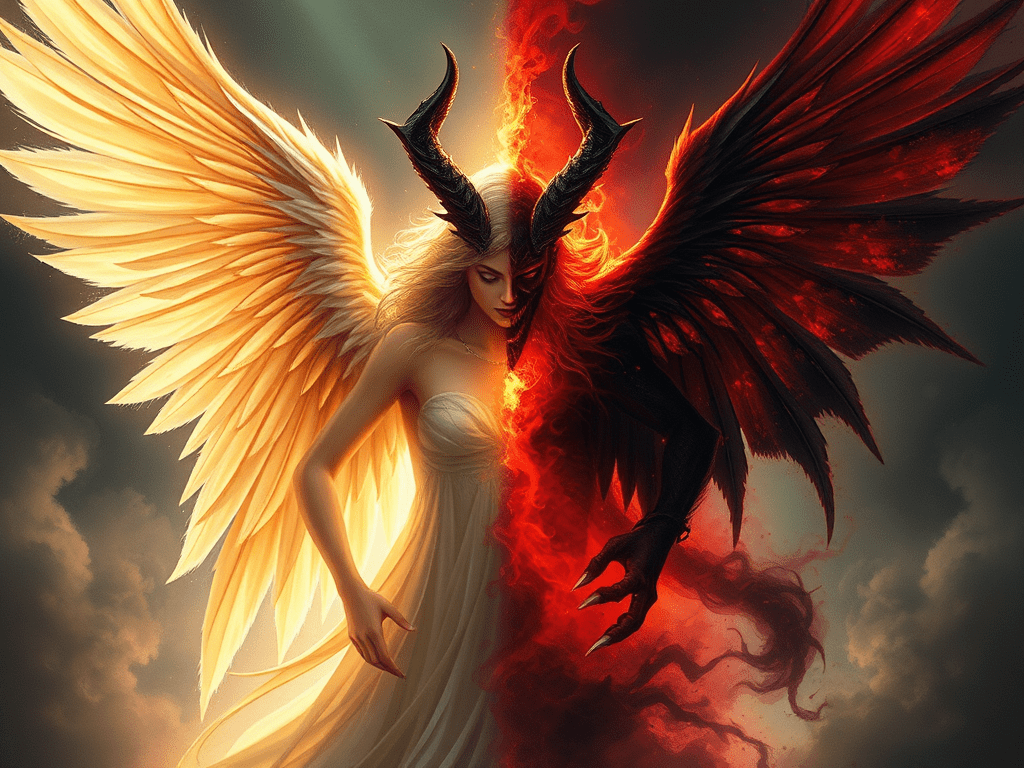
Angels and Demons

The text explores the nature of angels and demons, clarifying misconceptions about their existence and origins. It discusses how demons may be corrupted angels, influenced by Satan, while angels are distinct beings not derived from deceased humans. Both entities impact human life, with scripture referencing their roles in spiritual warfare and personal experiences of possession and intervention.

Most people, even if they are biblically illiterate, have heard of angels and Demons. They are known in other world religions as well, which is interesting. They are encountered by humans both in modern times, New Testament times, and ancient times. Are they real? And if so, what are they?

First, let’s say what they are not. Demons are not an ignorant understanding of mental illness. Mental illness is dysfunction of the brain. It can happen for a variety of reasons from genetics to trauma. I would not doubt that some trauma could be inflicted from spiritual (i.e. demonic) source, however. Angels, on the other hand, are not dead people. You do not die and become an Angel. Though the term, “angelus”, just means messenger, it is a term that is usually used to describe a certain species of being normally resident in Heaven. Angels are also not “Seraphim or Cherubim (in English: “burning ones” or “living ones”). These are synonyms for something of even higher capability than Angels.

It would appear that Demons are/were Angels. The information that we have is cryptic, but it appears that Satan (a Cherubim) managed to corrupt a large minority of Angels and turn them against God. Unlike humans where Satan was able to genetically corrupt the first set (Adam and Eve) and therefore corrupt every one of us, only a portion of Angels are corrupted. Perhaps this is because they don’t replicate, or that there were many Angels before Satan got to them.

What happened to Demons? This is very sketchy. Satan seems to have been able to hang on to residence in Heaven until Jesus’ victory on the cross. Nothing is said about Demons in this regard, except in Jude it says this:

And the angels who did not stay within their own position of authority, but left their proper dwelling, he has kept in eternal chains under gloomy darkness until the judgment of the great day—

Jude 6 (ESV)

From this passage we learn that Judgment Day isn’t just for people. Angels and Satan will receive their final disposition on that day as well. This passage can’t be about all fallen Angels, because many are shown creating problems on Earth. How is the timing of Jude 6 connected to this passage?

Now war arose in heaven, Michael and his angels fighting against the dragon. And the dragon and his angels fought back, but he was defeated, and there was no longer any place for them in Heaven. And the great dragon was thrown down, that ancient serpent, who is called the devil and Satan, the deceiver of the whole world—he was thrown down to the Earth, and his Angels were thrown down with him.

Revelation 12:7-9 (ESV)

Maybe these events are disconnected, maybe not. In the end, it would appear that we have both Angels and Demons among us. How do they contribute to our situations both positively and negatively?

On a personal level, the Bible records instances of demonic possession. There could also be lesser ways that a demon could affect a person. The most famous being the possession that inspired the book, “The Exorcist”. The Washington Post just happened to document this story back in the 1950’s. In that story the window that allowed the Demon to take hold was the dabbling in occultic practices by a “spiritualist” aunt and a boy’s use of a Ouija board to try to communicate to her after she died. I am not certain why and what occultic practices make this possible. They were also behind the scenes in all of the possessions encountered by Jesus. Pagan people lived very near or in Israel. People dabbled in these things and paid a price.

On a positive note, both the Bible and personal experiences account for angelic intervention. The most common being a helper that should not be there who assists someone in desperate need and then disappears.

There is also some interesting stuff about Angels and Demons at the national level, but I would like to briefly address our interaction with them after our death. First, Angels do not have wings and neither will you. My piece of art above in generated by AI. I cannot convince the “AI” that Angels do not have wings since there is so much garbage on the internet that shows that they do. This idea is an addition mostly from Renaissance artists. Cherubim do have wings. Angels will be a regular part of our existence in Heaven. Much like humans, they will seem like neighbors.

Demons will not be in Sheol, they will either remain on Earth or be contained in someplace called “the Abyss” until Judgment Day. After Judgment Day they will not be tormenting people in Hell. They will be suffering as well.

Will We Be Eternally Secure?

As we look at the Biblical narrative about the course of creation from its inception until now, we see a creation with several kinds of high reasoning beings who can either obey God or rebel. The rebellion of such beings has precipitated the less-than-ideal world we live in. The Bible points our hopes to the future when God will make all things new. But if it happened before, could rebellion happen again?

Ezekiel 28:12 and following is a section that may or may not describe Satan. It states that it is about the king of Tyre, but the description seems to not be about a mortal man but rather a “guardian cherub”. Cherubim, literally “living ones”, is the name given to a strange sort of being that lives in the closest proximity to God. There are descriptions in Isaiah 6 (called seraphim or “burning ones” there), Ezekiel 1, and Revelation 4. The Ezekiel 28 passage describes one that is cast out.

You were an anointed guardian cherub.
    I placed you;  you were on the holy mountain of God;
    in the midst of the stones of fire you walked.
15 You were blameless in your ways
    from the day you were created,
    till unrighteousness was found in you.
16 In the abundance of your trade
    you were filled with violence in your midst, and you sinned;
so I cast you as a profane thing from the mountain of God,
    and I destroyed you, O guardian cherub,
    from the midst of the stones of fire.

Ezekiel 28:14-16 ESV

From where did the “unrighteousness” come? Further reading indicates that this being (presumably Satan) became proud and corrupted in his wisdom. It seems to be an act of free will.

Satan tactics with Adam and Eve give insight as well. Adam and Eve don’t know what evil is. They only know that they are not to eat of the Tree of the Knowledge of Good and Evil, and they are capable of following that command or not. Satan feeds them a lie that may be similar to the lie he told himself,

For God knows that when you eat of it your eyes will be opened, and you will be like God, knowing good and evil.

Genesis 3:5 NIV (1984)

Though naive, humans made an act of the will to rebel against God. Consequently, their will was never truly free again. It is always influenced by a sinful nature and possibly also by evil outside forces.

We have no information about what happened with the angels, only that some of them (possibly as much as a third) also rebelled. Was it also an act of willful disobedience?

With the arrival of a New Heaven and New Earth, we are promised a resurrected body without a sinful nature and the removal of Satan and his angels. Will we have a truly free will? If so, can such a mess restart or can someone be expelled. There is no long biblical discourse to answer this. There is the promise of “eternal” life, and on this we must put our hope given the lack of information.

I would not postulate that we will have a constrained will of some sort. God created His greatest beings to be free for a reason. Love is free. Love is not the output of a pre-programmed mind that cannot deviate. What will prevent deviation? We barely understand what the soul or our will is. It is hard to speculate. Perhaps it will be because of new, more bonded relationship to Jesus. Even now we are somehow part of the body of Christ. This isn’t just a metaphor. It is a mystical relationship.

In the scant information that we are given, there seems to be no anticipation of further falling away or divisions in either cherubim, angels or humans. The question of whether we could fall away is a natural one. But we are thinking of our future situation through the lens of our current situation. Sin exists here. Evil is personified now. And we are corrupted in our wisdom.

The Citizens of Heaven

We have a sketchy picture of what Heaven is like.  We have an even more cryptic description of who or what will be there.

As you read through the Old Testament it is never revealed that humans had any hope of being citizens of Heaven.  There are a few visions of Heaven, but nothing more.  Old Testament believers understood that they were heading first to Sheol (preferably a good part of it) and that their ultimate hope was their resurrection from the dead and a New Earth.

I don’t believe that this means that Heaven wasn’t in the plans for humans or that the idea of going to Heaven was a “development of theology” or borrowed from other cultures at a later time.  Our place in Heaven had to be secured before it was promised.  Satan held some leverage over us.  Our species were rebellious sinners just like he was and like a significant minority of angels.  As long as humans were “under the Law”, we were stuck.

Jesus’ fulfillment of God’s Law as a human and His sacrifice of Himself to reconcile creation to God caused some major reorganization.  Satan and his minions lost their legal leverage and being inferior in power to God were cast out (Revelation 12:7-10). Humans were lead in a victorious procession in.  (Ephesians 4:7)  So for now, Heaven is the destiny of redeemed humanity until Judgment Day and a New Earth.

Who else will we find in Heaven?  Angels are one form of resident.  It is said of angels that they are “spirits”.  What does that mean exactly?  I think it means that they are properly citizens of Heaven’s dimensional space and not properly a part of this universe.  They can take on a form here or not, but it is not necessarily their form.  So what does an angel in Heaven look like?  We don’t know.  How many are there?  Beyond saying that there are many, we don’t know.  What are their abilities?  We can say that they are intelligent beings and that in some ways have higher capabilities than we presently have.  The name by which we know them, “angels”, speaks more to their function as “messengers” than as a proper name of their species.  I would expect them to be human-like in many ways.

Angels should be distinguished from Cherubim/Seraphim.  Isaiah 6, Ezekiel 1 and Revelation 4 described these beings as “living ones”(cherubim) or “burning ones” (seraphim).  They are described as intelligent and powerful beings who surround the throne of God.  Their physical description may be more symbolic than actual.  The description includes multiple faces, four to six wings, and covered with eyes–a rather frightening appearance.  Satan is described as being a disowned, guardian cherub (Ezekiel 28), beautiful, part of the council of God, and blameless until wickedness was found in him.

The only other citizens of Heaven that are described in the Bible (that doesn’t mean that their aren’t others) are a mysterious group of 24 elders. Who are these beings?  What are they?  They could be humans.  They do not appear in the only other descent description of God’s throne room in Daniel 7.  They are described in Revelation 4.  Since Revelation is full of symbolism, this could be a group symbolic of a greater portion of humanity.  Or not.  It is intriguing to think about how the picture given in Revelation 4 (a New Testament if not future picture) relates to references to a divine council found throughout the Old Testament.  More about this in my next blog.

The Throne Room of God

I would like start this section with a passage about Heaven that is frequently overlooked. It is John 3:13:

No one has ascended into Heaven except he who descended from Heaven, the Son of Man.

This is a “wow” statement when you think about it. Jesus is unequivocally saying that nobody has been to Heaven to that point. That means that the two Old Testament visions of Heaven that seem like the person travels to Heaven (Isa. 6, Dan. 7) were just that—visions. They were not field trips. Even though the Bible says that a fiery chariot took Elijah into Heaven. It does not mean that Elijah went to the throne room of God, it just means that the chariot took him up. The word “heavens” can be used to refer to outer space, so it is important to watch your context. This verse also means all those Old Testament people who have been considered “righteous” still had not yet received their righteousness from Christ and gone to Heaven. The punishment for their sins had only been suspended for the time being (see Romans 3:25b). They awaited Christ’s victory in a pleasant portion of Sheol.

Why hadn’t anybody ascended to Heaven up to the time Jesus made that statement? We are sinners and do not deserve to be there. Perhaps we could not even survive being there in our condition. Only atonement for sin can change that situation and when this was spoken Jesus had still not atoned for the sins of the world.

This raises an interesting question about Isaiah’s experience. In Isaiah 6, Isaiah experiences a vision of Heaven and he also experiences his unworthiness. He says, “Woe to me! For I am a man of unclean lips, and I dwell in the midst of people with unclean lips; for my eyes have seen the King, the LORD of (hosts.)” I’m sure Isaiah doesn’t know what exactly has happened to him. He doesn’t know if he is actually in Heaven or still in the temple and seeing Heaven. We would call it an out-of-body experience, but it would appear from Jesus’ statement above that he wasn’t as “out-of-body” as he perhaps felt.

Isaiah saw the throne room of God, but only as a vision. Even though only a vision, Isaiah was struck by his unworthiness to be there. “Woe to me” he said, “For I am a man of unclean lips and I live among people of unclean lips.” Heaven isn’t heavenly for those who are unworthy to be there. The holiness of God is stressful for Isaiah in a vision, and possibly lethal for him in person. Still, God gave Isaiah this vision for a purpose. God had a mission to give him and the means to carry it out.

In his vision, Isaiah sees several bizarre creatures in the throne room of God. He calls them, “burning ones”, or Seraphim. The seraphim respond to Isaiah’s unworthiness in this way:

Then one of seraphim flew to me, having in his hand a burning coal that he had taken with the tongs from the altar. And he touched my mouth and said, “Behold, this has touched your lips; your guilt is taken away, and your sin atoned for.”

I have always found this fascinating. Why didn’t Isaiah get burned? Why do coals on the altar atone for him? There is no answer given, so we can’t conclusively say. Perhaps the reason is that Isaiah wasn’t really there, so no burn. The altar that this refers to is the one copied in the Jerusalem temple where sacrifices were made. The Bible is clear that animal sacrifices do not really atone for sin at all. However, they were prophetic, as Isaiah’s experience was prophetic, of a sacrifice that will really atone; and that sacrifice was Jesus.

With the sacrifice of Christ completed, can mankind enter into Heaven and into the presence of God? It would appear so. The first invitation happens on the cross. Jesus says to the repentant thief, “Today you will be with me in paradise.” Some have interpreted Jesus’ words as saying that the thief will join Jesus in the good neighborhood of Sheol. The reasoning is simple, that is where Jesus is going next and we are not aware of a trip to Heaven until His ascension. But Jesus didn’t exactly leave us His travel itinerary. I would add to the evidence for Jesus going to Heaven on that day, Ephesians 4:8:

When he ascended on high he led a host of captives, and he gave gifts to men.

I don’t think the ascension referenced here is the one the disciples observed for two reasons. First, Jesus is leading the Old Testament redeemed, here referred to as “captives”, somewhere, presumably Heaven. Next, the gifts referred to is the forgiveness of sins, which would have begun immediately after Jesus had finished His task of atonement. As such, Jesus could have gone to Heaven the very day He was crucified.

Next time:  More from the throne room of God