
Whoever Believes Has Eternal Life

The author reflects on a visit to the Church of the Holy Sepulcher, where they encountered a priest who mistakenly defined eternal life. The piece clarifies the distinction between “eternal existence” and “eternal life,” emphasizing that the latter is connected to belief in Jesus and a mystical union with Him, experienced both now and in Heaven.

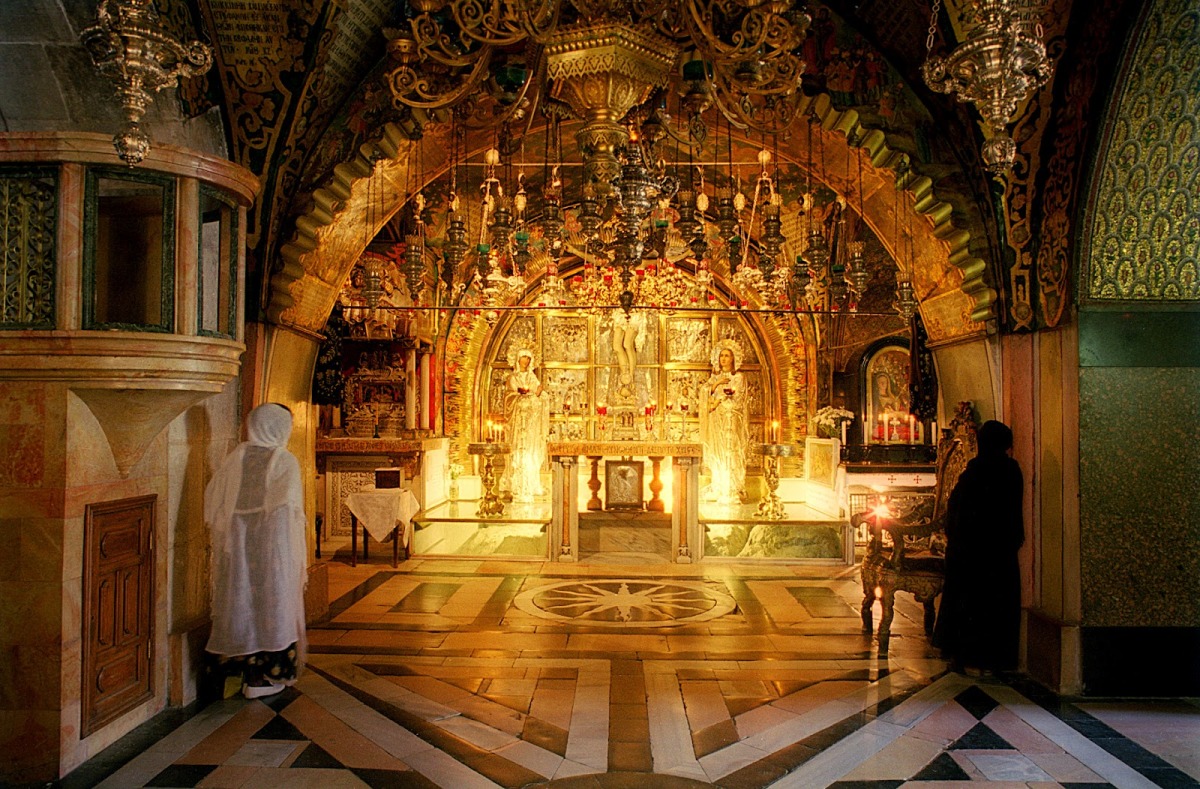
I went to Israel about 10 years ago. In the Church of the Holy Sepulcher (shown above), which houses the traditional place of Jesus’ crucifixion and His burial tomb, I overheard a priest say to his tour group, “I don’t know what eternal life is, but I would like to think that it has something to do with being remembered.” This admission and glaring error shocked me. I want you to know very clearly what is meant by “eternal life”.

First, we must make a distinction between “eternal existence” and “eternal life”. God made a few creatures to have eternal existence. To my knowledge from the Bible these include: Seraphim/Cherubim (same thing different names), Angels/Demons (same thing but the latter is in rebellion against God), and human beings. You won’t cease to exist. Your body will die but you will find yourself in another body in another place (not Earth). This has been true of you since conception, and there is no way to opt out.

Because of our rebellion against God and the sin that is enshrined in our DNA, our eternal existence would naturally be first in Sheol (use the search box above to look for articles on Sheol), and then after Judgment Day in Gehenna, which we commonly refer to as Hell. Nobody should call such an existence “life”, and the Bible doesn’t.

Jesus’ life, forsakeness, death and resurrection are for the purpose of taking us from such a fate and giving to us instead “eternal life”. If the first temptation is thinking that life equals existence, the second is to think that eternal life begins at our physical death. Look at the following Bible passages:

47 Truly, truly, I say to you, whoever believes has eternal life.

John 6:47 (ESV)

36 Whoever believes in the Son has eternal life; whoever does not obey the Son shall not see life, but the wrath of God remains on him.

John 3:36 (ESV)

And to the question of “what is eternal life?”, we have this:

And this is eternal life, that they know you, the only true God, and Jesus Christ whom you have sent.

John 17:3 (ESV)

It certainly sounds like eternal life is something that we have already, if we have belief. Belief is not simply believing that Jesus is real. Like a person could believe in ghosts. It is believing the story of Jesus to be historical and factual and it is trusting in the promise connected to Jesus of forgiveness of sins. These are what I call “first-level” proofs that you are connected to Jesus and have eternal life. They are not exactly the cause of eternal life. The cause of our receiving eternal life is all that Jesus did and the existence of a bond that Jesus forms between us and Himself. This “bond” or “connection” is not cognitive like belief is, it is not emotional, for lack of better words it is mystical. Theologians call it the “mystical union”. Read more about this here:https://givingchrist.com/2024/10/01/understanding-jesus-prayer-for-unity-in-john-17/

Once that connection is made and as long as that connection is viable, we have eternal life. Having this connection is “knowing” the only true God. Being united with Christ has evidence but you don’t feel it like you might feel a part of your body. The existence of eternal life in you will be much more obvious when your physical body dies. Heaven is the place you would go first if you have eternal life. The experience we will have there will be glorious. If you want to know more about Heaven, use the search bar in my blog above. I have written numerous articles on that.

You can’t quite say eternal life is life in Heaven. That is part of eternal life. It is life now connected with Jesus, life in Heaven, and life in the New Earth post Judgment Day. It is a package. A great package that we did not deserve, but is offered freely to us.

How sad it is to not know eternal life. I hope the priest in my opening story found out. I hope you do as well.
When Nobody Speaks Your Name

There is a tradition common among several cultures that speaks about dying twice. The first is when you physically die. The second is when you are forgotten, and nobody speaks your name. Variations on this belief can lead to distinctive practices. For instance, some cultures will memorize their family tree. Others will mummify their ancestors and take them out for special occasions, or there will be some other form of ritual to ensure that the ancestor is remembered. The Disney movie, Coco, incorporates this idea. Is it necessary to be remembered? What happens if you are forgotten?

Unless you are somebody who is quite famous or infamous, it is guaranteed that people will eventually forget your name. I have had a lot of success with researching my family tree. One branch I can trace back to before 1000 AD with a decent amount of certainty. The other branches don’t go back so far. They are likely forgotten by all. Hundreds of millions and perhaps billions have lived and died and left no living memory of themselves. Perhaps it is why some might do horrible things in hopes of just being remembered.

Let’s make this clear. Eternal life is not just being remembered by someone. Eternal life is being remembered by God. God forsakes and forgets the damned. But the dead in Christ continue to exist and live in happiness in the presence of God with or without being remembered.

And as for the resurrection of the dead, have you not read what was said to you by God: 32 ‘I am the God of Abraham, and the God of Isaac, and the God of Jacob’? He is not God of the dead, but of the living.”

Matthew 22:31-32(ESV)

Is it a lack of faith that leads some to doubt that those who die can be alive elsewhere? I once went on a tour of Israel. At the Church of the Holy Sepulchre there is an area that holds the traditional place of Jesus’ crucifixion. The very place where Jesus died to win for us eternal life is encased by three altars. We were in the central chapel while a Roman Catholic tour group was in the chapel next to us. I overheard the priest say something like this, “I don’t know what eternal life is, but would like to think that is has something to do with being remembered.” I was dumbfounded by this dumb idea. Eternal life has nothing to do with being remembered and we should celebrate that fact.

It is nice to remember somebody. But I assure you that they probably don’t know if you remember them or not, and their existence is in no way diminished or enhanced if you do. Memory is for our benefit. We can learn from the past. We can have an important thankfulness for what people did to make our present possible. But only Christ makes eternal life possible.

Understanding Life After Death

One of the most shocking moments I ever had from a theological point of view happened in Jerusalem, in the Church of the Holy Sepulcher, in the Chapel on top of Golgotha no less, where traditionally Jesus was crucified.  I heard a Catholic priest say these words to his tour group:  “I don’t know what eternal life is, but I like to think it has something to do with this world.  I like to think we live on in the memories of those who love us.”

My jaw must have hit the floor.  Did Jesus need to die to help people remember them? Nooo!  This priest was confused to the extreme, but confusion is not limited to him.  What happens after we die confuses many people for some reason.  The result is disagreement.

There are basically four ideas of what comes next. One is caught up in Paul’s use of the word “sleep” (see 1 Cor. 15:51 or 1 Thess. 4:13 for example).  In this model we are unconscious at our death until aroused at Judgment Day.  This model is quickly contradicted by 1 Thessalonians 4:14 which has the righteous dead returning with Jesus as he comes on Judgment Day. 

For since we believe that Jesus rose again, even so, through Jesus, God will bring with Him those who have fallen asleep.

1 Thessalonians 4:14

It also is in tension with Revelation 6:9-10 where martyrs are conscious, in Heaven, and asking God how long they have to wait for Judgment Day.  For that matter, also Revelation 7:9-17 which shows people in Heaven in a pre-Judgment Day setting.

Another is a time-warp model that doesn’t have you sleeping but going direct to the Judgment Day. The idea is that because God must be transcendent (above the Laws of Nature), that we are also transcendent after our death. While I do believe God can do whatever He wants with us. Assuming transcendence is a jump. This theory also contradicts the same passages as soul sleep mentioned above.

Yet another is a super vague explanation that equates “heaven” with being a part of the body of Jesus.  That doesn’t seem like a bad idea at first, but it is essentially making “heaven” (not capitalized) be a state of mind or being. Essentially, I am in heaven now because I am part of the body of Christ.  It is not Heaven a place where Jesus is. Again, Revelation 6 and 7 speak against this. 2 Corinthians 5 also speaks of our having an independent body in which we are “clothed”. We do not exist as a being assimilated into Jesus until the Resurrection.

Here is what the Scripture tells us.  When we die (like the thief on the cross), immediately we will be with Jesus in paradise (Heaven – capital H), fully awake, fully aware and loving it.  I would argue that this experience comes with a heavenly body (1 Cor. 15:40, 2 Cor. 5:1), you are not formless or ghostly.  Then, when the time arrives, we will return with Jesus from Heaven to Earth.  We will receive a resurrected body, appropriate for Earth, and go through a Judgment Day experience (1 Corinthians 3:10-15).  Judgment Day for the Redeemed is not a determination of salvation, but rather an accounting of our works and an appropriate reward.  (1 Cor. 3:10-15, et al.).  Where then?  Wherever you want.  God dwells with us on Earth, but I wouldn’t guess that Heaven is off limits either.

What Is Eternal Life?

I want to tell you of an encounter I had on Golgotha, the place where Jesus was crucified. I am not speaking metaphorically here. I was in Jerusalem a couple of years ago. We were visiting the Church of the Holy Sepulcher. This is a church in the old city of Jerusalem, where the traditional site of Jesus’ crucifixion and of Jesus’ burial lie within one building. Many people, including me, don’t appreciate that Golgotha and the rich man’s tomb were so close together; but John’s gospel records that the place of crucifixion was in a garden. It was an ugly act placed in a beautiful place near the gate of the city. I expect it was to show Roman dominance.

When you enter at the ground level through the main door, the top of Golgotha (the place of the skull) is just up about the equivalent of two normal floors of a building to your right. The tomb is around a corner to your left. Our group went up to the Chapel on top of Golgotha first. The chapel is a somewhat sad story of in-fighting among the groups that control the church. There are three altars. The far right altar is Roman Catholic, the middle Orthodox, the left Arminian. We were in the middle and a group (presumably Catholic) was in the right portion of the chapel. I couldn’t help but overhear the presentation being made by the priest, who sounded American. To my shock he said, “I don’t know what eternal life is, but I think it has something to do with this Earth; we live on in the memories of people.”

I almost had a stroke. Here we are on the likely place where Jesus died and a member of the clergy suggests that eternal life is being remembered. In reflection on the statement made by the priest, I guess I assumed that everyone is clear about the nature of eternal life; and, clearly, I assumed too much. When we let worldly doubts, fears, and academic criticism get into our heads, we can believe that real existence beyond our deaths is impossible. The Jews also had a group, the Sadducees, who did not believe in the resurrection of the body. When this becomes your worldview, references to eternal life are nothing more than wishful thinking or, as the priest said, memories.

My question is, “What would Jesus’ dying on a cross 2000 years ago have anything to do with whether people remember me or not?” The answer is, “It doesn’t.” On that rock on which we stood Jesus literally suffered being forsaken by His Father. That selfless act enabled a promise of God to work. God extends to humans the opportunity to be connected to Jesus. When connected through baptism in the name of Jesus (not some other ridiculous formula), the forsakeness of Jesus becomes the fulfillment of what God’s law requires of us. Because we have not kept God’s Law, we are required to be damned (forsaken). Jesus takes that sentence for us. Having been made right with God, we can live with God in the joy and glory of Heaven (a real place and thus capitalized) and also in the New Earth (also real and as a proper noun capitalized). If you can’t tell, the failure of many books and bible translations to capitalize both Heaven and Earth when referring to the place is a pet peeve of mine.

It is also important to note here that eternal life does not just mean existence. After your death you will exist regardless of your standing with God. That is how you are made. You will actually exist, not just in memory. It is just that if you exist as a being forsaken by God, the experience will be so hopeless and horrifying that calling such an existence “life” is a gross disservice to the word. The Bible is not even thrilled with called our current existence “life”. Existence in Heaven and the New Earth is real life. Once there you will not care if people remember you. You will be having too much fun. Life after death is not some version of the Disney movie, “Coco”. Maybe that is where the priest learned his theology.

So take heart. Jesus has opened the door to life. This is not some vague concept. It is more concrete that you are now.