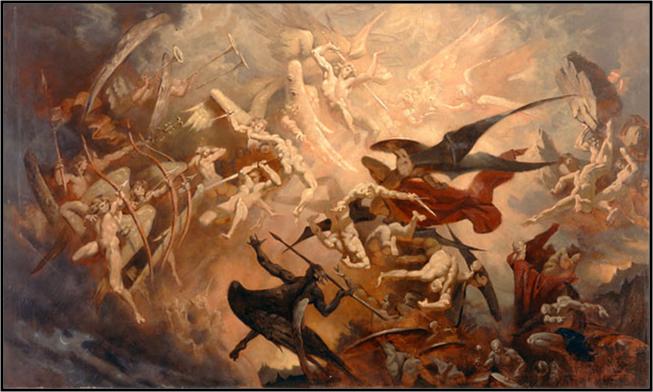
What Is Satan?

The post explores the biblical figure of Satan, discussing his nature, identities, and presence in both Heaven and Earth, including his manifestation as the King of Tyre. It argues that Satan is not merely a myth but a complex being with significant influence over human history and actions, rooted in scriptural evidence.

Satan is a name found in several places in the Bible and many places in popular culture. He had some pseudonyms: the Devil, Lucifer, the Deceiver, the Accuser, Beelzebub, among others. I would like to deal with the question of what is this being. We will only touch on such tangential questions as what is he like, what can he do, and where is he.

Let’s start with a prominent assumption: Satan is just a myth and a way to personify evil. Not many people want Satan to be a real, thinking, active being. Without direct, obvious interaction it is pretty easy to dismiss a real Satan. Even the majority of Christians do that. The intel that we have has to come ultimately out of revelation from God. Otherwise, we are unlikely to know. While Satan isn’t a primary theme of Scripture, he shows up more than you might think. The context is always personal. It does not seem to be talking about evil showing up as a concept. Is it mythical? Suspend that thought for moment.

To get at what Satan actually is, first we must see where he can be present. Frequently, Satan is depicted as being in Heaven, like in the challenge to God to test Job (Job 1:7). He is also shows up on Earth, like in the Garden of Eden and others. He does seem to be able to either disguise himself or to occupy a human being (2 Corinthians 11:14, Luke 22:3). With that information I would like us to consider a passage that doesn’t use “Satan” by name.

11 Moreover, the word of the Lord came to me: 12 “Son of man, raise a lamentation over the king of Tyre, and say to him, Thus says the Lord God:

“You were the signet of perfection,
    full of wisdom and perfect in beauty.
13 You were in Eden, the garden of God;
    every precious stone was your covering,
sardius, topaz, and diamond,
    beryl, onyx, and jasper,
sapphire, emerald, and carbuncle;
    and crafted in gold were your settings
    and your engravings.
On the day that you were created
    they were prepared.
14 You were an anointed guardian cherub.
    I placed you; you were on the holy mountain of God;
    in the midst of the stones of fire you walked.
15 You were blameless in your ways
    from the day you were created,
    till unrighteousness was found in you.
16 In the abundance of your trade
    you were filled with violence in your midst, and you sinned;
so I cast you as a profane thing from the mountain of God,
    and I destroyed you, O guardian cherub,
    from the midst of the stones of fire.
17 Your heart was proud because of your beauty;
    you corrupted your wisdom for the sake of your splendor.
I cast you to the ground;
    I exposed you before kings,
    to feast their eyes on you.
18 By the multitude of your iniquities,
    in the unrighteousness of your trade
    you profaned your sanctuaries;
so I brought fire out from your midst;
    it consumed you,
and I turned you to ashes on the earth
    in the sight of all who saw you.
19 All who know you among the peoples
    are appalled at you;
you have come to a dreadful end
    and shall be no more forever.”

Ezekiel 28:11-19 (ESV)

So is this lament about Satan or the King of Tyre at Ezekiel’s time? I think the answer is “yes”. Satan either disguised himself or possessed a person and was the King of Tyre. I say this because much of this story could not apply to a normal person and it then gives part of Satan’s backstory. The end (v.18b-19) could apply to Satan as manifested as the King. It could also be prophetic of Satan’s ultimate fate.

What does it tell us? That Satan is a cherub. Cherub’s are not fat, little, baby angels that dispense toilet paper. The word means “living one”. Ezekiel uses that term in Ezekiel 1 as he describes the creatures that accompany God. It is also picked up in Revelation 4. In Isaiah’s vision of heaven in Isaiah 6, he uses the term “seraphim” or “burning ones”. This is just how they look to Isaiah. They are clearly the same creatures: four faces, four to six wings, what looks like eyes on their wings. In fact cherubim have wings, angels are never said to have wings; but it seems impossible to get people or AI to get that popular depiction out of their heads. Cherubim and Seraphim are synonyms. They are not angels. This is very restricted club. A limited creation by God. There seems to be just four in Isaiah, Ezekiel and Revelation. Satan would make a fifth.

Was or is Satan nasty looking? No, very beautiful, at least at first. Satan wasn’t evil from the start either. He was a creature of freewill and invented rebellion against God. It is important to note that Satan isn’t an equivalent of God in power, but just evil, even if he momentarily thought he was. Isaiah 14 has a similar passage. This one nominally against the King of Babylon.

Sheol beneath is stirred up
    to meet you when you come;
it rouses the shades to greet you,
    all who were leaders of the earth;
it raises from their thrones
    all who were kings of the nations.
10 All of them will answer
    and say to you:
‘You too have become as weak as we!
    You have become like us!’
11 Your pomp is brought down to Sheol,
    the sound of your harps;
maggots are laid as a bed beneath you,
    and worms are your covers.

12 “How you are fallen from heaven,
    O Day Star, son of Dawn!
How you are cut down to the ground,
    you who laid the nations low!
13 You said in your heart,
    ‘I will ascend to heaven;
above the stars of God
    I will set my throne on high;
I will sit on the mount of assembly
    in the far reaches of the north;
14 I will ascend above the heights of the clouds;
    I will make myself like the Most High.’
15 But you are brought down to Sheol,
    to the far reaches of the pit.

Isaiah 14:9-15 (ESV)

While this passage could easily be understood as describing the delusional fantasies of the King of Babylon, it also could be describing a Satan possessed man. The human King of Babylon ends up in Sheol (you can search above for “Sheol” in this blog), but a bit a Satan’s backstory is revealed. He thought he could be God. Is that naïveté, stupidity, or pride? Cherubim seem to have extraordinary powers, but they are no where near God in that category. Satan is not the evil equivalent of Jesus either as the Mormons proclaim.

In Revelation 12, Satan is cast to Earth and banished from Heaven in connection with the victory of Jesus. We do not have a comprehensive report on what he can or cannot do. What pushes him out the realm of myth for me is not only the consistent talk all through Scripture of Satan being an actual, created being; but it is also the horrid history of mankind.

Humans are capable of great evil all by ourselves, but I doubt that we would reach the depths that we have gone without significant outside help. Satan can possess, manifest and influence with great effectiveness. It would not surprise me if the nastiest characters in human history were either Satan in disguise, possessed by Satan, or under extreme influence. I don’t think evil could hold together as a system, movement, or institution the way that it has without such help.

Am I being superstitious or just ignorant of our capacity for evil? Again, I defer to Scripture. Society has swung from finding Satan under every rock to the opposite extreme of dismissing his existence. The truth is likely in between.

How Is Sheol Different than Hell?

Many, if not most people, have a simplistic view of what the Bible tells us about life after death. Simply put they believe in Heaven and Hell. One of the goals of this blog is to help people realize that two events change this model: the death and resurrection of Jesus and Judgment Day.

Prior to Jesus, the Old Testament people knew of two things regarding their existence after death. The knew that there would eventually be a bodily resurrection of dead followed by either everlasting life in a New Earth or everlasting contempt somewhere. (Dan. 12:2, Isaiah 65) This information can be traced as early as Job, which is likely the oldest book in the Bible.

For I know that my Redeemer lives,
    and at the last he will stand upon the earth.
26 And after my skin has been thus destroyed,
    yet in my flesh I shall see God,
27 whom I shall see for myself,
    and my eyes shall behold, and not another.
    My heart faints within me!

Job 19:25-27 (ESV)

The Old Testament people are aware that Heaven exists, but it is never promised as a destination for them after death. Instead, the Old Testament people had an expectation of going to Sheol (the place of the dead). This is not the same as the grave. Some translations of the Bible botch this and then note that the Hebrew word is “Sheol” in the footnotes. Sheol is a distinct place of conscious existence.

Sheol seems to be a two-part place. One section is comforting, but not necessarily better than life. The other section is a place of suffering. The New Testament and the Greek translation of the Old Testament (the Septuagint) switch from the word “Sheol” to the Greek “Hades”. These are synonyms. Jesus uses another word “Gehenna”, which is not a synonym. Gehenna refers to the final destination of the damned, the post-Judgment Day lake of fire. This would be my candidate for the English word, Hell.

Getting Hades/Sheol and Gehenna confused is pretty easy to do. They do share certain properties. Darkness, suffering, and fire seem to be a part of both. One description of Hades includes “where the worm does not die”. I don’t think this is talking about the decay of our corpse in the grave. This seems to be part of the suffering of Sheol.

Finding differences is harder. I can come up with only three within the scant information we are given.

  1. It appears that it is possible, but not acceptable, to communicate with the dead in Sheol. In the story of the Witch of Endor (1 Samual 28), Saul summons the prophet Samuel from the dead through the forbidden skills of the Witch of Endor. Samuel would have been in the comforting section of Sheol. He doesn’t seem too pleased about it either. This practice must have been a part of pagan Canaanite culture and possible also others. The Jews are strictly forbidden from doing this (Deut. 18:9-13). I would infer from this that those in the suffering section might also have been reachable. Once you are in Gehenna you are unreachable and no one will try. (More on that in a bit.)
  2. A second difference connects to what Jesus did right after his death.

For Christ also suffered once for sins, the righteous for the unrighteous, that he might bring us to God, being put to death in the flesh but made alive in the spirit, 19 in which he went and proclaimed to the spirits in prison, 20 because they formerly did not obey, when God’s patience waited in the days of Noah, while the ark was being prepared,

1 Peter 3:18-20a (ESV)

This is where we get Jesus’ “descent into Hell” from the Apostles’ Creed. Here “Hell” is a misleading term. It should be descent into “Sheol” or something to that effect. Originally it was.

What was Jesus trying to do? 1 Peter 4:6 explains it:

For this is why the gospel was preached even to those who are dead, that though judged in the flesh the way people are, they might live in the spirit the way God does.

1 Peter 4:6 (ESV)

It certainly sounds like these people, long dead, condemned, held in the prison of Sheol are getting a second chance through the preaching of Christ. Did this ever happen again? Don’t know. Is there another reference to this in Scripture? Nope. Outside of Scripture? Yes, a bunch. It was a favorite theme of the ancient Eastern church.

This leads to the final and most critical difference between Gehenna (Hell) and Sheol.

In Revelation 20:14, Hades/Sheol is thrown in “the lake of fire”/Gehenna/Hell. At that point, post-Judgment Day, they become one thing. It appears to me that the worst part of being damned doesn’t happen until then. At that point God forsakes you.

You are utterly separated from God and all of God’s redeemed forget you. Jesus experienced this for us on the cross. He was forsaken, and even though He knew it was coming, it crushes Him.

45 Now from the sixth hour there was darkness over all the land until the ninth hour. 46 And about the ninth hour Jesus cried out with a loud voice, saying, “Eli, Eli, lema sabachthani?” that is, “My God, my God, why have you forsaken me?”

Matthew 27:45-46 (ESV)

This whole topic can remain an academic discussion because Jesus took the suffering for us. If we are baptized in Christ’s name then we are baptized into His death–specifically, this part of His death.

I don’t need to get any closer to Sheol/Hades/Gehenna/the Lake of Fire/ Hell than this.

Satan and the Afterlife

He is often shown in comedic form: a being with horns and a pitchfork and possibly a sense of humor ruling over Hell. But Satan is no joke. He can also be understood as a serious character ruling over the underworld. But there is nothing Biblical to connect Satan, or any demon for that matter, with Sheol; and Hell is described as a future placed prepared for the “Devil and his angels” not so that they can rule, but so they can experience being forsaken by God like all the damned.

I expect that most people dismiss Satan as pure fiction–a personification of evil. The Bible doesn’t waste too much space speaking of Satan, but he is definitely in there from the oldest book (Job) to the latest (Revelation). People tend to not believe in what they don’t want to be true. Anyway, Satan is a factor in any discussion of the afterlife, because without him there would be no such thing. There would only be life. The evil found in Satan becomes the source of all evil and the reason for death and segregation of those who belong to God from those who don’t.

So what is he? He is not the evil equivalent of God. Take a look at Ezekiel 28. It starts as a rebuke of the ruler of Tyre who thinks he is a god. Such megalomania was not unusual amongst ancient rulers, but around verse 12 it gets weird. Ezekiel is to “take up a lament” concerning the King of Tyre, and this lament no longer makes sense for a human:

You were the model of perfection, full of wisdom and perfect in beauty. You were in Eden, the garden of God; every precious stone adorned you…on the day you were created they were prepared. You were anointed as a guardian cherub, for so I ordained you. You were on the holy mount of God; you walked among the fiery stones. You were blameless in your ways from the day you were created till wickedness was found in you.


Ezekiel 28:12-15

This reads like a backstory for Satan. It may be associated with the ruler of Tyre because of either the influence or because of a direct possession of the ruler Tyre. If this is Satan it tells us several things. He was created, beautiful, blameless at one time. He is a “living one” or cherubim, which are described earlier in Ezekiel, Isaiah 6 and Revelation 4. Their descriptions may not be about what they look like, as all of these accounts are visions and not observations. Their descriptions may be of their capabilities. In this case the ability to shift in form and to see into multiple situations at once. We can also infer a truly free will, uncontrolled by God. This free will becomes the source of pride, rebellion and wickedness.

Satan’s rebellion becomes the cause for his expulsion from the “mount of God” but not immediately. Ezekiel speaks prophetically and not historically at this point. Satan is seen in the presence of the God and vigorously accusing humans if not angels all the way to the time of Christ.

Revelation 12 takes up the next part of Satan’s story.

Now war arose in heaven, Michael and his angels fighting against the dragon. And the dragon and his angels fought back, but he was defeated, and there was no longer any place for them in Heaven. And the great dragon was thrown down, that ancient serpent, who is called the devil and Satan, the deceiver of the whole world—he was thrown down to the earth, and his angels were thrown down with him. 10 And I heard a loud voice in Heaven, saying, “Now the salvation and the power and the kingdom of our God and the authority of his Christ have come, for the accuser of our brothers has been thrown down, who accuses them day and night before our God. 11 And they have conquered him by the blood of the Lamb and by the word of their testimony, for they loved not their lives even unto death. 12 Therefore, rejoice, O heavens and you who dwell in them! But woe to you, O earth and sea, for the devil has come down to you in great wrath, because he knows that his time is short!”

Revelation 12:7-12

Do we have any proof of this, outside of it being in the Bible? This could easily be just an ancient, irrelevant myth. I would offer a couple things. First, Satan appears to have had access to Earth before Christ and negative influence. So I wouldn’t expect human life to be necessarily worse at this point. But I do notice that as Christianity moved across the planet, initially it seemed to improve conditions; but within a generation or so there would be a negative snap back and corruption within the church itself. You can explain this from a sociological point of view, but I wonder if this has deeper roots. Also, while there was always anti-Semitism, it did not stand out as any worse than the fate of any other people group. Since then the Jews seem to lead to the way in the most hated department. The rest of Revelation 12 says this:

13 And when the dragon saw that he had been thrown down to the earth, he pursued the woman who had given birth to the male child. 14 But the woman was given the two wings of the great eagle so that she might fly from the serpent into the wilderness, to the place where she is to be nourished for a time, and times, and half a time. 15 The serpent poured water like a river out of his mouth after the woman, to sweep her away with a flood. 16 But the earth came to the help of the woman, and the earth opened its mouth and swallowed the river that the dragon had poured from his mouth. 17 Then the dragon became furious with the woman and went off to make war on the rest of her offspring, on those who keep the commandments of God and hold to the testimony of Jesus.

Revelation 12:13-17

The woman mentioned here is clearly the Jewish nation. Verses 15-16 sound eerily like WWII.

There is more to be said about Satan and the afterlife. I will take that up in my next blog entry.

Is It Perfect?

Many people resort to describing Heaven with one word, perfect.  Is it?  What does that word even mean?  Without a doubt the things that can make life here miserable will not be a part of Heaven by the time we get there.  But there is at least one section of the Bible that indicates that Heaven was at one time far less than perfect.

Revelation 12:7-10:

Now war arose in Heaven, Michael and his angels fighting against the dragon. And the dragon and his angels fought back, but he was defeated, and there was no longer any place for them in Heaven. And the great dragon was thrown down, that ancient serpent, who is called the devil and Satan, the deceiver of the whole world—he was thrown down to the earth, and his angels were thrown down with him. And I heard a loud voice in Heaven saying, “Now the salvation and power and the kingdom of our God and the authority of his Christ have come, for the accuser of our brothers has been thrown down.

This is a very different idea of Heaven then what most people think about. Heaven can’t have war, can it? But it seems that Heaven had rebellion problems just as the earth does. Satan, the source of all rebellion against God, is seen prowling around Heaven up until the time of Christ. Jesus speaks of seeing Satan fall from Heaven like lightening.   Jesus’ victory seems to be soon after a military type assault carried out by Gods’ angels against Satan and his cohort.

We can see Satan’s Old Testament access to God’s throne room in the picture of Heaven found in Job. The account gives no physical details of the place but speaks of the relationships between the “sons of God”, which includes Satan, and God himself. Satan is a tolerated and yet rebellious figure in this story, but his expulsion seems to be prevented at the time. The reasons for Satan’s continued presence in Heaven throughout the Old Testament are uncertain, but the reason probably rests in rules whose existence we can infer through biblical phrases like “it is written” and “this must happen”.

In a similar fashion we can see Satan’s antagonistic presence in Heaven in Zechariah 3. Here Satan is accusing the high priest, Joshua, of some wrongdoing. Satan is strongly rebuked by God and Joshua’s sins are forgiven.

Another Heavenly squabble is told of in Jude. This time it is the archangel Michael disputing with Satan over Moses body. No details of this dispute are found in Scripture, but a story about this event is found in the apocryphal book, the Assumption of Moses. Jesus’ words in John 3:13 would preclude anyone being “assumed into Heaven”, but apparently there is some truth in this reported dispute.

What do the stories in Job, Zechariah, Jude, and Revelation teach us about Heaven? For one, it was not as peaceful and perfect as we assume. That may no longer true, but the rebellion against God didn’t get its start on earth—it started in Heaven. Perhaps this may explain why God is intent on a new heaven and earth, as opposed to forever in Heaven.

Is It Perfect?

Many people resort to describing Heaven with one word, perfect.  Is it?  What does that word even mean?  Without a doubt the things that can make life here miserable will not be a part of Heaven by the time we get there.  But there is at least one section of the Bible that indicates that Heaven was at one time far less than perfect.

Revelation 12:7-10:

Now war arose in Heaven, Michael and his angels fighting against the dragon. And the dragon and his angels fought back, but he was defeated, and there was no longer any place for them in Heaven. And the great dragon was thrown down, that ancient serpent, who is called the devil and Satan, the deceiver of the whole world—he was thrown down to the earth, and his angels were thrown down with him. And I heard a loud voice in Heaven saying, “Now the salvation and power and the kingdom of our God and the authority of his Christ have come, for the accuser of our brothers has been thrown down.

This is a very different idea of Heaven then what most people think about. Heaven can’t have war, can it? But it seems that Heaven had rebellion problems just as the earth does. Satan, the source of all rebellion against God, is seen prowling around Heaven up until the time of Christ. Jesus speaks of seeing Satan fall from Heaven like lightening.   Jesus’ victory seems to be soon after a military type assault carried out by Gods’ angels against Satan and his cohort.

We can see Satan’s Old Testament access to God’s throne room in the picture of Heaven found in Job. The account gives no physical details of the place but speaks of the relationships between the “sons of God”, which includes Satan, and God himself. Satan is a tolerated and yet rebellious figure in this story, but his expulsion seems to be prevented at the time. The reasons for Satan’s continued presence in Heaven throughout the Old Testament are uncertain, but the reason probably rests in rules whose existence we can infer through biblical phrases like “it is written” and “this must happen”.

In a similar fashion we can see Satan’s antagonistic presence in Heaven in Zechariah 3. Here Satan is accusing the high priest, Joshua, of some wrongdoing. Satan is strongly rebuked by God and Joshua’s sins are forgiven.

Another Heavenly squabble is told of in Jude. This time it is the archangel Michael disputing with Satan over Moses body. No details of this dispute are found in Scripture, but a story about this event is found in the apocryphal book, the Assumption of Moses. Jesus’ words in John 3:13 would preclude anyone being “assumed into Heaven”, but apparently there is some truth in this reported dispute.

What do the stories in Job, Zechariah, Jude, and Revelation teach us about Heaven? For one, it was not as peaceful and perfect as we assume. That may no longer true, but the rebellion against God didn’t get its start on earth—it started in Heaven. Perhaps this may explain why God is intent on a new heaven and earth, as opposed to forever in Heaven.

Sheol in the Book of Job

The oldest book of the Old Testament is not the first one. It is the book of Job. When Job lived exactly is unclear. That he and friends knew about Sheol is abundantly clear, because they use the word many times.   In discourses like you find in Job or in the poetry that you find in Psalms, a certain degree of translational caution is in order. Some poetic license is used in these books. Also, in Job, several people speak who do not speak the truth. Consequently, determining the meaning of a word like Sheol or deriving doctrinal information about it using these books must be done with caution. The good news is that we can learn the meaning of Sheol from other places. While one might poetically refer to a non-existent place of the dead and call it Sheol, the reality of the place is established by its use in other books. So it is proper to understand Sheol as a place even in Job, Psalms and other poetic passages. You just have to double check what you glean from them.

Job first speaks of Sheol in 7:9

As a cloud vanishes and is gone, so he who goes down to (Sheol) does not return.

Job is despairing of his life, but is even more concerned at this point with his death. He knows that he will eventually go to Sheol and considers it to be a one-way trip. This is not to discount Job’s belief in his eventual salvation. Job does speak of the resurrection at the last day in Job 19:25-27:

I know that my Redeemer lives and that in the end He will stand upon the earth. And after my skin has been destroyed, yet in my flesh I will see God: I myself will see Him with my own eyes—I and not another. How my heart yearns within me!

Job, a righteous man, speaks of Sheol and the resurrection of the body, but not of Heaven! It makes you wonder that if Job received knowledge of Sheol and the resurrection by revelation from God, why would God withhold information about Heaven?   Gaps like this leads the skeptic to conclude that Heaven is a theological innovation of a later time, but God has His reasons for rolling out information at appropriate times. He doesn’t need to share those reasons with us.

In Job 11:8, Job’s friend Zophar speaks of the mysteries of God. His statement is a metaphor comparing the scope of the mysterious nature of God to the height of the heavens and depth of Sheol. Often when the word heaven is plural it is referring to the universe. Sheol is repeatedly referred to as the lowest place, but does this comparison mean that it is part of this universe? Here the poetic nature of the reading would not justify such a conclusion. Nonetheless, if it were just a grave, a grave would not be considered very deep. Clearly Zophar is referring to something else.

Job 14:13 provides an interesting contrast to what Job said in 7:9. Earlier, he did not wish to die, but as his suffering continues he now begs to be hid in Sheol until God’s wrath is done.  So what is more desirable, to suffer in this world or be in Sheol? The question is pondered further in chapter 17:

If the only home I hope for is Sheol(grave), if I spread out my bed in the darkness, if I say to corruption, “You are my father” and to the worm, “My sister”, where then is my hope? Who can see any hope for me? Will it go down to the gates of Sheol (death)? Will we descend together into the dust?

Truly this is a sad passage. Job grasps for any kind of hope, because suffering stifles hope. It is easy to see why translators might choose “the grave” and “death”, because Job speaks of corruption and the worm. That makes it sound like we are talking about the condition of the body. But Jesus speaks in the terms used in this passage as well. We’ll address these passages later, but for now lets note that Jesus wasn’t speaking about the fate of the earthly body.

Job seems to have a hard time deciding whether Sheol is a desirable or undesirable place. In Job 21:13, he gripes about the injustice that exists in life. He notes that wicked people sometime have a good life, and they go to Sheol peacefully. Since Job’s life is such a horrible trial, it is understandable that he is a bit jaded. To note, he doesn’t seem to see Sheol as a place of justice. In other words, it’s not a place where the evil people get what’s coming to them. To him it is just the common fate of us all. Jesus would paint a significantly different picture. So would Job’s friends. One of his “buddies”, Bildad, describes death and Sheol as a punishment for sin in 24:19. Whether ultimately saved or damned, Sheol exists because of sin.  Bildad is at least correct about this.

The Bible doesn’t paint death as a deliverance from what is undesirable about life. Death is the direct result of sin. It is punishment, and it’s a punishment that every human being has earned through sin. What lies on the other side of death is also the consequence of sin, at least in part. This is true of whether we are talking about Sheol for the righteous or for the unrighteous, or even for that matter in one way, if we are talking about Heaven.

Humans are properly a body and a soul (call it consciousness if you like). Having those two things segregated as they are by death is undesirable, even though one might argue that having soul and body together in a life like Job’s is worse.

Next Time:  There is more to say about Sheol, but lets take a break and look at some of what the Bible says about Heaven