

Dying Well: The Stewardship of Our Health and Time in Our Final Years

The post discusses the inevitability of death and its acceptance as part of God’s mission. It emphasizes the importance of maintaining a connection with Jesus for eternal life, the stewardship of one’s body, and living a life dedicated to God’s work. Balance is crucial, as is navigating decisions around health and end-of-life care thoughtfully.

It is tough to accept that dying is something we have to do. I would go so far as to call it part of my God-given mission. God has kept me on this planet for a long list of things that He wants to do through me. Eventually it will be enough, and the remainder of God’s mission will be carried on by other people. All I have to do at that point is to let this sin damaged body go to the grave.

If I have my sins forgiven by God, then my destiny at death is eternal life with Him starting in Heaven. That is a great thing for me. I can have that only by being connected to Jesus.

The connection to Jesus is something only God can do. Jesus made it the way to eternal life by fulfilling God’s Law and paying the spiritual punishment of my sin by being forsaken by God on the cross. The connection to this is done by God too. Only He can get through to a person and make the connection usually through baptism. Once connected (saved) priority one is remaining connected. Keep feeding the faith by Word and Sacrament, surround yourself with other supportive believers, be a person who knows God through prayer, always have your radar on opportunities to do the work of the Kingdom of God. That is what you can do. God will keep you from falling.

When you finally physically grind down to the point where you can die, it will be an emotional balance between wanting to do more, but knowing you’re done, and being eager for what comes next. Dying well, means looking forward:

16 So we do not lose heart. Though our outer self is wasting away, our inner self is being renewed day by day. 17 For this light momentary affliction is preparing for us an eternal weight of glory beyond all comparison, 18 as we look not to the things that are seen but to the things that are unseen. For the things that are seen are transient, but the things that are unseen are eternal.

2 Corinthians 4:16-18 (ESV)

How should we manage “grinding down”/”wasting away”? There is the stewardship of our bodies to consider. On the one hand, I want to get out of here. This life on Earth doesn’t compare favorably to Heaven. On the other, the work of the Kingdom of God is a good thing in a place that really needs it and I want to be of service. With this tension in mind, I believe we do our best to a point.

To be considered good stewards of the body, we definitely don’t cut corners to hasten our death: no suicide, no medical non-compliance, no clearly bad habits, no unnecessarily risky behavior. There could be situations where we risk martyrdom, but we don’t go looking for it.

We are not asked to extraordinary things that prolong our lives into an artificially extended period where we will be of little use. I knew one man whose lungs were severely damaged by COVID. It was determined that he could never get off of a vent, so he stopped it, and died. I support that decision. That isn’t suicide.

Sometimes the decision isn’t so black and white. Family discussions and family prayer are necessary then. People tend to error on the side of doing too much, because they are not ready to grieve. You are not doing the person a favor, if they are in Christ.

Now I am going to really meddle. What about diet and exercise? If you have a clear medical diagnosis, like diabetes, where you need to be strict about diet. I would consider that to be not just a personal but also a spiritual obligation. We can all follow theories about how best to eat or care for our bodies, but the fact is that many extreme regimens often prove to be wrong in the end. I think the best stewardship of the body at any point in our lives is moderation in everything. If you follow conscience on this, you are doing well.

You may say that God determines the day of our death, and there is nothing we can do to change it; but the Bible says God knows the day of our death. Its date is not pre-determined, it is contingent. God just knows everything. With this in play it is possible to miss out on some of what God plans for us.

For we are his workmanship, created in Christ Jesus for good works, which God prepared beforehand, that we should walk in them.

Ephesians 2:10 (ESV)

Living, aging, and dying well is to complete that which God has prepared beforehand for us. He doesn’t give us a printout so that we can be prepared or look ahead. We can only be formed for service and ready to do it until the end.
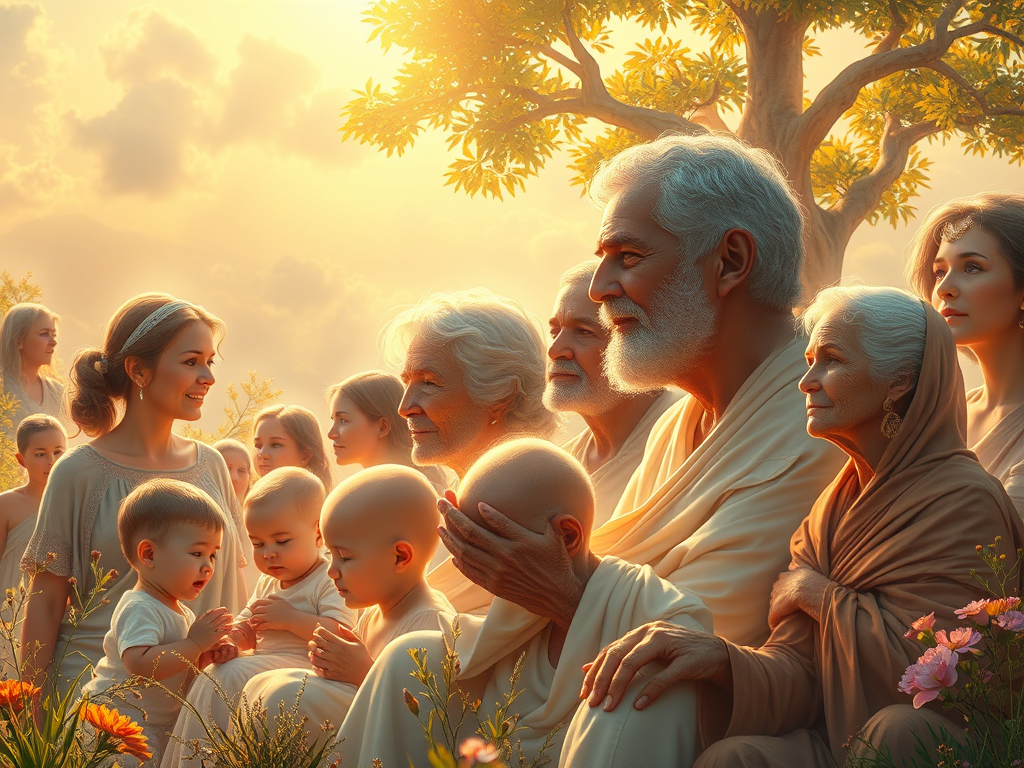
How Old Will We Appear In Eternity?

The passage reflects on the process of aging and the nature of bodies in both Heaven and the New Earth. It suggests we will have bodies that differ from Earth’s and speculates about their characteristics. While acknowledging the mystery of God’s plans, it emphasizes the importance of faith in Jesus for eternal life and encourages spiritual growth and stewardship.

We are used to the process of aging. We start as little babies, somewhere we hit our maximum as far as strength, health, and appearance, maybe intelligence peaks at another time, and then comes the long downgrade until death. Unless we die early, that is the course of it. In other articles in this blog I make the case that we will have a body of some sort in whatever place we end up. There is a Heavenly body, there is a resurrected Earthly body, there is likely a body for Sheol, there is some form in Hell. We are never “naked” as Paul calls it in 2 Corinthians 5, unless we are naked in Hell.

There is precious little information about the body we will have in Heaven. We can say that it is without a sinful nature, it is beyond the curse, we can presume it is recognizable to others, it isn’t a radical departure from our current body plan, but that is about it. Is there an age equivalency to changes we go through here?

The only thing that might be construed as speaking to our question is Isaiah 65 which expressly speaks of the New Earth and may have some real interpretive issues that go with it.

No more shall there be in it
    an infant who lives but a few days,
    or an old man who does not fill out his days,
for the young man shall die a hundred years old,
    and the sinner a hundred years old shall be accursed.

Isaiah 65:20 (ESV)

Because this speaks of death, some have interpreted this as referring to a millennial earthly kingdom. The text expressly says “a New Earth”, so I don’t think that is the solution. Eternal life is eternal. We can say that from many other parts of Scripture. What is up with this?

This passage is likely a figure of speech. It contrasts eternity to the painful and unpredictable pattern of our world. Could it literally suggest a life process in the New Earth where you are born, grow up, replicate, grow to maturity, and then start over? We will find out, won’t we? There are creatures on Earth that do this today. If we were without sin and the curse, each phase of life would present its own unique pleasures. Maybe the New Earth is like this. That doesn’t mean that Heaven is the same.

There is plenty of mystery about what God has planned for us. Even the situation of having an “eternal” body in Heaven, as well as, a resurrected “spiritual” body on the New Earth and how those work together is a complete unknown. But I like to try to imagine it anyway.

How about this? When we die in Christ we find ourselves in a uniquely beautiful Heavenly body with some new capacities like instant recognition of others, the ability to travel long distances instantly or nearly so, and maybe more. Sort of an enhanced 25 year old forever. Then post-judgment day a body for this time-space continuum which interfaces with the Heavenly body. Maybe this body experiences the joys of aging. I could be a kid in the New Earth and then transition to an optimized adult in Heaven and back. Does that appeal?

Is there sex? Maybe. The reasoning to exclude it is presumptive. Maybe there is much better than sex. Will we remain the same gender? If so, there will be no negativity associated with it. Are we species fixed? There is nothing in the Bible to suggest that you could spend a week as a salamander. Sorry.

One faulty idea that you don’t have to worry about is that you are the same age that you die at on Earth. If you are old when you die, then you are old in Heaven. That is a weird idea but I have heard it.

Get ready for something great–however it works. We gain access to this only because of Jesus. We shouldn’t even delude ourselves about gaining this by default, or being “good enough”, or traveling a different path to Heaven. The Bible is very emphatic and clear about this. It makes sense too. If there were multiple paths, then Jesus would have been spared His suffering for us. Jesus won the right for us to inherit this. It is offered to us as a gift. When we are connected to Christ through faith and baptism, we are ready to go.

Complete your course of this life with good stewardship of what you have, seeking your God-given purpose, protecting your connection to Christ with God’s Word, the Lord’s Supper, the fellowship of other Christians, growing in Christ’s qualities. Always keep your eyes on the unseen prize.