
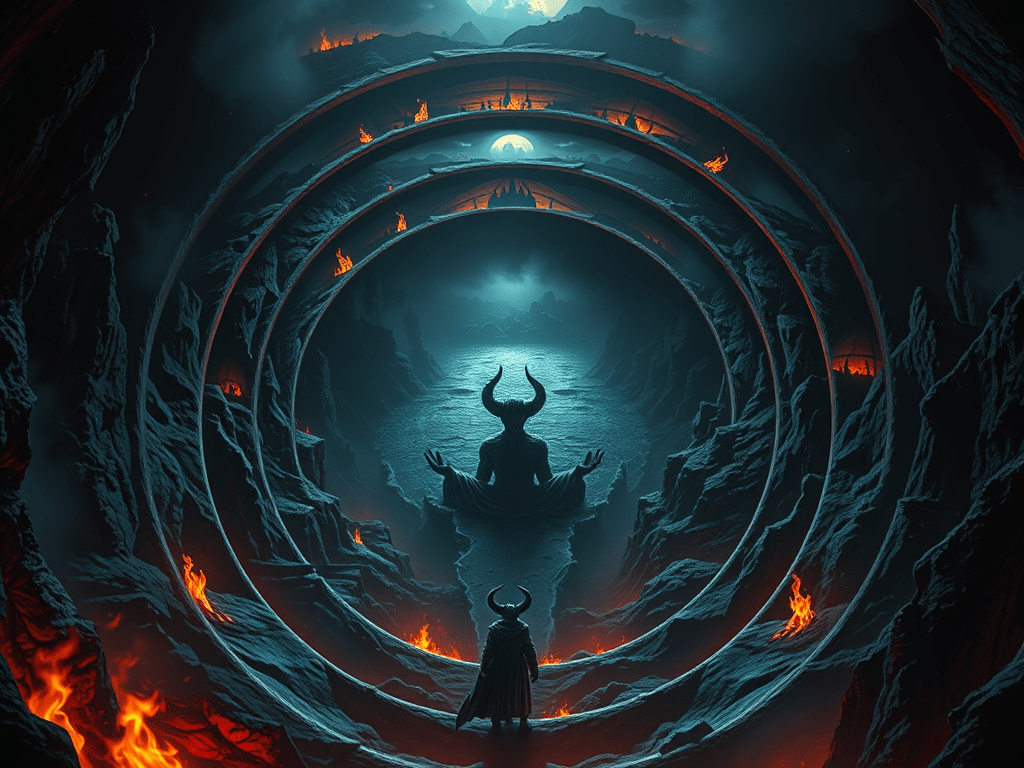
In the classic poem, Dante’s Inferno, Dante pictures Hell as nine concentric circles of increasing suffering. Each based on a person’s predominate sin. Satan is at the bottom frozen into a lake. So there would be a “cold day in Hell” if Dante were correct.
The Bible has very little to say about the final place of judgment for the damned. Revelation describes it as a “lake of fire”. Jesus’ word for it, Gehenna, describes a burning garbage dump. Jesus describes it as a place of flames and where the worm does not die. “Eternal” suffering is also stated. We can also infer from Jesus’ suffering on the cross that the punishment for sin is both a physical death and a spiritual death, where spiritual death is being forsaken by God. That is enough to know that I don’t want a tour let alone to permanently end up there.
The only passage to possibly suggest a variation of suffering comes from Jesus:
20 Then he began to denounce the cities where most of his mighty works had been done, because they did not repent. 21 “Woe to you, Chorazin! Woe to you, Bethsaida! For if the mighty works done in you had been done in Tyre and Sidon, they would have repented long ago in sackcloth and ashes. 22 But I tell you, it will be more bearable on the day of judgment for Tyre and Sidon than for you. 23 And you, Capernaum, will you be exalted to heaven? You will be brought down to Hades. For if the mighty works done in you had been done in Sodom, it would have remained until this day. 24 But I tell you that it will be more tolerable on the day of judgment for the land of Sodom than for you.”
Matthew 11:20-24 (ESV)
I think the key of understanding this passage is that it speaks of it being “tolerable” on the “day of Judgment”, and not after. The people in Chorazin, Bethsaida, and Capernaum had seen Jesus do miracles. They will know that they had unrefutable proof before their eyes and still rejected it.
It is suggested that Tyre, Sidon, Sodom, and Gomorrah would have repented had they been able to see this. At least, many people in these cities would have repented. The other cities had their opportunity and blew it.
Will it be a similar situation for those who heard the Gospel? Maybe even had family members plead with them. They may have heard the considerable proof that comes with Christian apologetics. Still, they rejected the opportunity of salvation. There will be fear and regret, for sure, only too late.
These realizations have to arrive on a person long before Judgment Day. It should be evident at death if you find yourself in Sheol. https://afterdeathsite.com/2023/11/14/how-is-sheol-different-than-hell/
Is there another level of “tolerability” that comes with the possible hope that still exists in Sheol? The cities that Jesus condemns had their opportunity to see and believe. Many other cities, though very evil, had not. What does 1 Peter 4:6 and Jesus’ actions in 1 Peter 3:19-20 say about a possible witness and repentance post-mortem?
19 in which he went and proclaimed to the spirits in prison, 20 because they formerly did not obey, when God’s patience waited in the days of Noah, while the ark was being prepared, in which a few, that is, eight persons, were brought safely through water.
1 Peter 3:19-20 (ESV)
In this part the people who were drowned in Noah’s flood get a witness from Jesus while in Sheol. They were not known for their virtue. All they could claim is ignorance. Then just a few verses later:
6 For this is why the gospel was preached even to those who are dead, that though judged in the flesh the way people are, they might live in the spirit the way God does.
1 Peter 4:6 (ESV)
This reads like a post-mortem opportunity to me. The use of Hebrews 9:27 to counterpoint this is clear misapplication of a verse. If opportunity did/does exist for Tyre, etc. or other people who die in ignorance, then it is certainly “more tolerable”. Faith is a strange thing, however. The reaction of the people who saw the miracles but still did not believe proves it. Even those who would receive witness in Sheol would not necessarily repent.
This topic only interests me because I care. I would rather that no one experiences Hell. I feel that way because God feels that way. But the Law is something that God doesn’t change. He fulfills it for us through Christ. To receive what He has done makes all the difference.

 afterdeathsite