
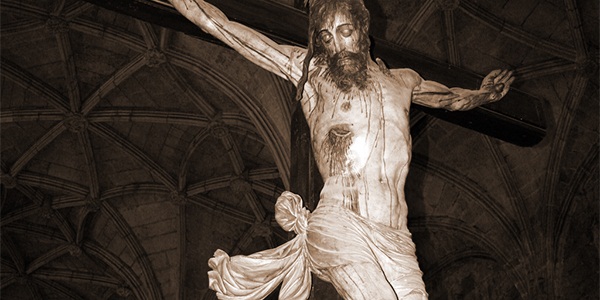
What Is It Like To Be Forsaken?

One of the things I often force myself to do during Holy Week is to watch The Passion of the Christ. This movie is a very graphic depiction of what happened to Jesus. I suspect that Mel Gibson got it mostly right. It is rough.

There is one aspect of Jesus’ crucifixion that one can never fully capture on film. It is the most important part–Jesus being forsaken by His Father. I don’t think people understand this in general. God’s Law needs to be fulfilled. God is not inclined to compromise or change any part of it. As it stands the wage of sin, (being contrary in any way to the way we were originally meant to be), is death.

Death is the “destruction” of the parts that make us. Our bodies are segregated from our souls and our bodies break down to the elemental level. Our souls, which cannot be similarly destroyed would first go to Sheol and eventually would be forsaken by God in Gehenna (Hell). This required consequence of sin, Jesus absorbs willfully himself, so that humans can have eternal life and Creation can be remade.

Jesus experiences the elements of death in a different order than we would. While still physically alive, He experiences being forsaken. I would guess that this is connected to the three-hour period of supernatural darkness. What does He feel? Hopelessness, horror, physical dysfunction, the absence of love, and I don’t know what else. Jesus knew this had to happen. It scared him. To know about it and to experience it is two different things. The Son of God, fully prepped, determined to do this thing, still is crushed.

46 And about the ninth hour Jesus cried out with a loud voice, saying, “Eli, Eli, lema sabachthani?” that is, “My God, my God, why have you forsaken me?”

Matthew 27:46 (ESV)

These words are our only window into being forsaken. It is the only window I want. Jesus knows why. But in such a state of abandonment, He can’t make sense of His condition.

We may not acknowledge it, but God is with us in multiple ways all the time. God makes our body function. God oversees our minds. We may feel far from God, but we have never been forsaken. Not yet.

Jesus is forsaken so that I will never know what it is like.

What did that mean for the Trinity? I don’t understand the type of unity that makes God one and still three persons. Likewise, I can’t fathom what it means when the Father forsakes the Son. But I know it isn’t easy and I know it is a big deal, and it happened for me.

The classic picture of eternal suffering is being in fire. Those who know Jesus’ words also include a kind of perpetual form of decay (…the worm does not die). These apply to Sheol as well as Gehenna and therefore create confusion between the two. The final, distinguishing factor is forsakeness. Sheol seems to lack this. There is nothing funny about forsakeness.

All good things come from God. Hell is not the party spot for the wicked. There is no party, no friendship, no comfort, no hope. And by the grace of God there doesn’t have to be us either.

Jesus’ forsakeness, His death applies to us and satisfies the legal requirements of God’s law for us when we are connected to Christ. We become part of His body and consequently His death through baptism. Not so much what we do in a baptism, but what God does in the spiritual realms.

It is still good that we should remember, at least once a year, the tremendous cost of saving us. We should look with grateful wonder at Jesus forsaken.
Will Many Be Saved?

Have you gone to many, or any, funerals where you assumed a negative eternal destiny for a person? This is so hard to think about that we simply hope for the best, even in cases where there is little evidence that this could go well.

We are not to judge. We don’t have the ability to know what interactions a person has had with God. But even with the fact that Jesus died for the sins of everyone, and that God desires all people to be saved, one sobering verse stands out for me. I call it my least favorite passage of Scripture:

13 “Enter by the narrow gate. For the gate is wide and the way is easy that leads to destruction, and those who enter by it are many. 14 For the gate is narrow and the way is hard that leads to life, and those who find it are few.

Matthew 7:13-14 (ESV)

The word “few” devastates me. It is a relative term, so against the billions of people who have lived and currently live “few” could still be a vast number. Still, to imagine an even larger number going to eternal damnation is staggering.

How can this be? Isn’t God love? Isn’t God all-powerful? Yes, He is. But He is also a God of justice who abides by what is “written”. So, He will not do a compromising end run around the Law, even for this. If Scripture is to be believed at all, people are damned and they are damned in vast numbers.

I would love to wrong about this. Perhaps, “few” is 49.999%. Or it could be “few” relative to the 100% that could have been saved. Maybe 95%. Or maybe the key is the word “destruction”. If destruction refers only to Sheol and not necessarily Gehenna, then perhaps Jesus would have a mechanism to evangelize the dead and to do so in mass. I’m not saying that any of these could not be, but the most natural way to read this verse is to expect many losses.

Who would make up the many? Good works can’t make up for sins. There would be many “good people” by our standards who would miss out. Many consider Jesus to be irrelevant and hold on to a “let’s see what happens” approach to death. They reason that either they just cease to exist, or it will be O.K. because they are nice.

Many hold on to an alternative worldview with an alternative means of salvation, even if they have heard the Gospel. Muslims hold on to a somewhat vague hope of Allah’s mercy if they follow the Five Pillars of Islam well enough. Hindus cling to gradual ascension through reincarnation if they live well. Cultural Christians cling to being “good enough” if they don’t understand the Bible. Then there are the atheists who expect to disappear. That is a lot of people.

Maybe there are multiple paths to salvation?

Jesus said to him, “I am the way, and the truth, and the life. No one comes to the Father except through me.

John 14:6 (ESV)

It makes sense. If there were other ways, would God have made Jesus do what He did? If you don’t like it, speak to Jesus. I didn’t say it.

Many people have not even heard the Gospel of Jesus. What about them? I personally think that 1 Peter 4:6 alludes to how God deals with the Church’s failure to get the Word out.

For this is why the gospel was preached even to those who are dead, that though judged in the flesh the way people are, they might live in the spirit the way God does.

1 Peter 4:6 (ESV)

It is a somewhat vague, one passage testimony; but it makes more sense to understand this passage as Jesus or somebody preaching to the dead than all of the other weak explanations I have seen. If this were so, what sort of fool would reject the Gospel while toiling in Sheol? The mystery of faith is great. You would be surprised at how dense people can be.

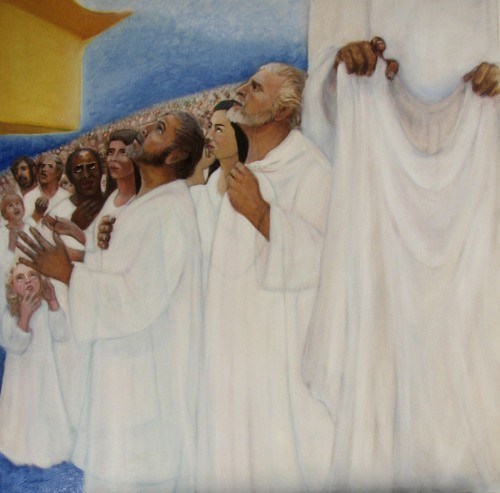
When you add it all up it is sadly easy to imagine how the many end up in destruction. Can we move the needle in any way? Yes. Our witness to people matters. The few will still be a “great multitude that no could count.” (Revelation 7:9) I want to be in that multitude. I want those I love to be in that multitude. I want to have some role that many others will be in that multitude. And I still hope that the obvious way of understanding Matthew 7:13-14 is wrong.